October 26, 2026 · 15 min read · Pineflows team
Top Step FX Explained: Funded Accounts and Rules
Top Step FX offers futures-only funded accounts, not spot forex. Learn how its rules, eligibility and payouts work, and whether it fits your trading.
Topstep does not offer spot forex, its currency access is exchange-traded futures such as 6A, 6C, 6J, E7 and M6A, and positions must be closed by 3:10 p.m. Central Time on weekdays. If you searched for Top Step FX expecting to port a spot EUR/USD strategy straight into a funded account, that's the popular advice worth questioning. The product, the clock and the risk rules all change, and a strategy that ignores those changes can fail for mechanical reasons before its market idea is ever tested.
Table of Contents
- Topstep FX Means Currency Futures, Not Spot Forex
- How the Funded Account Path Works
- Combine Rules That Decide Whether You Pass
- Eligibility and What You Need Before Starting
- Where Funded Accounts Break Down in Intraday and Automated Trading
- Realistic Odds From Evaluation to Payout
- Costs and Payout Terms to Check Before Paying
- Decide Whether Topstep FX Fits Your Trading
Topstep FX Means Currency Futures, Not Spot Forex
Topstep is futures-only. Spot forex never enters the product list.
That one fact reframes the entire search. The key question is whether an FX view survives translation into exchange-traded currency futures, with fixed specifications, expiries and a hard daily close.
What You Trade Instead
According to the Topstep help center guide on products and trading hours, FX-background traders on the platform use CME contracts including the Australian dollar (6A), Canadian dollar (6C), Japanese yen (6J), E-mini Euro FX (E7) and Micro AUD/USD (M6A). The same schedule sets the weekday cutoff: positions and pending orders must be flat by 3:10 p.m. CT, and trading reopens at 5:00 p.m. CT. These contracts are standardized and centrally cleared, with exchange-defined tick sizes, expiry schedules and margin mechanics replacing the dealer liquidity and fractional lot sizing of spot FX.
The consequence is concrete. A tick has a fixed dollar value, every contract expires and must be rolled, and sizing moves in whole contracts. Stop distance, target and risk per trade all need recalculating before your strategy means anything on Topstep.
| Feature | Spot forex | Topstep currency futures |
|---|---|---|
| Where it trades | Dealer-to-dealer, decentralized liquidity | Exchange-traded, centrally cleared on CME |
| Products | Currency pairs such as EUR/USD | Contracts such as 6A, 6C, 6J, E7 and M6A |
| Contract size | Set by the broker's lot size | Fixed by the exchange contract specification |
| Expiry | No expiry for a spot position | Contracts expire on a schedule and must be rolled |
| Weekday session on Topstep | Not offered on Topstep | Positions closed by 3:10 p.m. CT, trading reopens 5:00 p.m. CT |
The Clock Ends the Swing Trade
The weekday close converts every position into an intraday trade. A spot-style carry held over several sessions cannot exist inside a 3:10 p.m. CT deadline, and the 5:00 p.m. reopen does not restore it. Each day starts flat.
Adapting means three things: intraday execution, managing contract rolls on schedule, and accepting forced liquidation as the cost of missing the cutoff.
Practical rule: If your edge needs overnight holds, weekend gaps or broker-defined micro lots, it is not a Topstep strategy yet, whatever the currency view.
Run one test before paying for an evaluation. Rewrite your entries, exits and sizing in the contract's tick value, force every trade flat before the close, then check whether the expectancy survives. If the idea only works with continuous spot access, the Top Step FX question is already answered.
How the Funded Account Path Works
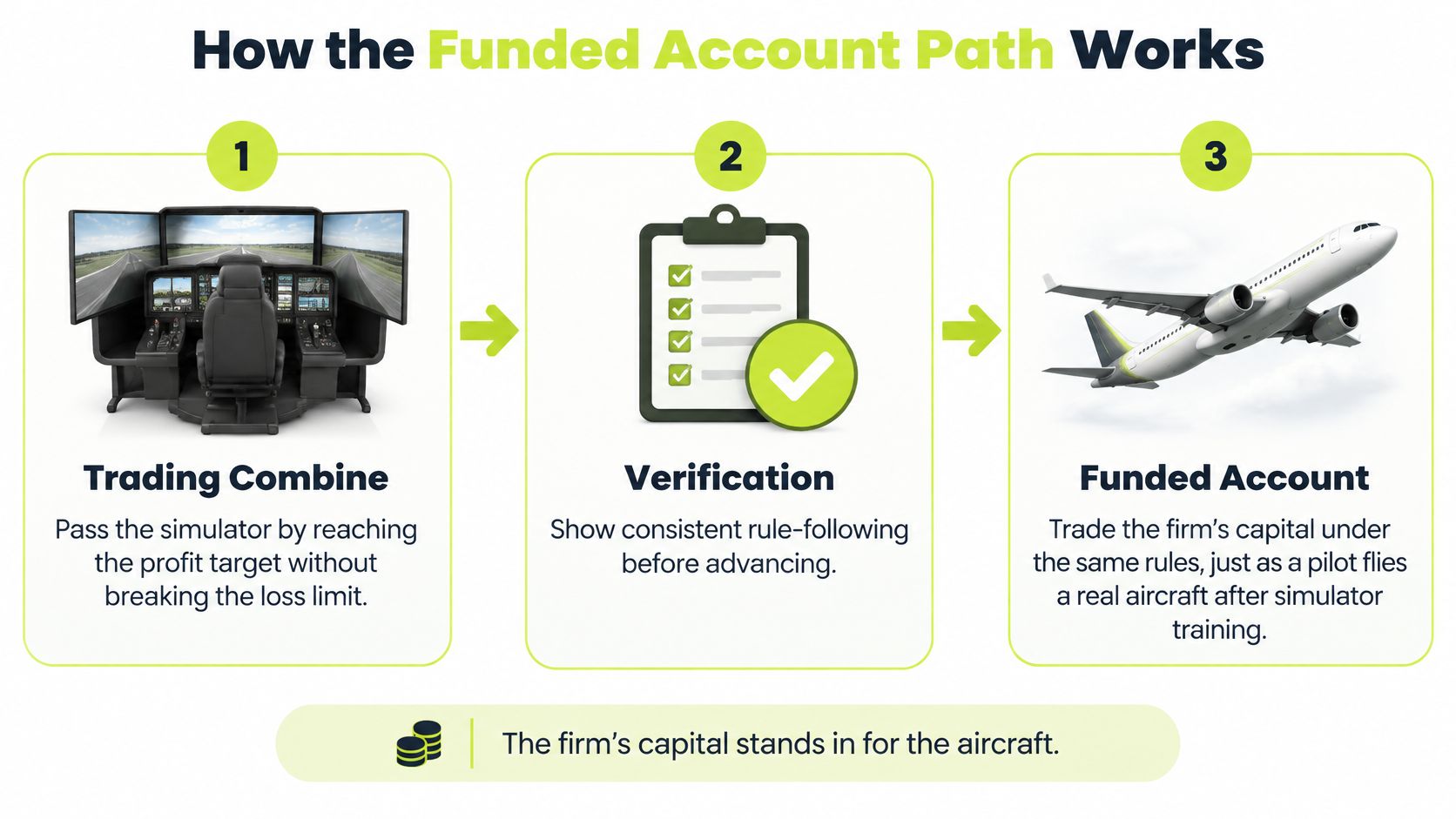
The Trading Combine works like a check ride in a flight simulator: you prove you can follow procedures in simulation before the firm lets you near its capital. For a trader arriving from spot forex, that distinction sets the whole frame. The evaluation fee buys the simulator, and each later stage admits a smaller group.
The stages run in a fixed order. You start in the Trading Combine evaluation, then you may advance to the Funded Level, which includes simulated or live accounts, and a smaller group may reach a Live Funded Account. The Express Funded Account is the second funded route referenced in the program's statistics, and its current terms are worth checking on Topstep's pages because they can change.
Why the Labels Matter
The Topstep company background on its legitimacy and model splits the funnel into participants, Trading Combines, Funded-Level accounts and Live Funded Accounts. Each label counts a different stage, and one person can appear in the statistics several times. A trader who resets three times shows up as four Combine attempts, so adding the categories together overstates how many individuals succeed.
That separation matters when you read any headline figure. A large participant count shows the program is popular. It says nothing about how many individuals reached a payout, which is the number that decides whether an evaluation fee makes sense for you.
The Firm Behind the Model
According to Topstep's about page, the company reports serving more than 200,000 traders across more than 140 countries. Treat those as company-reported figures rather than independently audited market-share statistics. They establish scale, while your own odds come from the stage-by-stage attrition, not the headcount.
The firm is based in Chicago, a major global futures center, and it helped commercialize the structured futures evaluation: traders attempt a scored simulation instead of risking equivalent personal capital upfront. For you, the appeal is concrete. You don't stake personal trading capital equal to the account size to get evaluated. In exchange, you accept the firm's rules as the price of access, and those rules decide whether you continue, whatever your personal risk tolerance would allow.
Combine Rules That Decide Whether You Pass
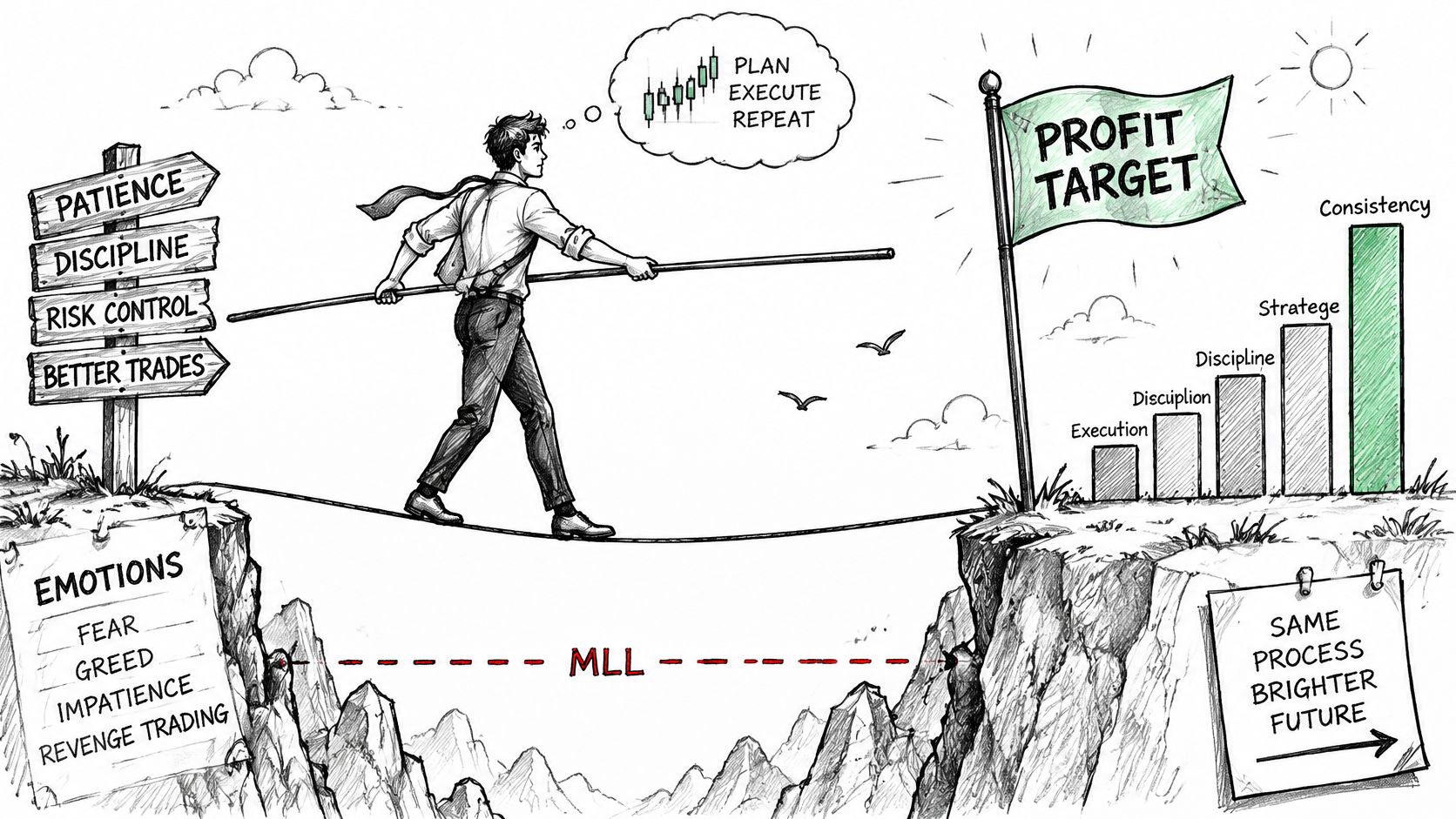
The core rule is blunt. Your account balance must not hit or fall below the Maximum Loss Limit (MLL). Cross that line and the attempt ends, regardless of what your strategy might have done over the following week.
Profit alone doesn't pass you either. You must reach the profit target while keeping your best trading day below 55% of the profit target, or the consistency requirement increases the total profit you need. The Combine is a constrained risk-and-consistency test, and traders who treat it as a race to a number usually create the exact pattern it penalizes.
The 55 Percent Rule in Dollars
The Topstep Trading Combine parameters set that 55% threshold, and the arithmetic is unforgiving. If the profit target is $3,000, a single day producing more than $1,650 breaches the consistency threshold and can increase the required total profit. One oversized winning day doesn't just fail to help, it moves the finish line.
Say your best setup tends to produce one large winner after several small losses. In a personal account, that's a valid return profile. In the Combine, that concentration works against you, so you may need to cap daily profit, take partials earlier or reduce size after a strong morning.
Position ceilings are account-dependent. A $50,000 account permits up to 5 mini contracts or 50 micro contracts, while a $100,000 account permits 10 minis or 100 micros, with micros counting at a 10:1 ratio against minis.
| Account size | Max mini contracts | Max micro contracts | Best-day cap under 55% rule |
|---|---|---|---|
| $50,000 | 5 | 50 | $1,650 if the profit target is $3,000 |
| $100,000 | 10 | 100 | 55% of that account's profit target |
The table covers only the account sizes confirmed here. Check any other size against Topstep's current parameters before you rely on it.
Designing Around the Rules
A good trading strategy built for rule-based evaluation starts from constraints, not signals. Size below the maximum allowance rather than at it, because the ceiling is a legal limit, not a sensible risk level. A trader using 5 minis on a $50,000 account has far less room for normal intraday fluctuation than a trader using micros to grade exposure.
Track two numbers together on every session:
- Real-time distance to the MLL: Know how much adverse movement, in ticks at your current size, ends the attempt.
- Best-day percentage: Know what today's profit represents against the target before you press for more.
Cumulative P&L is the least useful number on your screen during a Combine. Distance to failure and profit concentration decide whether that P&L counts.
This is why micros matter beyond smaller dollar risk. They let you shape the return distribution the rules reward, steadier days and controlled drawdowns, instead of hoping a lumpy spot FX profile happens to fit.
Eligibility and What You Need Before Starting
A Combine can fail before a single order is placed. Pick an account size your strategy can't fill, or discover mid-evaluation that your data feed lacks the contract you need, and you've paid for an attempt that was never viable. Eligibility checks exist to strip out those preventable failures. None of them predicts a pass.
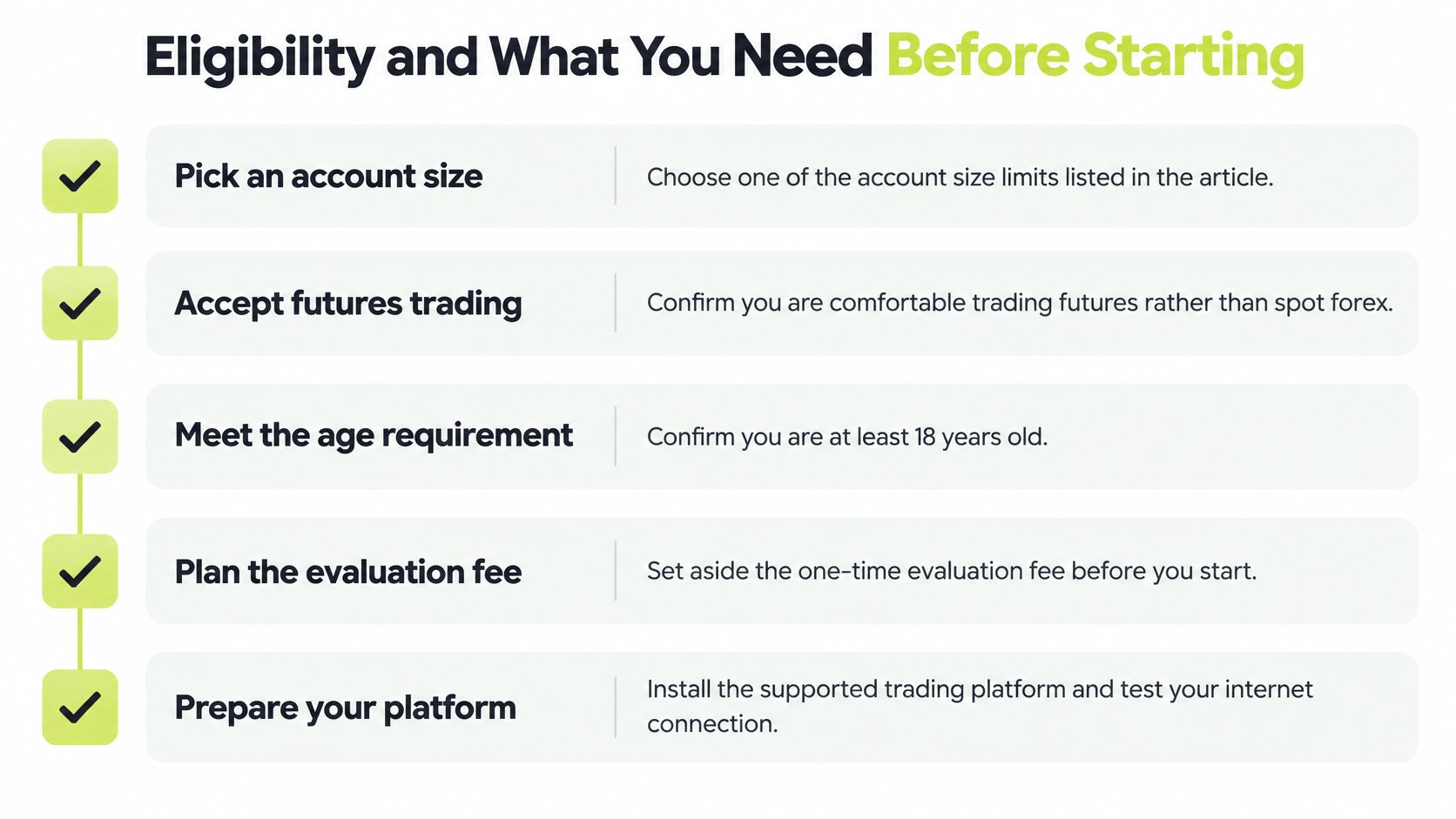
Work through the gates in order:
- Pick an account size: Match the account to the position limits you've already sized your strategy against, not the largest account you can afford.
- Accept the futures format: Standardized contracts, expiries and exchange tick values replace the currency pairs you're used to. Confirm your strategy holds up under that translation.
- Fit the session window: Your strategy has to open and close inside the weekday window ending at 3:10 p.m. CT.
- Test platform and data: Confirm your platform, charts and data access can handle the exact futures contracts you'll trade.
- Rehearse the rules: Follow the loss limit and consistency cap in simulation before paying for the live version.
- Confirm entry requirements: Age, residency, country restrictions and identity-verification steps vary by jurisdiction and can change, so check Topstep's current help-center pages before committing money.
Map Every Pair First
For a trader arriving from spot FX, the least obvious gate is contract translation. Convert each pair you trade into its futures equivalent and write the contract size and expiry next to it. AUD/USD becomes a decision between 6A and M6A, and that choice changes your tick risk on every order.
Do the mapping on paper first. Discovering a mismatch mid-Combine costs you the attempt, and the attempt is what you paid for.
Clear every gate and you've earned one thing: the right to start the test that decides the outcome.
Where Funded Accounts Break Down in Intraday and Automated Trading
The most dangerous assumption in Top Step FX trading is that a loss limit trailing your highest end-of-day balance only matters once the session closes. Calculation time and enforcement time are different things. The limit may be checked in real time against open-trade equity, so an intraday price wick can terminate an account even when the session later closes profitably.
That risk is easy to miss because daily statements look calm. Your closed balance never crossed the line, yet the account is gone. What crossed the line was unrealized equity during a fast move, and no end-of-day recovery reverses that.
Four Ways an Open Trade Ends an Account
The StillFunded review of Topstep's risk mechanics highlights how intraday equity can breach the limit even when a session later recovers. Picture the concrete versions. A long position shows healthy unrealized profit, price snaps back through your entry, and equity swings from comfortable to terminal in seconds. A stop-loss fills late through a fast move or gap, so the realized loss exceeds the planned risk you sized for.
Partial fills create a quieter version of the same problem. Your exit fills on part of the position while the remainder stays exposed, and your mental model says you're flat when you're not. A delayed exit does similar damage, letting a manageable loss run while the order waits.
For alert-driven traders, these risks multiply away from the screen. That's why we built Pineflows to start in test mode, where alerts are accepted and logged but never sent to the broker until you switch to live. It's also why you must watch automations, because alerts can arrive late, twice or not at all, markets move and brokers reject orders.
Account Rules Outrank Strategy Controls
Separate two layers that traders constantly confuse. Strategy-level controls include a pause, a maximum-position rule and alert deduplication. Account-level liquidation belongs to the prop firm. Once an order is open, your platform controls cannot necessarily prevent a loss-limit breach, because the firm is measuring live equity against its own threshold.
Our pause control blocks new entries immediately and cancels our own open entry orders while keeping valid exits available. Useful as that is, it doesn't rewind an open position's unrealized loss. The same logic applies to any trading strategy automation you run elsewhere.
End-of-day trailing does not mean end-of-day risk. You need an intraday equity buffer between your stop and the firm's limit, sized for slippage, not for your ideal fill.
Run This Test Matrix First
Before any automated or alert-driven approach goes live near a funded account, test each failure on purpose:
- Rapid adverse move: Observe the largest unrealized drawdown, not just the closed loss.
- Webhook delay: Observe how far price travels between signal and fill.
- Duplicate alert: Observe whether one event can create a second order.
- Connection loss: Observe what happens to open exits when the feed drops.
- Equity crossing: Observe whether your buffer triggers action before the firm limit is touched.
Realistic Odds From Evaluation to Payout
Topstep's published 2025 figures describe a funnel with four different denominators, and merging them into one conversion rate produces nonsense. Each percentage counts a different population. Read them separately and the picture is still sobering.
From January through December 2025, the Topstep about page with its trader performance statistics reports that 16.8% of all Trading Combines initiated were successfully completed and advanced to the Funded Level. Measured by people instead of attempts, 51.8% of people who entered one or more Trading Combines reached the Funded Level in at least one attempt.
| Metric | Reported 2025 value | What it counts |
|---|---|---|
| Trading Combines completed | 16.8% | Combine attempts that advanced to the Funded Level |
| Individuals reaching Funded Level | 51.8% | People who entered one or more Combines and reached the Funded Level in at least one attempt |
| Funded-level participants paid | 33.3% | Participants at the Funded Level who received a payout |
| Express Funded Account traders promoted | 0.71% | Express Funded Account traders called up to a Live Funded Account |
Among participants at the Funded Level, 33.3% received a payout, while only 0.71% of individuals trading an Express Funded Account were called up to a Live Funded Account. Topstep also states that the figures include both simulated and live trading environments and are not predictions of future performance.
How to Use These Numbers
The gap between the first two rows is the most instructive. Attempts fail far more often than people do, which means persistence and repeat attempts lift the individual figure. It also means your budget should assume the Combine is the selective step, not a formality before funding.
Reaching a funded stage is materially more common than receiving a payout, and progression from Express to live is comparatively rare. Don't budget around a payout. Budget around surviving a losing streak without breaching the loss limit, because rule breaches are the lever you actually control.
One figure needs careful handling. Topstep reported a 99.26% payout-approval rate on its instant payouts page published in 2026. That measures approval of payout requests, not the share of funded traders who get paid, so reading it as your odds of a payout would flatter you badly.
Use backtested trading strategies checked against the Combine rules to stress your sizing before you pay. A backtest isn't a forecast, and we never show projected returns, but it can reveal whether your drawdown pattern would have survived the limit at all.
Costs and Payout Terms to Check Before Paying
Topstep's evaluation, reset and activation fees vary by account size and change over time, so the only figures worth budgeting against are the ones on Topstep's current pricing page. Pull that page up first, then work through this checklist while the numbers are in front of you.
- Evaluation fee: Find the fee for your chosen account size and whether it is charged once or again after a failed attempt.
- Funded-level charges: List any activation fee separately from monthly platform or market-data charges, so recurring costs don't hide inside a one-off number.
- Reset cost: Find what another attempt costs after a failed Combine, since repeat attempts are common enough to budget for.
- Payout split and timing: Confirm the split, the minimum request size and when a request can be made.
- Instant payout eligibility: Check whether instant payouts apply to your chosen account type at all.
Keep the payout-approval figure in its proper place while you read. It measures requests, which is a different population from funded-level participants who received a payout. Approval speed is a service question, not evidence about how likely you are to reach a request.
Finish with one sum. Total the cost of one full attempt, including a possible reset and a month of platform or data charges, then compare that total with the account size you would trade. If the all-in cost surprises you, you were not ready to pay it.
Decide Whether Topstep FX Fits Your Trading
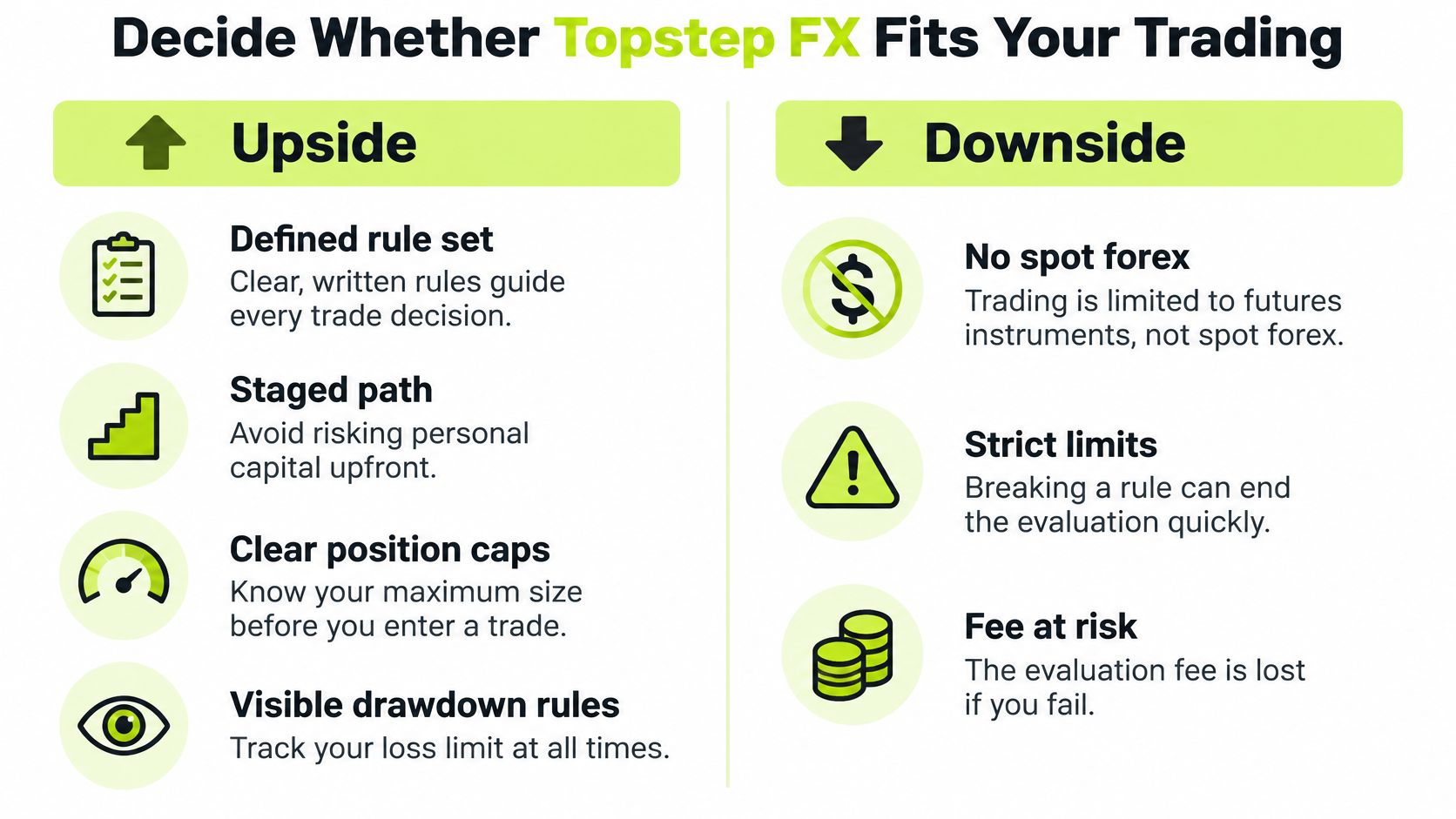
The evaluation fee buys a test of one specific trading shape. Whether that fee is money well spent depends on how close your current approach already sits to that shape, so read the two columns below as one equation: every item on the left only matters if nothing on the right disqualifies you first.
Upside:
- Defined rule set: Written loss, consistency and size rules you can test against in advance.
- Staged path: No equivalent personal capital risked upfront to get evaluated.
- Clear position caps: Maximum contracts known before you enter.
- Visible drawdown rules: A loss limit you can monitor in real time.
Downside:
- No spot forex: Your pairs become futures contracts with expiries and fixed sizes.
- Strict limits: One rule breach can end an attempt quickly.
- Daily flat close: Overnight and multi-day holds don't fit.
- Low live promotion odds: The Express to Live step is rare.
- Strategy dependence: The platform executes your approach, it doesn't make it profitable.
Three Trader Profiles, Three Verdicts
An FX trader who holds positions for days is a poor fit. The daily flat close removes the holding period the strategy depends on, and converting to intraday futures creates a different strategy that needs its own testing. Paying an evaluation fee to discover that is an expensive way to learn it.
An intraday futures trader who already follows strict risk rules is a plausible fit. If you already cap daily loss, size with micros and finish flat each session, the Combine mostly formalizes habits you have. The consistency cap is where this profile still trips: one strong day can push a single session's profit past the share the rules allow, so gains have to be spread across days deliberately rather than taken when the setup pays best.
A newer trader attracted mainly by funded capital should paper-trade the rules first. Run your approach under the loss limit and the 55% cap in simulation until rule-following is boring. Capital access doesn't fix an untested process, it just makes the feedback cost money.
Next step: Read the current rules on Topstep's help pages, backtest your strategy against the loss limit and consistency cap, run the intraday failure tests, and only then choose an account size.
Treat Topstep FX as a rules contract that rewards one specific shape of trading: intraday, sized conservatively, spread across days. If your trading already has that shape, the evaluation is a fair test. If it doesn't, reshape and retest it before the meter is running.
If you trade US equities or ETFs through Robinhood, Pineflows can apply the same test-first discipline to your automation. It turns TradingView alerts into market orders, executes long only (a short signal flattens the position rather than opening a short), and starts in test mode where alerts are accepted and logged but never sent to the broker. Review the alert log, approve the exact configuration, and only then switch to live.