November 1, 2026 · 13 min read · Pineflows team
Swing Trading Robinhood for Holds Past the Close
Swing trading Robinhood means holding past the close. Compare orders, overnight margin after 2026, position size, and alert-to-order checks.
The most popular advice on swing trading Robinhood is simple: just don't make four same-day round trips, and you'll stay out of trouble. That's the wrong lesson. Avoiding a flag doesn't protect you from the close, an overnight gap, or an alert you assume became a fill.
Robinhood is an execution venue, not a strategy. Your job is to pick an order that can live across sessions, size the position so a bad open is survivable, and prove what reached the broker.
Table of Contents
- What Swing Trading on Robinhood Actually Means
- Orders and Overnight Margin Rules
- How Large a Swing Position Should Be
- A Two-Day Hold From Entry to Exit
- From a TradingView Alert to One Order
- Confirm the Alert Before You Go Live
What Swing Trading on Robinhood Actually Means
Avoiding a day-trading flag does not make a swing trade safe. A swing hold carries a position through the close, when you cannot react in the regular session, and into an open that may be far from the previous day's price.
For example, buy a liquid US stock or ETF on Monday afternoon and keep it through Tuesday's open. That is a swing hold. A day trade opens and closes on the same day, so it carries intraday price risk without the same overnight gap exposure.
What changed and what didn't
Robinhood has changed its day-trade counting rules for eligible margin accounts. The thresholds that apply depend on your account and current rules, so check Robinhood's current day-trading support page. A change to counting rules does not reduce overnight gap risk or guarantee that a stop will fill near its set price.
Permission to trade more often does not make a position safer to hold overnight.
Robinhood reported 27.0 million funded customers and 28.4 million investment accounts at year-end 2025 in its 2025 SEC filing. Those figures describe the platform's scale, not how well any individual swing trade may perform.
A swing trader's work is to choose an order that behaves as expected, size the position for an adverse gap, and confirm that a signal produced the intended broker order. Avoiding a pattern-day-trader flag addresses only how trades are counted. The close, overnight gaps, and alerts that have not been confirmed remain part of the trade.
Orders and Overnight Margin Rules
A swing position can pass a day-trade counting rule and still fail the overnight margin test. Order types shape how you enter and exit; account rules determine whether a margined position can remain open after the close.
Robinhood order types for a multi-day swing
| Order type | Regular-session behavior | Extended hours | Swing failure mode |
|---|---|---|---|
| Market | Fills at the prevailing price | Generally not used | Slippage at a thin open |
| Limit | Fills only at your price or better | Typical extended-hours order | May never fill if price runs away |
| Stop market | Becomes a market order after the stop | Not a reliable overnight guard | Gap can fill well through the stop |
| Stop-limit | Triggers a limit after the stop | Not a reliable overnight guard | Gap can skip the limit and leave you in |
| Good-til-canceled limit | Stays working across sessions until filled or canceled | Limit price applies in eligible sessions | Stale price after news or a gap |
| Extended-hours limit | Not the regular-session default | Limit only | No stop protection while the session is closed |
Read the table by failure mode
A market order prioritizes getting a fill, not controlling the price. At a thin open, wider spreads and fast price moves can put your fill beyond the level you planned.
A limit order controls the worst price you will accept, at the cost of possibly missing the trade. That trade-off suits an entry you can wait for.
A stop market order uses the stop price as a trigger, not a guaranteed exit price. Once triggered, it becomes a market order and fills at the next available price, which may be far from the stop after a gap.
A stop-limit order sets a limit on the exit. If the market gaps past that limit, the order may remain unfilled and the position stays open.
Practical rule: A stop is a trigger, not a locked door. It can submit an exit order, but it cannot guarantee yesterday's price.
Good-til-canceled limits can outlive the reason you placed them. Earnings, a guidance cut, or a sector-wide gap may turn a sensible order into a stale one. Review working orders at each close.
Extended-hours orders are generally limit-only. A regular-session stop does not protect you while that session is closed, so account for the gap risk in your plan. For a broader look at Robinhood stock trading basics, see how order choice fits the platform.
Day-trade counting is not overnight margin
Day-trade eligibility concerns restrictions tied to same-day round trips. Overnight margin concerns whether a position using borrowed funds can remain open after the close, and whether your equity supports it.
Robinhood says positions using intraday margin must meet overnight margin requirements to remain open after the close, and that borrowed funds can magnify losses beyond the initial investment in its day trading guidance. Buying power displayed during the session does not guarantee that the same position can be carried overnight. Check the margin rules that apply to your account before relying on borrowed funds.
What a margin deficit actually means
If your account falls short of its requirements, you may need to add funds or reduce the position. In applicable circumstances, the firm may liquidate positions without contacting you first. That possibility makes it important to know how much of your buying power depends on margin.
Cash accounts avoid that particular margin deficit risk, but they still carry gap risk and limits on reusing unsettled funds. Margin accounts offer more flexibility while adding a separate test at the close. Compare the amount you can carry overnight with the buying power shown during the session.
The hold-through-close checklist
Before the closing bell, check:
- Account basis: You are in a cash account, or your overnight buying power covers the shares without relying on an intraday figure.
- Intraday-only exposure: The position does not depend on buying power that disappears at the close.
- Dates during the hold: Check whether earnings, splits, or dividends fall before your planned exit, then decide whether to hold through them.
- Exit plan: Set the price and order type you will use in the next regular session.
- Bad-open tolerance: Decide how a several-percent adverse open affects your position before it happens.
If a check fails, reduce or close the position before the bell. Do not count on the margin rules or the market price being more favorable in the morning.
How Large a Swing Position Should Be
Start with arithmetic, not confidence. You're choosing how much you can lose if you're wrong, then letting that number set your share count.
The formula in three lines
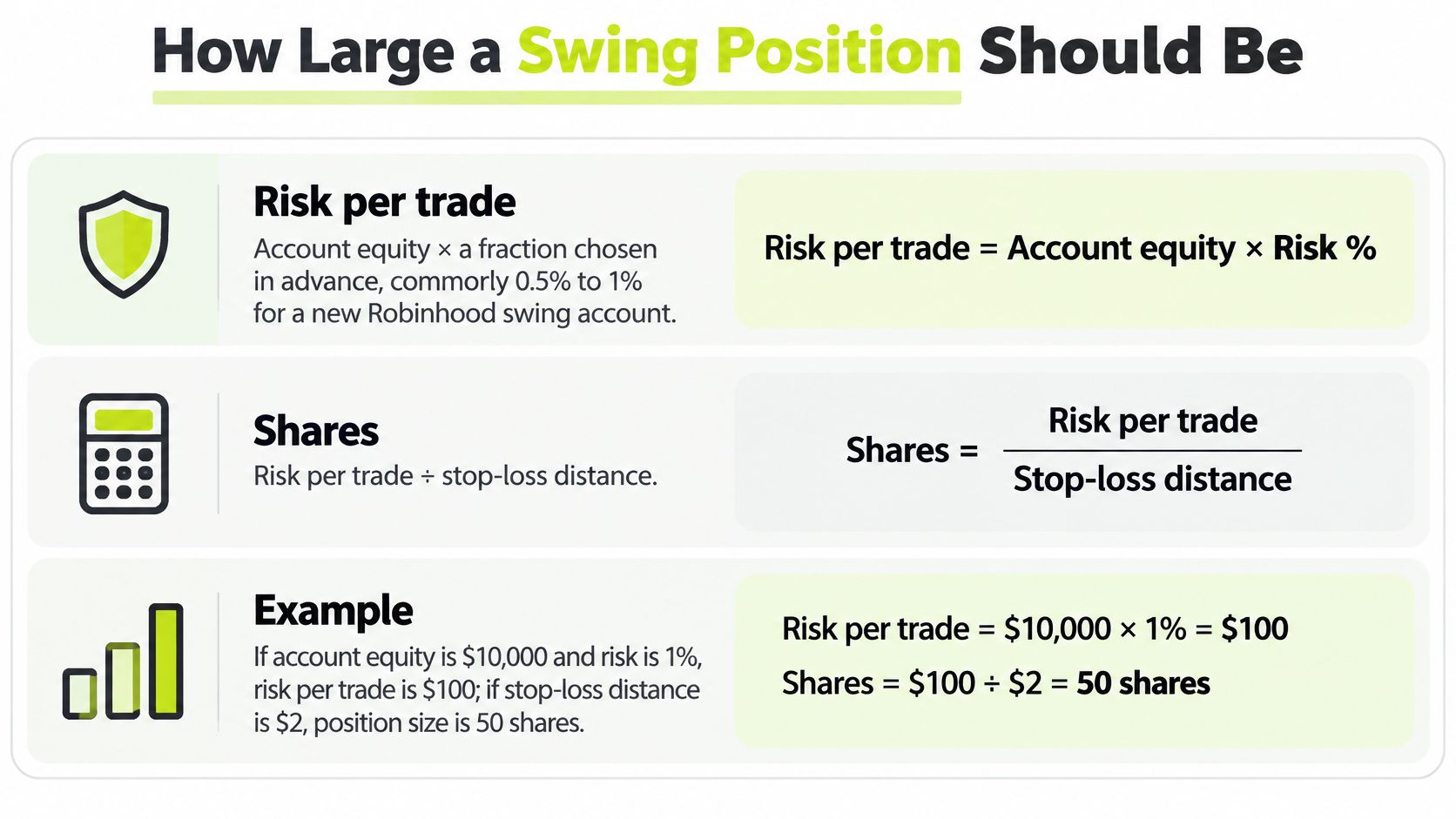
- Risk per trade: Account equity times a fraction you choose in advance, commonly 0.5% to 1% for a new account.
- Stop distance: Entry price minus the price where your idea is wrong, not where it hurts.
- Shares: Risk per trade divided by stop distance.
Say your account is $10,000 and you risk 1%. Your planned loss is $100. If you enter at $50 and the idea is wrong at $48, your stop distance is $2, so you buy 50 shares. That's a $2,500 position, not a $10,000 position. Most beginners find that shockingly small. It's supposed to feel small.
Share count by account size, risk, and stop distance
| Account equity | Risk per trade | Stop distance | Shares |
|---|---|---|---|
| $10,000 | 0.5% ($50) | $2 | 25 |
| $10,000 | 1% ($100) | $2 | 50 |
| $25,000 | 1% ($250) | $2 | 125 |
If you use margin, recompute against overnight buying power, not the larger intraday figure. A position you can't legally carry through the close isn't a swing position. It's an intraday accident waiting for a forced exit.
Why aggressive orders drag returns
A large study using the complete trading history of individual investors in Taiwan, published in the Review of Financial Studies, found individuals incurred an aggregate annual performance penalty of 3.8 percentage points, with losses equal to 2.2% of Taiwan's gross domestic product and 2.8% of total personal income, while institutions earned an annual performance boost of 1.5 percentage points. The researchers attributed virtually all individual-investor losses to aggressive orders.
That sample isn't Robinhood and it isn't swing trading alone. Use it as a warning about marketable orders and urgency, not as a prediction for your account. Faster fills don't fix a negative-expectancy rule, which is why the discipline in building a good trading strategy has to come before automation or larger size.
Your backtests need realistic spreads, slippage, and partial fills, and your first live size should sit below backtest size. Gains on positions held one year or less are generally taxed at short-term rates, and frequent exits and rebuys can trigger wash-sale adjustments, so review after-tax results with a tax professional. When the open gaps against you, cut size, don't widen the stop.
A Two-Day Hold From Entry to Exit
Follow one hypothetical path in time order. Every price below is an illustration, not a recommendation.
The setup below shows the kind of daily chart review you'd do before writing down an entry and an invalidation price.
Monday afternoon
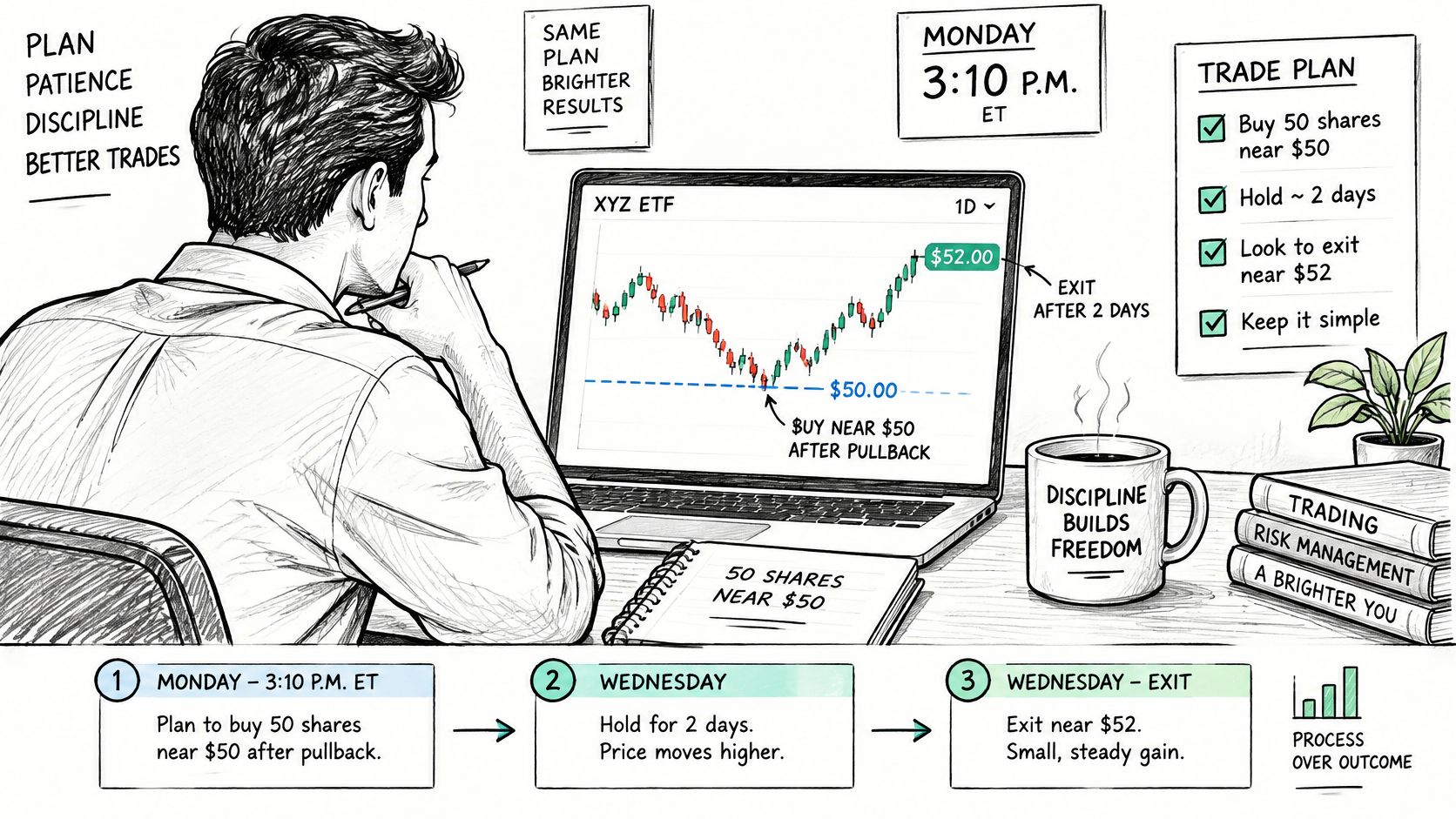
It's 3:10 p.m. Eastern on Monday. A trader wants 50 shares of a liquid ETF trading near $50 after a pullback to a level marked on the daily chart. Instead of sending a market order into the close, the trader places a limit at $50.10. The fill happens at that price or better, or it doesn't happen.
The invalidation is $48. If filled near $50, planned risk is about $100, matching the 1% example from sizing. The trader writes that number down before the fill arrives, not after.
The trader also writes a sentence many plans skip: no stop-limit will protect this position overnight. The protection is the 50-share size. If tomorrow opens badly, the loss may exceed $100, but it shouldn't threaten the account or trigger a margin problem.
Tuesday open, inside the plan
Tuesday opens at $48.70 after mild news. That's uncomfortable, but it's inside the planned loss range. The trader doesn't chase a market order in the first minute, when spreads are widest. The regular-session exit is a limit slightly through $48.70, written down on Monday, so the decision is execution, not invention.
Watch how a trader talks through entry, invalidation, and exit planning before placing the order.
Two variations that change the decision
A second case the same week has earnings on Wednesday. The hold isn't allowed to cross that print, because an earnings gap isn't the pullback risk the trader sized for. The position closes Tuesday, win or lose, or it never opens.
A third case opens at $46, well beyond the plan. The action is to exit at the open and log the extra slippage. The trader doesn't average down to make the average price look better. Averaging down after a gap converts one planned error into a larger unplanned position.
What the log must contain
- Intended shares: What the plan said, before any fill.
- Fill price: What the broker gave you.
- Gap in dollars: The distance between the prior close and the open, times shares.
- Position check: Whether the broker position matches your plan after the exit.
That log is simple when you click each order yourself. It gets harder, and more important, when the plan arrives as an alert.
From a TradingView Alert to One Order
Your alert fired. That doesn't mean your trade happened.
This is the most common failure in alert-based swing trading Robinhood workflows. A trader sees a TradingView notification, assumes Robinhood holds the shares, and manages a position that doesn't exist. Or the opposite happens, and a repeated alert creates a position twice the planned size.
Build one reconciliation line per signal
Every signal needs its own record you can audit later. Don't rely on screenshots or memory.
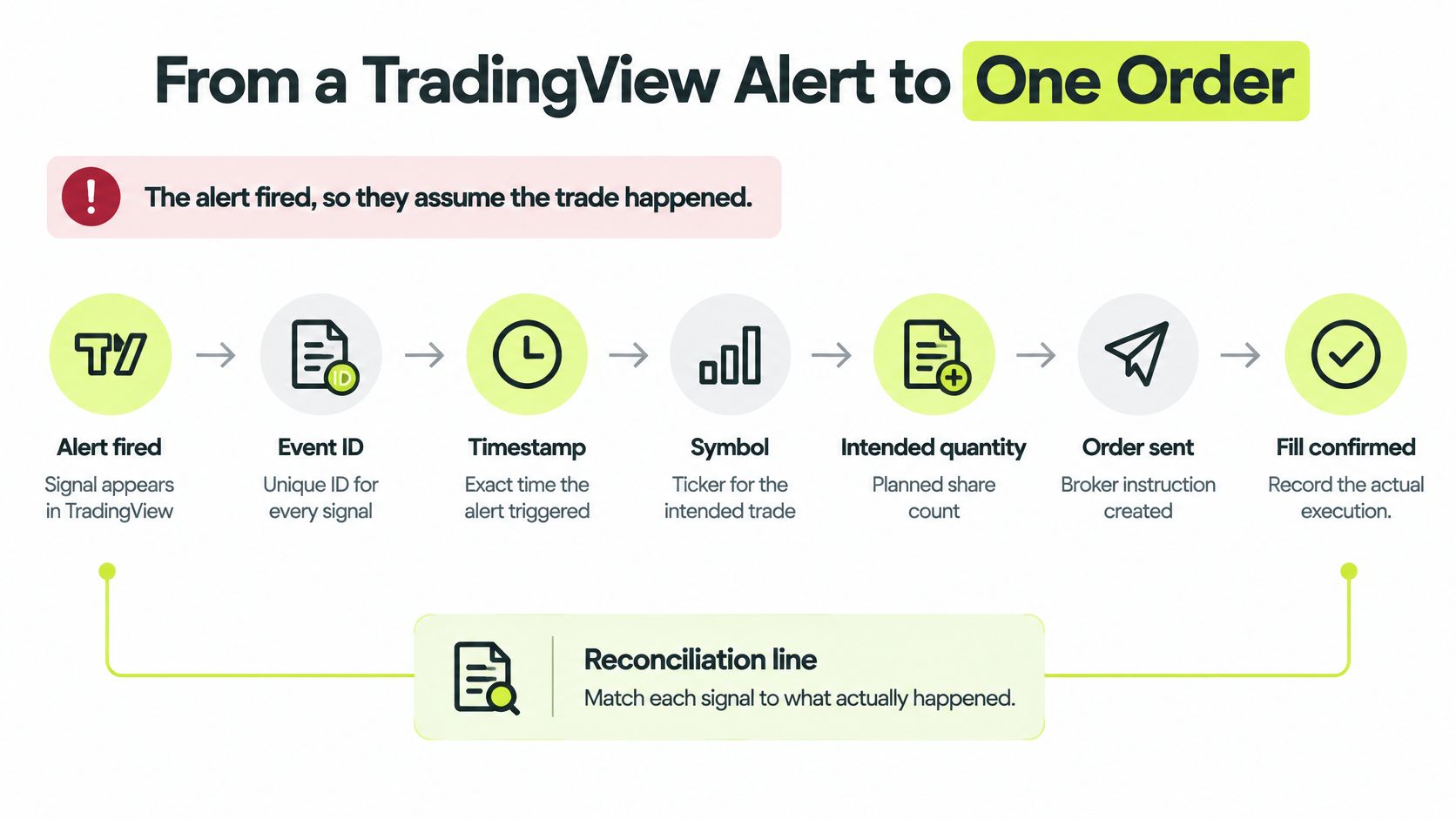
- Unique event ID: One identifier per alert, so a duplicate can be spotted and blocked.
- Timestamp: When the alert triggered, not when you noticed it.
- Symbol and intended quantity: The ticker and share count the strategy meant to trade.
- Broker acknowledgment: Proof the order reached the broker.
- Fill and remaining quantity: What filled, at what price, and what's still open.
- Pause rule: When status is unknown, pause new entries while keeping risk exits available.
Measure signal-to-order latency, fill status, slippage, rejected orders, and divergence between strategy position and broker position. A backtested win rate tells you nothing about those five numbers, yet they decide what your account experiences.
Robinhood's disclosures in its intraday margin guidance emphasize that margin deficits may require additional funds or position reduction and the firm may liquidate positions without prior notice in applicable circumstances. An unverified extra order isn't a small software bug in that world. It's unintended exposure that can force someone else to close your trade.
Separate two kinds of bugs
A strategy bug means your rule was wrong. The alert fired at the wrong price or on the wrong condition. You fix the logic.
An execution bug means your rule was fine but the delivery failed. The alert arrived late, arrived twice, hit stale buying power, or fell outside market hours. You fix the pipeline. Treating an execution bug like a bad strategy leads traders to rewrite working rules while the delivery problem stays in place.
Don't debug your entry rule until you've proved the order it produced reached the broker once, filled once, and left the position you expected.
What Pineflows does and doesn't do
If you already run Pine Script on a paid TradingView plan with two-factor authentication, we're one path that receives your alert and places an order in a connected Robinhood account. Know the constraints before you rely on it.
We place market orders only, and only for US equities and ETFs. We execute long only, so a short signal flattens a long position instead of opening a short. Live mode stays off until a real alert has been verified, Robinhood is connected, and a trial or plan is active.
If an alert arrives and no order is sent, our signal log names the reason, such as paused, duplicate, test mode, plan needed, or Robinhood not connected. If an order shows unknown, the broker couldn't be confirmed after the order left, and we never send that order again. Resending an unknown order is how one signal becomes two positions.
You still need sufficient buying power. You also remain responsible for following Robinhood, TradingView, and Claude terms, including Robinhood's rules for agentic trading. Automation removes transcription delay. It doesn't remove your duty to know what your account holds.
Confirm the Alert Before You Go Live
Make this a yes-or-not-yet decision. If any line fails, you stay in test mode.
The pass-fail gate
- Overnight buying power: Your account can cover the planned shares after the close, not just intraday.
- Webhook ability: Your TradingView plan can send webhooks, with two-factor authentication enabled.
- Connection status: Robinhood shows connected at the moment you check, not last week.
- One real alert in the log: At least one genuine alert appears with the expected symbol and size, and no order was sent while you were testing.
Practicing that review habit in a simulator first helps, and our walkthrough on how to paper trade in TradingView shows how to rehearse the alert side before money moves. The principle is identical for swing trading Robinhood manually or through an alert. Verify first, then enable.
Our four-step path in one sitting
Our setup is sign in with Google, connect Claude, create one TradingView alert, and review before going live. You should review the alert log in test mode before switching to live trading, and you switch only after that alert is verified and your trial or plan is active.
We're not investment advice, trading involves risk of loss, and a backtest is not a forecast. We execute your strategy, but we don't make it profitable, and you'll never see a projected return from us. If a Robinhood token expires after a password change or a revoked app, leave automation paused until you've reconnected.
Manual traders use the same gate in one sentence. Write the share count, use a considered entry, and don't call a stop overnight insurance. Your next action is one verified alert or one small manual hold, not a full-size live book.
Start your next swing with one alert held in test mode, check that its symbol, size, and event ID match your plan, and only then decide whether it should ever reach Robinhood live. Pineflows gives you that test-first path from TradingView alert to Robinhood market order, with logs and a pause control so you can prove one signal became one order.