October 21, 2026 · 12 min read · Pineflows team
Buy Call and Sell Put Strategy: A Practical How-To Guide
Master the buy call and sell put strategy with this practical how-to guide covering mechanics, strike selection, margin rules, and alert-based automation
Your TradingView strategy has turned bullish, but buying shares would tie up more cash than you want to commit. A call looks expensive, so you consider selling a put to help fund it. The order ticket looks manageable. The obligation behind it deserves a closer look.
The buy call and sell put strategy can deliver stock-like upside with a smaller initial premium outlay. It can also leave you managing an assigned stock position while your automation still thinks it owns an options combination. A useful trading plan accounts for both the payoff and the path from alert to verified execution.
Table of Contents
- What the Buy Call and Sell Put Strategy Actually Does
- Why Historical Returns Look Tempting but Mislead
- Choosing Strike Price and Expiration That Fit Your View
- A Worked Example on a 30-Day Backtest Window
- Assignment and Margin Risks the Payoff Chart Hides
- Wiring a TradingView Alert to a Verified Execution Pipeline
- Pre-Live Checklist and Rules of the Road
What the Buy Call and Sell Put Strategy Actually Does
Suppose you expect an underlying asset to rise and want exposure through a defined holding period. Instead of buying shares, you buy a call and sell a put on the same underlying, using the same strike, expiration, and matched contract quantities. That combination is commonly called a synthetic long-stock position.
The purchased call gives you the right to buy at the strike. The sold put creates an obligation to buy at that strike if assigned. These aren't independent bullish bets you can evaluate separately and then casually add together. Their combined economics are what matter.
The diagram separates those responsibilities.
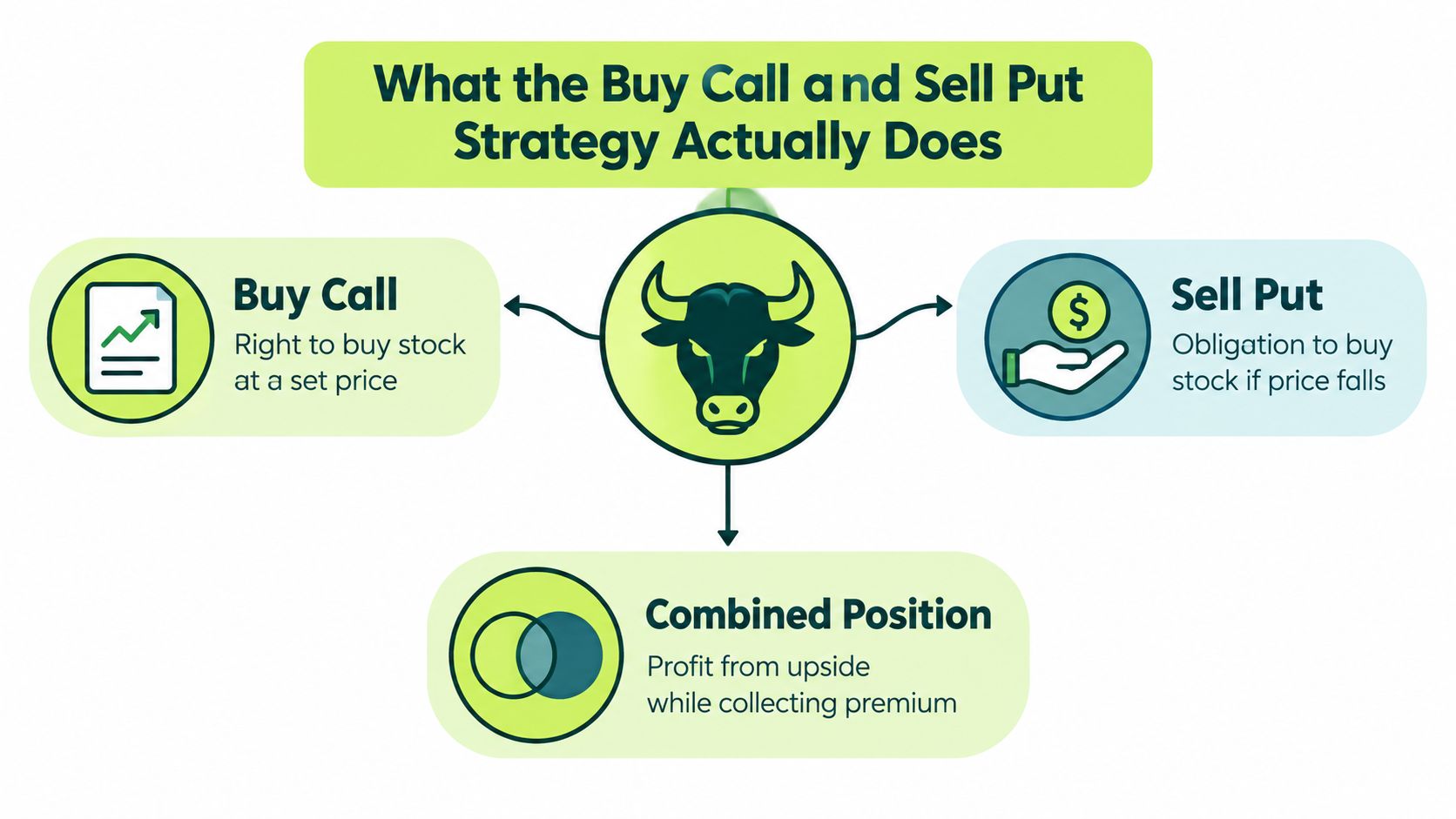
Follow the combined position
- Above the strike at expiration: The call supplies the upside exposure, while the put has no intrinsic value.
- Below the strike at expiration: The call has no intrinsic value, while the short put produces the downside obligation.
- At entry: The put premium offsets some or potentially all of the call premium, but that funding changes neither the underlying directional thesis nor the need to support the position.
Under put-call parity, the matched combination approximates owning the underlying financed at the risk-free rate. Actual results differ because of dividends, transaction costs, margin, early exercise, and execution. The important construction insight is that you're choosing a stock-like exposure, not discovering a discounted call with the same limited downside.
Practical rule: Compare the capital needed to survive the trade, not just the premium needed to open it.
Why choose it over shares or a call?
The attraction is capital deployment. Depending on pricing and broker requirements, the initial premium payment can be smaller than the purchase price of shares. That can suit a trader who deliberately wants synthetic exposure and has reserved resources for the short-put obligation.
A standalone long call serves a different purpose: its loss is limited to its premium. Adding the short put gives up that limited-loss profile for the combined position. If keeping a firm premium-sized loss ceiling is your priority, this construction doesn't meet that requirement.
Why Historical Returns Look Tempting but Mislead
Premium-selling benchmarks can make the funding leg look especially attractive. But a cash-secured put-writing index isn't a synthetic long, and neither is a covered-call index. Comparing them helps frame trade-offs, not forecast your account's return.
In Cboe's historical comparison, PutWrite recorded 1,153% total growth and 10.4% annualized returns, versus 830% and 9.1% for BuyWrite, from mid-1986 through the period covered by the 2012 comparison; their reported Sortino ratios were 0.90 and 0.71, respectively (Cboe historical option-writing benchmark comparison). Those figures describe a particular historical window and systematic benchmark rules, generally before transaction costs, not executable returns for a retail synthetic-long position.
Treat the illustration below as conceptual rather than as a validated return comparison. Its displayed return figures and drawdown characterization aren't established by the cited benchmark evidence.
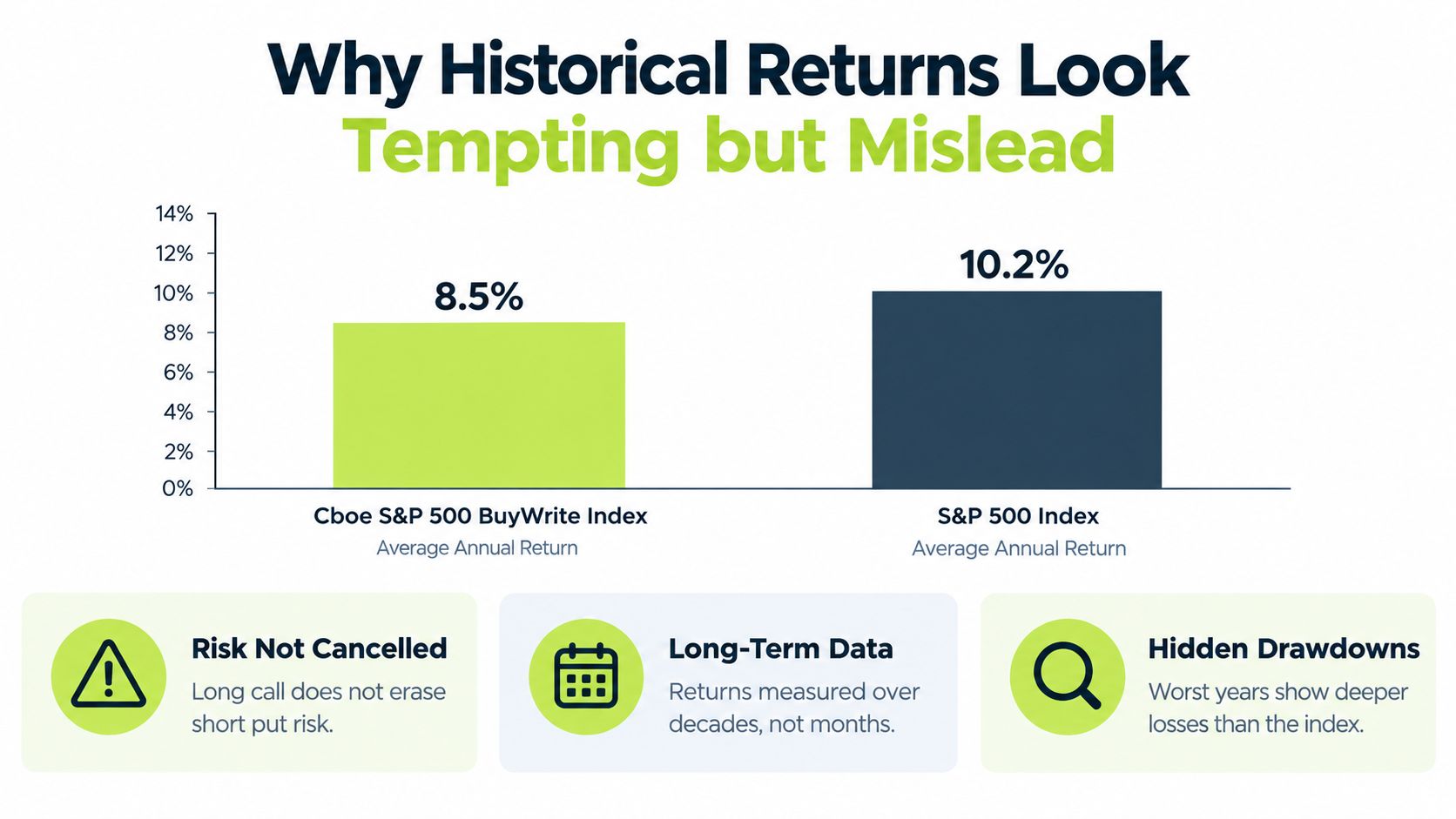
Premium compensates a risk bearer
A peer-reviewed study examining index-option returns from 1987 through 2012 found that put returns were generally inconsistent with standard option-pricing models and concluded that buyers of out-of-the-money tail protection often paid a significant premium (research on historical index-option returns). A put seller may collect compensation for accepting crash and volatility risk. That doesn't make the premium free income.
The distinction matters because the synthetic-long trader also pays for a call. You can't import a put-writing benchmark's return into the combined trade while ignoring the purchased leg, financing assumptions, or collateral.
Judge the implementation, not the headline
A useful review of backtested trading strategies asks whether the simulation represents the trade you can execute.
- Return basis: Separate returns on committed collateral from returns calculated only on the opening debit.
- Trading friction: Include executable spreads, fees, and failed or delayed fills.
- Stress behavior: Examine whether the account could maintain exposure through adverse moves without forced liquidation.
Historical averages won't tell you whether your broker will accept tomorrow's order. Position sizing should reflect that operational constraint before you compare performance.
Choosing Strike Price and Expiration That Fit Your View
Start with the bullish thesis and its invalidation condition. Write down what would justify remaining long, what would make you exit, and how long you're willing to wait. Only then open the options chain.
For a matched synthetic long, choosing a higher strike doesn't turn the entire position into a lower-probability call purchase. You're simultaneously changing the put obligation and the financing embedded in the premium difference. Evaluate the pair, not the call's moneyness alone.
Use a contract-selection worksheet alongside the chain.
Calculate from executable prices
Use the call purchase price minus the put sale price to determine the net premium. Add trading costs separately. A positive result is a debit; a negative result is a credit.
For a position held to expiration, the breakeven is the strike plus the net debit, or the strike less the net credit, before additional costs. If the underlying becomes worthless, the loss reflects the strike obligation plus the net debit, adjusted for contract size and costs. Upside has no fixed payoff ceiling.
Those relationships are more useful than fabricated quotes. Populate them with actual bid and ask prices from your intended contracts, then save the order preview showing the broker's buying-power requirement.
Strike Selection Trade-Offs for a Synthetic Long
| Strike Choice | Net Debit | Breakeven vs Spot | Short Put Margin | Typical Use |
|---|---|---|---|---|
| Near the current underlying price | Determined by paired quotes and financing | Assess using the full net premium | Confirm in the broker preview | A straightforward reference point for comparing available contracts |
| Above the current underlying price | May shift toward a larger credit | A larger credit isn't automatically a better breakeven | Greater strike-price purchase obligation | When liquidity and collateral fit the higher strike |
| Below the current underlying price | May require a larger debit | A lower strike alone doesn't establish an advantage | Lower strike-price purchase obligation, subject to broker rules | When the lower strike offers a better executable combination |
Match expiration to the decision horizon
Choose an expiration that accommodates your thesis and a planned exit before unwanted expiration handling. Don't choose the shortest available contract merely because you expect faster premium decay.
Time decay affects each leg differently, but the combination isn't a pure theta-income trade. Likewise, call delta alone isn't a reliable summary of the pair's directional exposure or probability of profit.
For collateral planning, distinguish a broker's margin requirement from the cash needed to accept the purchase obligation. The discipline behind cash-secured put selling is useful here: establish the funding plan before treating the premium credit as available spending money.
A Worked Example on a 30-Day Backtest Window
Consider a hypothetical Apple synthetic-long test, not a reported historical trade. The window in this heading is a testing specification, not evidence of measured performance. Without timestamped option quotes and execution records, assigning it an entry debit or profit figure would create false precision.
The entry condition is a bullish TradingView signal generated under a defined bar-confirmation rule. At entry, the test selects matched call and put contracts using the strike-selection process above, records the executable quotes, and captures the account's available buying power.
The test should retain a record of what the trader knew at the time. Selecting a strike afterward because it produced an attractive outcome would invalidate the exercise.
Follow alternative paths
| Scenario | Entry Debit | Mid-Trade Mark-to-Market | Exit P&L | Assignment Handling |
|---|---|---|---|---|
| Steady uptrend | Recorded from paired executable quotes | Revalue both legs using available exit prices | Calculate from confirmed entry and exit fills | Check actual contract status before closing |
| Choppy range | Same calculation method, not an assumed reusable quote | Track the combination rather than the put's decay alone | Deduct trading friction from the combined result | Continue monitoring the short contract |
| Sharp gap down | Preserve the original entry record | Mark the short-put liability and remaining call value | Include any stock transaction caused by assignment | Replace the assumed options-only state with the broker's actual holdings |
In the uptrend scenario, the trader leaves the position intact while the thesis remains valid, then exits under the original rule. The test shouldn't improve its result by substituting a favorable midpoint when the market offered a worse executable price.
In the range scenario, the trader doesn't book the shrinking put premium as profit while ignoring the call. The meaningful question is whether closing the entire position produces a gain after costs.
Handle the interruption
The gap-down scenario tests something different: whether the process still works when the position changes form. If assignment appears during the window, the next action must use the updated stock and option holdings rather than the original strategy label.
A backtest that can't represent an assigned stock position hasn't tested the complete lifecycle of this trade.
Keep separate records for strategy decisions, broker events, and execution outcomes. That separation lets you identify whether a disappointing result came from the bullish thesis, poor fills, or a position-management failure. It also prevents a clean payoff calculation from concealing an untradeable sequence.
Assignment and Margin Risks the Payoff Chart Hides
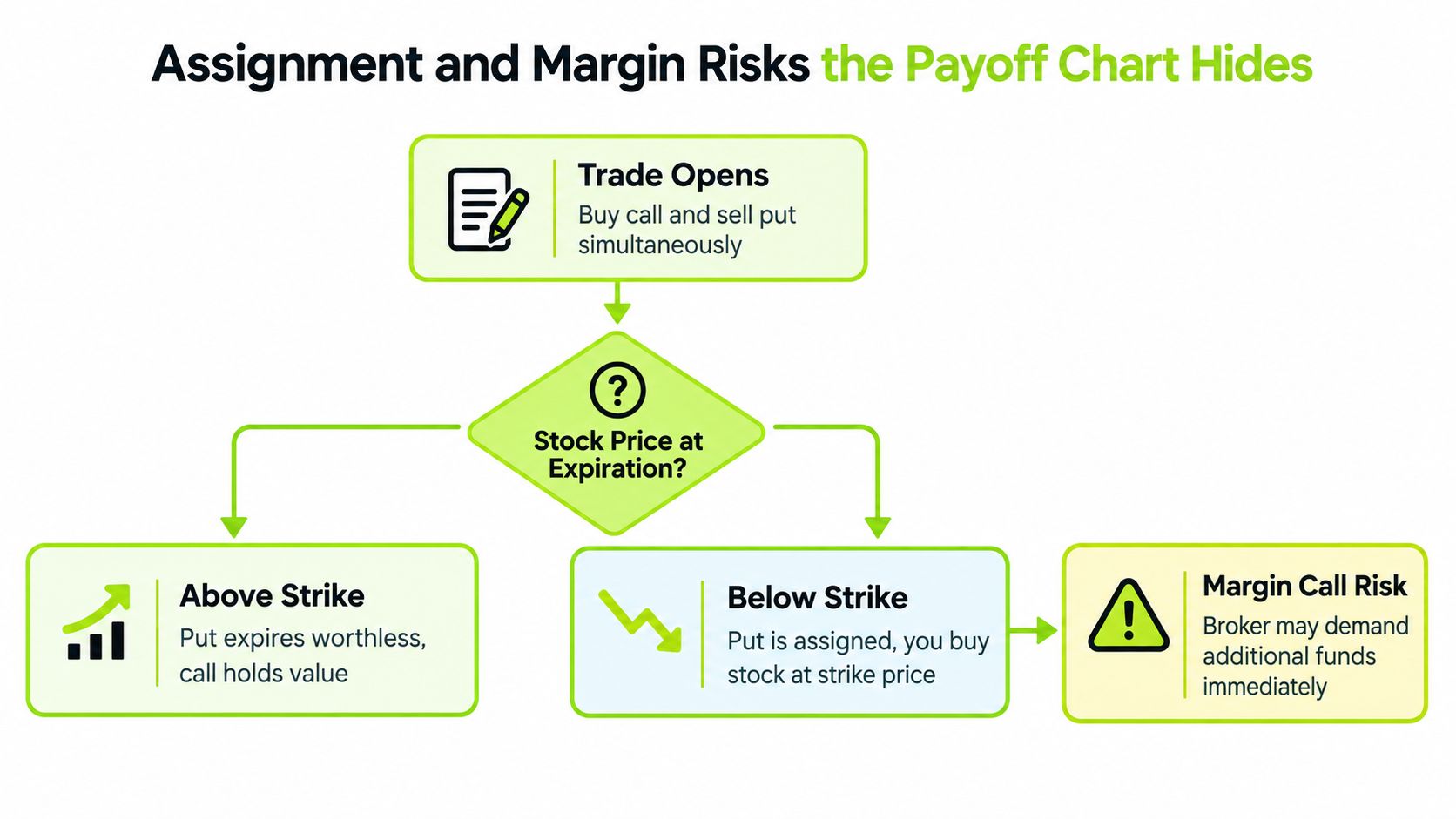
The long call doesn't cap the combined downside. It limits the loss on its own leg. It doesn't cancel the purchase obligation created by the short put.
For American-style options, assignment can occur on any business day, with risk increasing as a put moves deeper in the money and expiration approaches; assignment can also change required capital and create margin pressure (Options Industry Council assignment guidance). Confirm the contract's exercise style and settlement conventions rather than assuming every market follows the same process.
The diagram captures the basic expiration branches, but assignment monitoring must begin before expiration.
Choose a response before urgency chooses it
- Close or roll the put: Closing removes the remaining short-put obligation once filled. Rolling opens a replacement exposure, so evaluate its collateral and pricing as a fresh decision rather than calling it a repair.
- Sell or consider exercising the call: Selling can remove the remaining call exposure. Exercising purchases additional underlying rather than offsetting stock received from put assignment, so it isn't an automatic cleanup action.
- Accept assignment: Do this only when the resulting stock holding fits your plan and available capital. Update both the position record and exit instructions.
- Reduce the position: Cut exposure when account resources or liquidity no longer support the original plan. Don't wait for a directional recovery to solve an operational problem.
Before submitting a response, check settlement timing, outstanding orders, available buying power, and the broker's treatment of the remaining legs. A pending cancellation isn't the same as a confirmed cancellation.
The accompanying video provides another format for reviewing the trade's risk mechanics.
Reconcile before sending an exit
An exit instruction designed to buy back a put is no longer sufficient if that put has already become stock. Query current holdings and open orders before deciding what to close.
Operational boundary: Never let the strategy's remembered position override the broker's confirmed position.
This is also why international traders need market-specific checks. Exercise rights, settlement mechanics, and account requirements belong in the trading plan, not in assumptions imported from a generic payoff chart.
Wiring a TradingView Alert to a Verified Execution Pipeline
A correct bullish signal doesn't establish that the account holds the intended position. Signal correctness means your strategy triggered under its rules. Order-state correctness means the broker accepted the intended instructions, the expected quantities filled, and subsequent actions match actual holdings.
Execution deserves attention even in an active market: U.S. listed-options volume exceeded 15.2 billion contracts in 2025, up about 26%, while retail traders represented roughly 30% of options volume (Cboe's options-industry review). Activity alone doesn't establish liquidity for your selected contracts or protect an automation workflow from stale signals.
Establish the execution boundary first
Before connecting TradingView to Robinhood, verify that the execution layer supports the exact option instruments, multi-leg instructions, and position transitions you need. A webhook connection or general market-order capability doesn't prove synthetic-long options support.
Use the principles of automated trade execution to define a verifiable route from a Pine Script alert() event to broker acknowledgment. Keep the payload human-readable, with the intended action, instrument identity, quantity, strategy reference, event ID, and signal timestamp.
- Route deliberately: Send the TradingView alert to the execution layer's verified webhook. Confirm the destination in the integration interface rather than copying an unverified endpoint.
- Start in test mode: Inspect logged alerts without transmitting orders. Check that contract identifiers, direction, and sizing survive the entire parsing process.
- Test abnormal delivery: Repeat an event ID, replay a stale alert, and simulate a rejected instruction. The system should handle these cases predictably rather than creating unintended exposure.
Verify states, not notifications
A delivery receipt proves receipt at a particular stage. It doesn't by itself prove broker acceptance or a fill. Retain timestamps, rejection details, partial-fill quantities, and final execution status.
Event-ID deduplication should prevent repeated delivery from creating repeated orders. It doesn't fix an incorrect contract identifier or an exit generated from stale holdings. Reconciliation remains necessary.
Before enabling live transmission, test a global pause that blocks new entries, requests cancellation of outstanding system-originated entries, and preserves valid risk-reducing exits. Verify cancellation acknowledgments and pause behavior separately. A pause control isn't a promise that every pending instruction has disappeared.
Pre-Live Checklist and Rules of the Road
Treat live activation as a release decision. The strategy logic, account permissions, and execution workflow must all support the same intended trade. A successful alert test alone isn't enough.
Pre-Live Checklist for a Synthetic-Long Automation
| Check | Why It Matters | How to Verify |
|---|---|---|
| Buying power | The opening premium isn't the full capital obligation | Review the broker preview and assignment funding plan |
| Options permissions | Account access may not cover the intended construction | Confirm approval for the exact trade |
| Contract liquidity | Attractive theoretical prices may not be executable | Inspect current spreads and available quotes |
| Leg sequencing | An incomplete combination creates unintended exposure | Define partial-fill and rejection responses |
| Fill reconciliation | Alerts and holdings can disagree | Match execution records against broker positions |
| Assignment monitoring | Contract transitions change valid exit actions | Confirm notifications and holdings checks |
| Emergency pause | Entry control must remain available during disruption | Test blocking, cancellation requests, and permitted exits |
Keep the notebook rules short
- Do size from downside capacity: Use the position you can maintain through stress, not the largest order the account currently accepts.
- Do preserve evidence: Save the contract selection, alert event, broker status, and final holdings.
- Don't chase a premium credit: A larger opening credit isn't proof of a better trade.
- Don't improvise after a mismatch: Pause entries and reconcile before issuing replacement instructions.
The practical standard is simple: know what you intend to own, verify what you own, and retain a workable way to reduce it. If the workflow can't demonstrate those controls in testing, keep live transmission disabled.
Pineflows turns TradingView strategy alerts into Robinhood orders through a test-first pipeline with event-ID deduplication, execution records, and pause controls. Visit Pineflows to inspect the workflow and confirm supported instruments and order types before considering it for a synthetic-long setup.