September 28, 2026 · 13 min read · Pineflows team
Automated Trade Execution: Building Safe Pipelines
Master automated trade execution with alert-to-order pipelines, idempotency safeguards, and pause controls. Learn to build reliable workflows

You click into a trade expecting the alert to do the rest. Instead, the market moves, the webhook waits, a retry arrives, and your broker shows either no position or two. The strategy may be sound, but the path from TradingView to the broker has become the new source of risk.
Automated trade execution isn't just a signal connector. It's an operational system that must decide whether an event is genuine, whether it has already been processed, whether the order is still valid, and whether a human can stop new exposure without losing control of exits. The difficult work sits between the alert and the order.
Table of Contents
- Why Alert-to-Order Pipelines Fail Without Engineering
- Building the Alert-to-Order Pipeline
- Idempotency and Deduplication at the Event Boundary
- Test-First Workflows and Pause Controls
- Audit Trails, Delivery Receipts, and Verification
- Manual Entry Versus Automated Trade Execution
- When Automated Trade Execution Finally Works
Why Alert-to-Order Pipelines Fail Without Engineering
A TradingView alert fires during a sharp move. Your endpoint receives the request, but the response times out before the sender knows whether it succeeded. The sender retries. Your first worker is still formatting the order while the second worker accepts the duplicate. The broker then receives two valid instructions, because neither request knows the other exists.
That failure doesn't require a broken strategy. It can come from ordinary network uncertainty, slow processing, an invalid symbol, a stale timestamp, a rejected broker request, or a missing acknowledgment. A basic forwarder treats every webhook as a fresh command. A reliable pipeline treats it as an event that needs identity, validation, state, and a verifiable outcome.
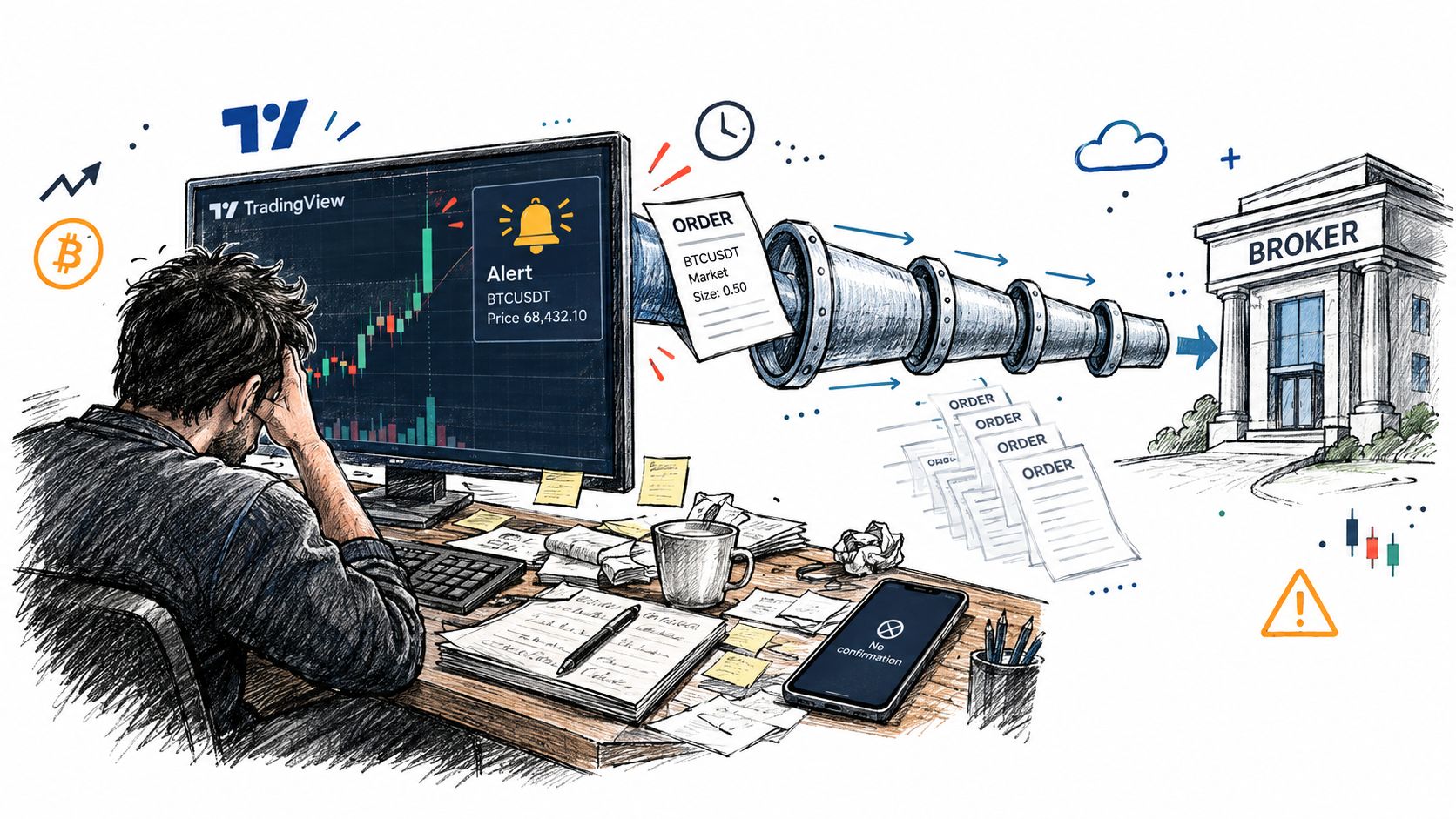
The gap between signal and execution
Electronic execution now handles most activity in major equity markets. One industry summary estimates automated systems execute about 70% of U.S. equity trading volume and roughly 60–75% of global equity volume, while another 2026 estimate places AI-driven algorithms at approximately 89% of global trading volume. These figures come from industry coverage of automated trading, and they describe a market where routing, order logic, and infrastructure already operate at machine speed.
Retail traders often copy the visible part of that workflow, the alert and the order form, while omitting the controls surrounding it. That creates a dangerous mismatch. The system acts automatically, but nobody can answer basic operational questions: Which event created this order? Did the broker acknowledge it? Was the request retried? Can new entries be stopped without disabling protective exits?
Practical rule: Treat every alert as an instruction that can be duplicated, delayed, malformed, or replayed.
What breaks first
A useful design starts by assuming failure rather than hoping for clean delivery.
- Network timeouts can leave the sender uncertain even when the broker received the request.
- Duplicate deliveries can turn one trading decision into multiple orders.
- Out-of-order events can submit an exit before the corresponding entry is visible to your execution layer.
- Malformed payloads can produce the wrong symbol, side, quantity, or order type.
- Stale signals can execute a decision that was valid only during an earlier market condition.
- Opaque status handling can make a rejected order look like a successful trade.
The fix isn't adding more strategy logic. It's building a boundary between incoming intent and broker action, then making that boundary observable and controllable.
Building the Alert-to-Order Pipeline
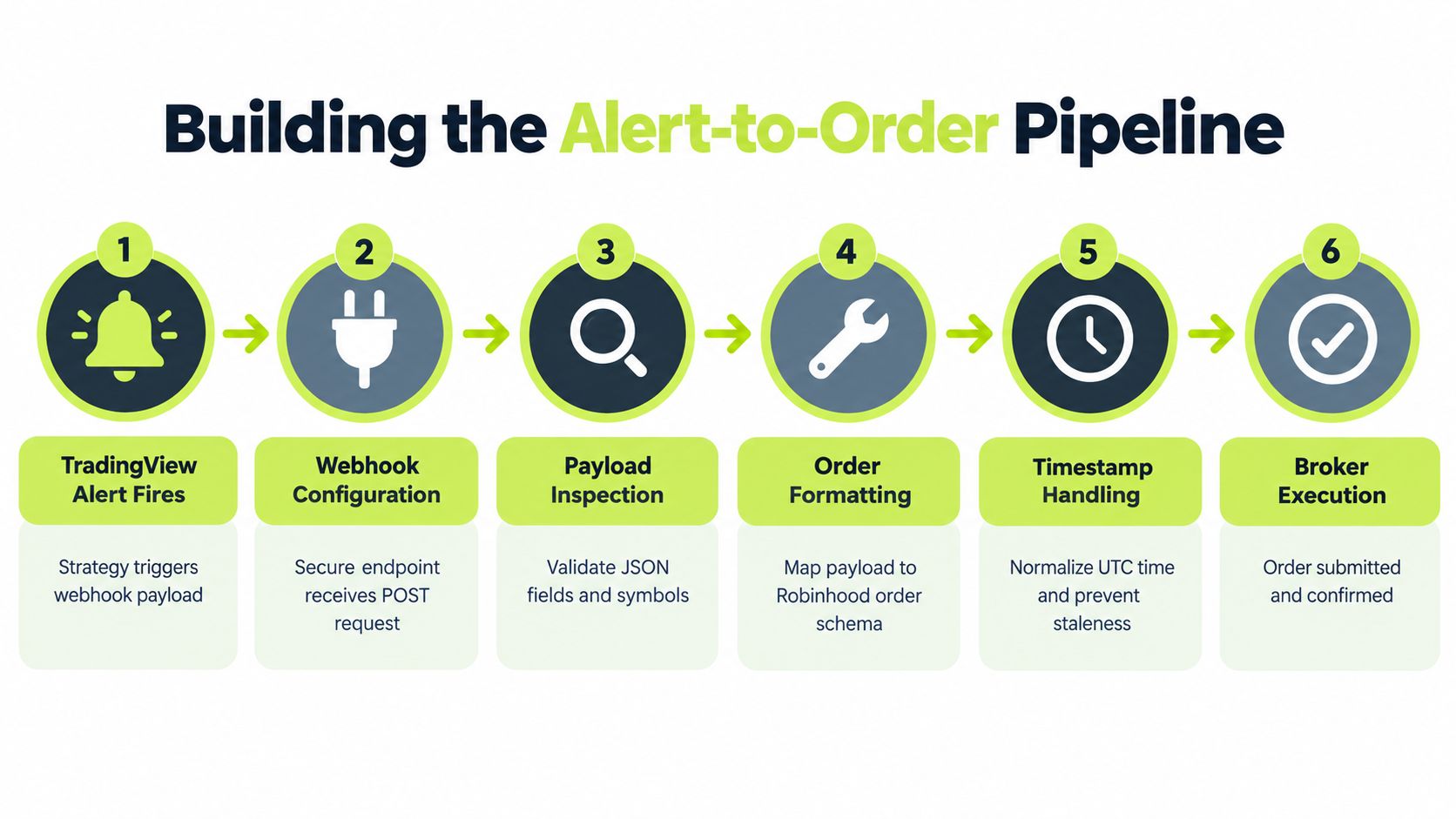
A dependable route from TradingView to Robinhood has distinct stages. Each stage should create a record, reject bad input early, and pass only normalized data to the next component.
Start with the alert contract
Configure the TradingView strategy alert to send a predictable JSON payload. Include the instrument, action, quantity or sizing instruction, event identifier, strategy context, and event timestamp. Don't let downstream code guess whether sell, exit, and close mean the same thing. Normalize those values at the webhook boundary.
TradingView webhook delivery also has operational prerequisites, so confirm the account and alert configuration before debugging order logic. The TradingView alert documentation provides the setup reference for this part of the flow.
The receiving endpoint should immediately record the raw request and return a controlled response. It shouldn't place the order before validation finishes. Check that required fields exist, values use an approved format, the symbol is supported, the action is permitted, and the timestamp isn't stale.
Normalize before routing
After validation, convert the payload into an internal order object. Keep the original payload alongside the normalized version. This gives you a clear comparison when a broker rejects an instruction or a post-trade review finds an unexpected position.
A practical sequence looks like this:
- Receive and identify: Assign or verify the stable event ID.
- Inspect and validate: Reject missing fields, unsupported instruments, and invalid actions.
- Record receipt: Store the event, arrival time, payload, and validation result.
- Format the order: Map the internal object to the Robinhood order schema.
- Handle time consistently: Normalize timestamps to UTC and reject stale instructions.
- Submit and verify: Store the broker response, order identifier, status changes, and fill details.
The status check matters because an HTTP response only tells you about the request exchange. It doesn't necessarily tell you whether the order filled, remained open, or was rejected later.
Keep the route testable
Start in a mode that records alerts without sending live orders. Then send a controlled test event, inspect the normalized order, and compare each status transition with what you expect. A short video walkthrough of the alert-to-order flow can help visualize the sequence, but your own logs must remain the source of truth.
The cleanest pipeline is boring to operate. You can see what arrived, what changed, what was sent, and what the broker confirmed without reconstructing the story from scattered screens.
Idempotency and Deduplication at the Event Boundary
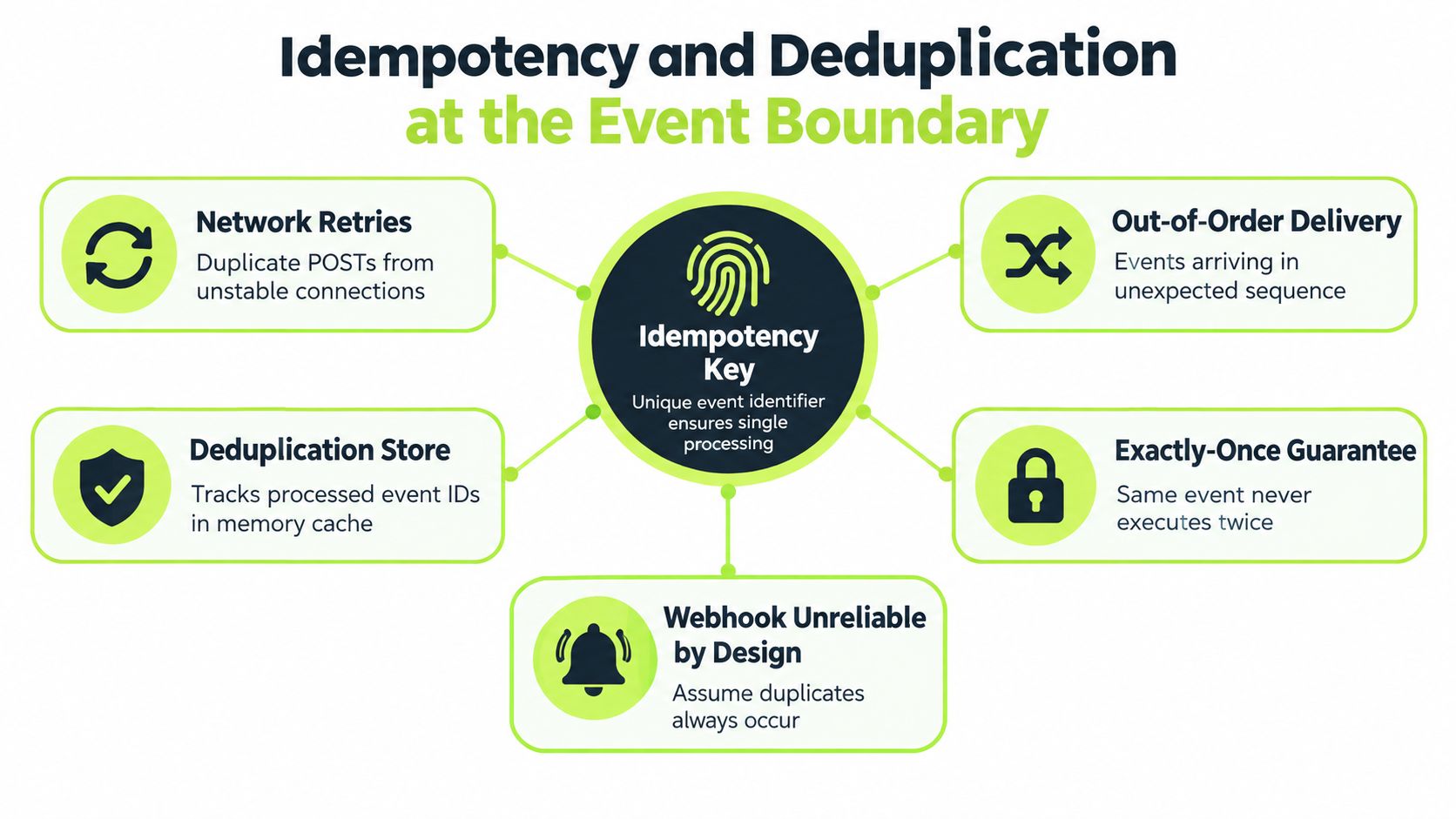
Webhook systems should assume duplicate delivery. A sender can retry after a timeout, a worker can restart after persisting part of its state, or two consumers can process the same message concurrently. If both paths can place an order, the system has no protection at the point where an event becomes financial exposure.
Idempotency means processing the same event more than once produces the same effective result as processing it once. For trade execution, that usually means the first valid event may create an order, while later deliveries of that same event return the existing result and never create another order.
Give every alert a durable identity
The event ID must be stable across retries. Don't generate a new random ID each time the webhook handler sees a request, because that makes duplicates look unrelated. Prefer an identifier produced from the original signal, or a deterministic combination of strategy identity, event time, instrument, action, and sequence information where that combination is guaranteed to distinguish legitimate events.
The webhook implementation guidance recommends the critical pattern: generate a stable identifier, store it durably before placing the order, make the check-and-insert operation atomic, and treat a duplicate as a successful receipt rather than a new command.
A simple state transition might look like this:
- New: The event ID doesn't exist in the durable store.
- Reserved: The system has claimed the event for processing.
- Submitted: The broker accepted an order request.
- Completed: The system recorded the final known result.
- Rejected or failed: Processing ended without a valid order outcome.
If another request arrives while the first is processing, it should find the reservation and wait, return the known state, or safely acknowledge the duplicate. It must not proceed independently.
Make the database decision atomic
The dangerous implementation is a separate “check” followed by an “insert.” Two workers can both check before either inserts. The safe implementation combines those actions into one unique operation protected by a uniqueness constraint or equivalent atomic store behavior.
Store the event ID, account or strategy scope, received time, payload hash, processing state, and broker order ID. A deduplication index keyed by client order ID can remain active for the relevant session duration, as recommended in order-management system design guidance. That keeps the lookup practical while preserving enough history to investigate retries and replays.
A retry is normal. A retry that creates a second position is a design failure.
Don't confuse idempotency with strategy logic. A strategy can intentionally generate two separate valid entries, so the event identity must distinguish those events. Deduplication protects the execution of one intent. It doesn't decide whether the strategy should produce another intent.
Test-First Workflows and Pause Controls
Live mode shouldn't be the default. The first goal is to prove that alerts arrive, payloads parse, timestamps behave correctly, order mapping is valid, and status updates are visible without risking capital.
Begin with a dry run
Use a test mode that stores the incoming alert and simulates the downstream order. The system should show the symbol, side, quantity, event ID, normalized timestamp, and the broker request it would have created. If the payload is invalid, the test should fail loudly and explain why.
Run several deliberate tests:
- Entry test: Confirm that a valid buy or sell instruction maps to the intended instrument and size.
- Exit test: Check that an exit uses the correct position context and remains available when entries are paused.
- Duplicate test: Send the same event twice and verify that only one processing record exists.
- Stale-event test: Submit an old timestamp and confirm that the system rejects it.
- Malformed-input test: Remove a required field and inspect the error record.
- Broker-response test: Verify that accepted, rejected, open, and filled states remain distinguishable.
The test-send workflow should be part of routine setup, not a one-time demonstration. A successful test proves routing. It doesn't prove that the strategy behaves correctly under every market condition.
Separate the pause from the kill switch
A useful pause control blocks new entries, cancels entry orders created by the automation, and leaves valid exits available for risk handling. That distinction matters. A blanket shutdown may stop the mechanism that can reduce an existing position, leaving the trader with less control during the event that caused the pause.
The pause action should also produce an audit record. Store who activated it, when it took effect, which pending instructions it affected, and whether any request was already submitted. If the control is only a button with no state history, you won't know whether it worked during an incident.
Require deliberate activation of live mode
Move to live execution only after the dry-run output matches the intended broker request and the duplicate, stale, malformed, and pause tests behave correctly. Keep the transition explicit. A configuration change, confirmation step, or separate environment makes accidental activation harder.
Operational standard: You should be able to stop new exposure without losing the information needed to manage existing exposure.
Risk controls still belong around the pipeline. Scope broker permissions narrowly, enforce instrument and position limits, reject unexpected order types, and alert on unusual request volume or repeated failures. FINRA warns that third-party auto-trading services can involve unregistered activity, misleading performance claims, and vague AI marketing, so software controls don't replace due diligence or compliance judgment. The FINRA discussion of automated investing risks is a useful reminder to evaluate the service as well as the code.
Audit Trails, Delivery Receipts, and Verification
Visibility changes how you operate automation. If the only evidence is a TradingView alert and a broker position, every mismatch becomes a guessing exercise. A proper audit trail lets you reconstruct the event from arrival through validation, submission, acknowledgment, and fill.
Record two versions of the request. Keep the raw payload exactly as received, then store the normalized representation used for order construction. Add the event ID, receive timestamp, validation result, pause state, deduplication decision, broker request identifier, response, and later status changes.
Make receipts answer useful questions
A delivery receipt shouldn't merely say “received.” It should answer:
- Did the endpoint accept the payload?
- Which event ID did it assign or verify?
- Was the event new or a duplicate?
- Did validation pass?
- Was the order blocked by test mode or pause state?
- Did the broker accept, reject, or leave the order open?
- What fill information became available afterward?
Write those results in human-readable language as well as structured fields. During a fast market, a trader needs to find the answer quickly, not interpret a raw stack trace.
Monitor the tails, not just the average
Latency is a distribution problem. A high-performance trading reference describes network latency near 0.5 microseconds with kernel bypass, market-data parsing near 0.1 microseconds, order serialization around 0.05 microseconds, and scheduling jitter reduced from 0–100 microseconds to under 1 microsecond with CPU pinning and a real-time kernel. Those figures are specific to high-performance infrastructure, but the operational lesson applies broadly: a low average can hide dangerous tail spikes. See the latency and tail-performance reference.
For a retail pipeline, monitor the full journey instead of chasing institutional hardware. Track arrival-to-validation time, validation-to-submission time, broker acknowledgment delay, fill status delay, duplicate rate, rejection rate, and stale-event rate. Alert when the pipeline stops receiving expected events or when statuses remain unresolved.
Execution quality also means more than “an order was sent.” Review fill rate, partial fills, slippage against the arrival price, consistency, and behavior during volatile or illiquid conditions. TradeStation's execution discussion describes the broader shift toward judging execution through stability, pricing discipline, and performance under stress.
Manual Entry Versus Automated Trade Execution
Manual entry has one major advantage: a person sees the signal before deciding whether to act. That adds judgment, but it also adds delay, inconsistency, and the possibility of missing a fast setup. A basic alert-forwarding bot removes the manual click while leaving the trader exposed to duplicate delivery, weak validation, and unclear status.
Production-grade automation adds engineering overhead in exchange for controlled behavior. It doesn't make a strategy profitable, and it can't remove market risk. It gives the trader a clearer answer when the system encounters uncertainty.
| Approach | Strength | Main weakness | Best fit |
|---|---|---|---|
| Manual entry | Human review before submission | Slow and inconsistent during fast moves | Infrequent signals and discretionary decisions |
| Basic forwarding bot | Quick setup and low operational friction | Poor duplicate, pause, and status handling | Experiments with no live exposure |
| Controlled pipeline | Validation, idempotency, receipts, and overrides | Requires testing and maintenance | Repeated alerts and meaningful capital risk |
The right choice depends on signal frequency, order complexity, account exposure, and your ability to monitor failures. A slow strategy with rare alerts may not justify an advanced execution layer. A strategy that fires repeatedly during volatile conditions has a much larger need for event identity, pause controls, and post-trade verification.
Don't use speed as the only decision criterion. A slower system that rejects stale events and exposes every status can be safer than a faster connector that silently retries. Automated trade execution earns its place when it reduces human delay without hiding the decisions that matter.
When Automated Trade Execution Finally Works
A volatile session provides a useful test of the whole design. A TradingView strategy sends an entry alert, the endpoint validates the payload, records the event ID, and routes the order. The broker acknowledges the request, and the audit record stores the order identifier and later fill status.
Then the webhook sender retries. The second request reaches the service while the first event is already marked as reserved. The deduplication check returns the existing event state, records the duplicate delivery, and refuses to create another order. The trader sees both the original receipt and the duplicate decision instead of discovering an unexplained second position later.
A pause should preserve control
Suppose volatility increases and the trader activates the pause control. New entries are blocked, automation-created entry orders are cancelled where possible, and valid exits remain eligible for risk management. The system records the pause timestamp, affected events, and any order that had already crossed into broker submission.
That sequence doesn't predict the market or guarantee a fill. It does something more practical: it limits what the system can do while preserving evidence of what happened. The trader can review whether the pause took effect before a later signal arrived, rather than relying on a visual assumption that a button press stopped everything.
Reliability is a set of deliberate boundaries
The strongest pipelines share a few characteristics:
- They identify intent: Each alert has a stable event ID.
- They validate before acting: Bad symbols, fields, actions, and timestamps stop at the boundary.
- They persist state: The system records receipt and processing before order placement.
- They expose outcomes: Broker acknowledgment and fill status remain visible.
- They permit intervention: Pause controls stop new exposure without erasing exit pathways.
- They support review: Raw payloads and normalized orders explain every decision.
Automated trade execution works when the system behaves predictably during ordinary delivery and failure. The objective isn't to build a clever bridge between two platforms. It's to build an execution process that can reject a duplicate, stop a new entry, explain a broker response, and leave a trustworthy trail when the market is moving faster than your attention.
Pineflows turns TradingView alerts into executable Robinhood orders with test-first routing, duplicate detection, pause controls, delivery receipts, and step-by-step status visibility. If you want to replace fragile alert forwarding with an auditable pipeline that keeps you in control, visit Pineflows and start by testing your alert flow before enabling live execution.