November 11, 2026 · 17 min read · Pineflows team
Day Trade Rules for Margin, Cash, and 2026
Day trade rules in one table: four trades in five days, the 6 percent test, $25,000 equity, 4x buying power, T+1 cash, and the June 2026 change.

The most repeated line in retail trading is still “keep $25,000 or stay under three day trades.” That line made sense when every U.S. margin login used the same pattern test. It is a weak guide now. Day trade rules in 2026 bind by account type and by whether that broker still runs the pattern day trader framework. A cash account never uses that count. A margin account at a firm that has already switched does not use it either. An alert that fires a same-day exit can still be a day trade, even when you labeled it a stop.
Look up the row that matches the login before you size the next order. Then read only the entry that owns that row.
Table of Contents
- Day Trade Rules Lookup by Account and Market
- The Pattern Day Trader Count
- Equity Floors and Day Trading Buying Power
- Cash Account Settlement and Violations
- Recovering From a Flag or Restriction
- Broker Overlays and Rules Abroad
- The 2026 Shift Off the PDT Label
- Check Status Before the Next Round Trip
Day Trade Rules Lookup by Account and Market
Start with the account type and the broker's current rules. A cash account, a margin account under the legacy pattern framework, and a margin account using the newer intraday-margin framework do not share one rulebook. A day trade means buying and selling, or selling and buying, the same security on the same day.
| Rule | Trigger | Requirement | Account |
|---|---|---|---|
| Pattern day trader count | 4 or more day trades in 5 business days | Day trades must also exceed 6 percent of total trades in that window | US margin, legacy framework |
| Minimum equity | Account designated a pattern day trader | At least $25,000 equity at all times, not only at the open | US margin, legacy framework |
| Day-trading buying power | Prior close maintenance-margin excess | Generally up to 4 times that excess; a call if exceeded | US margin, legacy framework |
| Broker designation | Firm reasonably believes the customer will day trade | PDT limits may apply even under the numeric count | US margin |
| Cash-account round trip | Same-day buy and sell without margin | Reuse sale proceeds only after T+1 settlement | US cash |
| Intraday margin replacement | Firm adopts the 2026 framework | No PDT label or fixed $25,000 floor; equity sized to actual intraday exposure | US, according to the adopting firm's rules |
A four-trade count beside the table
Suppose a margin account still follows the legacy framework. Monday, you round-trip stock A. Tuesday, you round-trip stock B. Thursday, you round-trip stock A again. That is three day trades in five business days.
On Friday, you round-trip stock C, bringing the count to four. The proportional test also matters: four day trades out of 40 total trades is 10 percent, so both tests are met. Four out of 80 is 5 percent, so the proportional test is not met.
Five families and where each one lives
- Activity rules cover pattern designation, including the count, the 6 percent test, and a firm's belief that you will day trade.
- Equity and buying-power rules set intraday exposure under the legacy equity floor and prior-close formula.
- Settlement rules determine when cash-account sale proceeds can be reused and address good-faith, freeriding, and cash-liquidation problems.
- Broker overlays add firm-specific limits. Non-U.S. markets may use margin caps or dealer margin sheets rather than a U.S. pattern count.
- The 2026 shift applies at firms that have adopted intraday margin. Check the rule for the specific account before placing an order, and keep automated orders logged against that account's current status.
Use the table to identify the row that matches the account and broker. Then apply that rule to the next trade.
The Pattern Day Trader Count
Under the legacy U.S. margin framework, FINRA, as summarized in the SEC investor bulletin on margin, defines a pattern day trader as a customer who executes four or more day trades within five business days, provided those day trades are more than 6 percent of the customer's total trades in that same window. A day trade means buying and selling, or selling and buying, the same security on the same day. Once classified, the customer must maintain at least $25,000 of equity at all times before continuing to day trade. A brokerage may also classify a customer it reasonably believes will day trade.
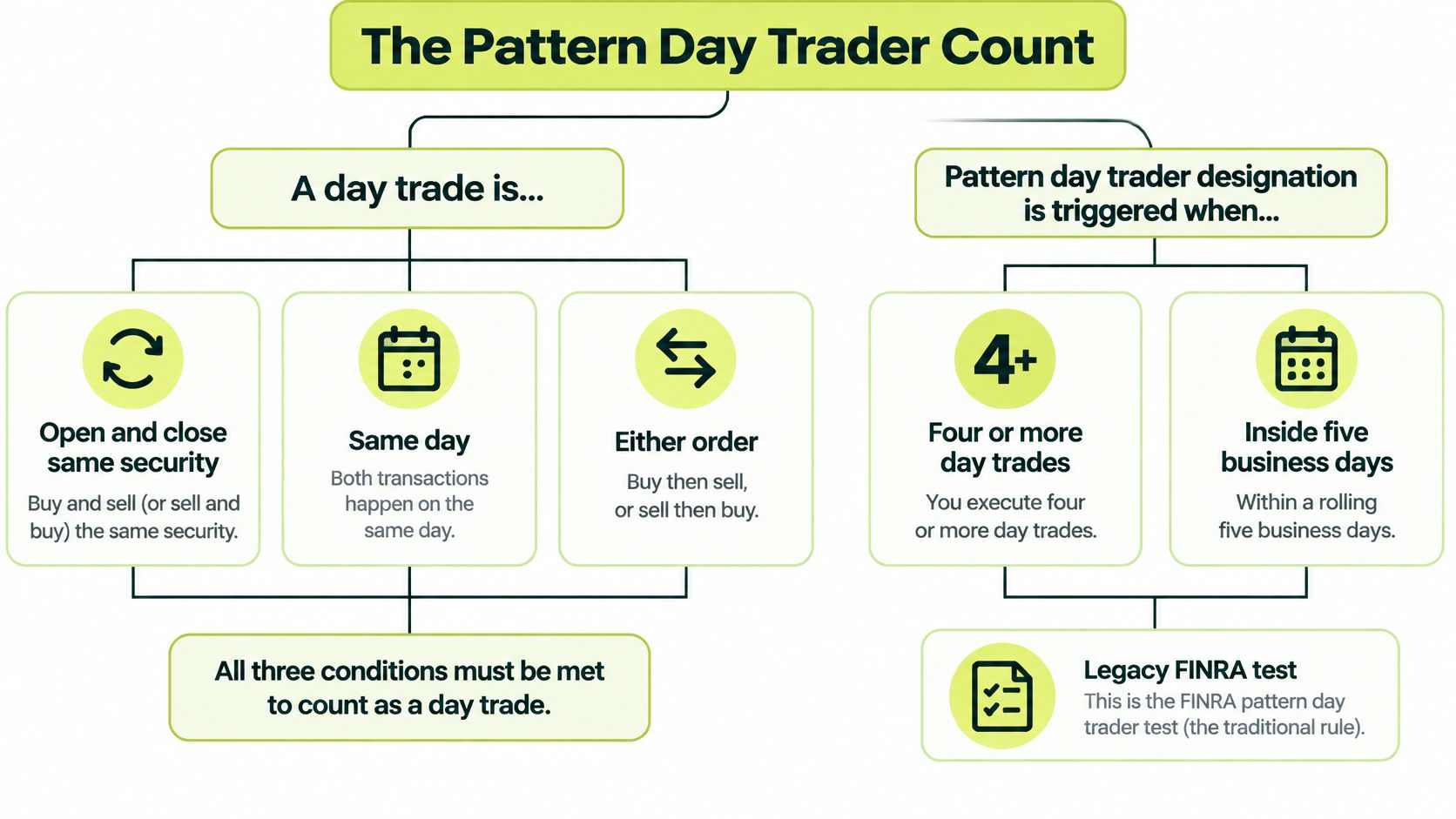
The test has two parts. Miss either part and the numeric label does not attach from the count alone. The firm can still designate you from intent.
Three windows, three different results
Four day trades and 40 total trades. Four divided by 40 is 10 percent. The count is met and the share of trades is above 6 percent. Both parts are met.
Four day trades and 80 total trades. Four divided by 80 is 5 percent. The count is met. The proportional test is not. Activity alone does not finish the designation.
Two day trades, any size. Two is not four. A pair of large round trips does not meet the count, even if each ticket is the biggest trade of the month.
Practical rule: Count the way the broker's day-trade counter counts, not the way the strategy is named.
A stop-out or a take-profit that closes the same security today is still a day trade. The strategy label “risk control” does not remove it. A scale-out can surprise you too. You buy 100 shares at the open and sell 40, then 60, in two tickets before the close. If the counter treats each closing ticket against that same-day open as its own day trade, you did not make “one idea.” You made two closes. Partial fills can split one intended exit the same way. If you are unsure how many round trips a busy strategy produces, compare the counter with a written trades-per-day log before you add another entry.
What the designation does after the window rolls
The designation sticks to the margin account. Dropping under four day trades in a later week does not, by itself, erase it. Small automated round trips add up because each same-day open and close counts, even when the dollar size is tiny. Equity and buying power after a designation are a separate control. Firms that drop this count on the published schedule are covered in the 2026 entry, not here.
Equity Floors and Day Trading Buying Power
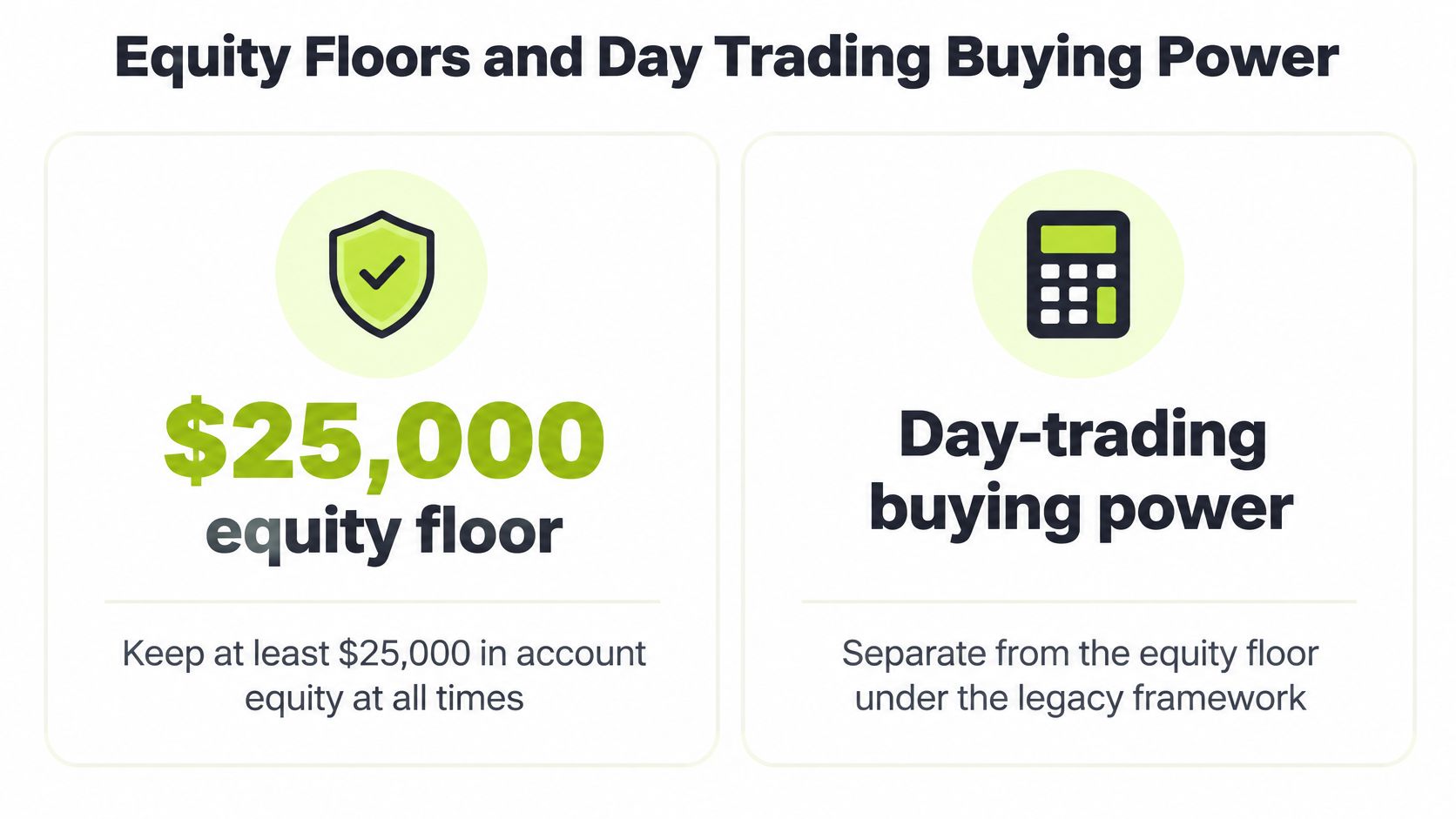
The equity floor and day-trading buying power are different controls. Passing one does not satisfy the other.
The FINRA rule filing on the day-trading margin framework traces the current U.S. setup to SEC-approved amendments involving the New York Stock Exchange and NASD in 2001. Its central number is the $25,000 minimum equity for customers classified as pattern day traders. Those traders are also limited by day-trading buying power, generally up to four times maintenance-margin excess based on the prior day's close. Exceeding that buying power can trigger a margin call and trading restrictions.
The floor is an all-day equity test
Once the account is designated, you keep at least $25,000 of equity at all times before you continue day trading. It is not a figure you only need at the open, and it is not the same thing as settled cash sitting in the account. If equity falls through the floor, you generally cannot keep day trading until the minimum is restored.
A deposit that arrives after equity has already fallen short does not cure trades you already placed. Those trades stay on the record. The later wire only speaks to whether you may trade again after the broker shows the equity back above the floor.
Buying power uses yesterday's excess
Buying power is not four times the whole account, and it does not refresh with each winning trade during the session. It is generally up to four times maintenance-margin excess as of the prior close.
Say equity is $30,000 and the maintenance requirement on the positions is $25,000. Excess is $5,000. Day-trading buying power is up to $20,000. A string of small same-day round trips can use that $20,000 even while equity is still above $25,000. Cross the permitted buying power and you can draw a day-trade margin call, with restrictions until the call is met.
Track the day-trade count, total trades, equity, and buying-power use as four separate numbers. An alert-driven system will not pause itself between round trips.
The 2001 amendments paired an activity test with a borrowing cap after speculative day trading expanded and customers ran into trouble. An alert stack can produce several same-day round trips with no manual pause, so the buying-power meter moves while you are still watching the chart. Firms that replace this prior-close formula with exposure-based intraday margin are on a different row. Until your login shows that switch, keep the floor and the four-times excess as two checks, not one.
Cash Account Settlement and Violations
A cash account is not a back door around the pattern count. It is a settlement rule. The pattern designation described for margin logins does not run here. U.S. stocks and most ETFs settle on T+1, so sale proceeds are not buying power for another purchase until the next business day. If you are routing alerts into a Robinhood cash account, treat unsettled proceeds as unavailable, even when the app shows a larger “buying power” style number from a different product view.
Three violations, each on a single day
| Violation | What happened | Typical result |
|---|---|---|
| Good faith | Bought with unsettled sale proceeds and sold that new position before settlement | Warning, then settled-cash-only restriction if repeated |
| Freeriding | Bought and sold the same security without paying for the purchase | Settled-cash-only freeze until the purchase is paid and the broker lifts the block |
| Cash liquidation | Sold another position to pay for a purchase, then sold or reused it too soon | Warning, then a restriction if repeated |
| Unsettled reuse | Tried to fund a second same-day purchase with T+1 proceeds | Order reject, or a violation if the sale is allowed |
Good faith. You sell stock A on Monday. Before that sale settles, you buy stock B with those proceeds and sell B the same day. You used money that was not yours yet, and you closed the new position before it became yours.
Freeriding. You buy stock C and sell it the same day without paying for the purchase at all. There is no settled cash behind the buy, and no later sale of something else that was supposed to cover it. The broker treats that as taking a free ride on the firm's money.
Cash liquidation. You buy stock D, then sell stock E to pay for D, and you sell D or reuse it before E's sale settles. The covering trade had not finished settling, so the new position was still unpaid when you turned it over.
A reject is not the same event as a violation
A rejected order never becomes a position. A violation is recorded after the broker allowed the trade. Repeated violations commonly end with a settled-cash-only restriction for the period stated in the account agreement. House rules can reject an order earlier than the regulation requires, which is safer than collecting a violation, but you should not plan on the reject as your only control.
A workable cash routine is short. Size the first buy to settled cash only. Wait until that sale settles before a second round trip. Do not assume a margin-style day-trade counter is running in the background. If the platform will not show settled versus unsettled as separate figures, keep your own T+1 ledger and do not send the next buy until the settlement date on the prior sale has passed.
Recovering From a Flag or Restriction
Stop, restore what the notice names, and wait for the broker's confirmation. A later deposit does not rewrite trades that already happened.
- Read the notice and write down three facts. Record the date, the account type, and which event it is: a designation, an equity call, a buying-power call, or a cash restriction. Those four are not interchangeable, and the fix for one does not clear the others.
- Stop new day trades in the margin account immediately. Trades placed before equity is restored are not cured by money that arrives afterward. Cancel pending entry orders so a resting buy cannot fill while you are reading the message.
- Restore equity for a legacy pattern designation before you plan another intraday round trip. Do not treat a deposit made after the account fell through the floor as cover for trades already placed. Wait until the account screen shows the restored equity, not merely a pending transfer.
- Recheck buying power from the prior close. Intraday gains do not rebuild that figure during the session. If the next order needs more than the unused excess, it waits.
- Recount the five-business-day window, then remember what does not age off. Individual day trades leave the rolling count as they pass five business days. The designation on the margin account remains until the broker removes it.
- For a cash restriction, buy only with settled cash. Stay on that limit until the restriction period in the agreement ends and any broker review is complete. Do not “test” the block with a small order.
- Log the restoration date and the broker's confirmation before you turn automated entries back on. If the notice is ambiguous, ask the firm which of the four events it recorded before you send anything new.
Resume automation only after the broker confirms the restored status. A green balance is not that confirmation.
Broker Overlays and Rules Abroad
FINRA's text is the floor. The script your login enforces can be tighter. A firm may designate you because it believes you will day trade, set equity above the regulatory floor, block a fourth day trade, or count a round trip differently when an order is only partly filled. Two customers can read the same public summary and hit different rejects because their agreements are not the same.
What to read in the margin agreement
Before you trust a blog summary, including this one, read these lines in the agreement for this account:
- Day-trade counter: how the firm defines a round trip, including partial fills and scale-outs.
- Shared counter: whether options and equities increment the same tally.
- Minimum equity: the house number, which can sit above the regulatory floor.
- Call deadlines: how long you have to meet an equity call or a buying-power call.
- What gets blocked: opening transactions only, or closing transactions as well.
If the agreement is silent, ask in writing and keep the answer with the log. A published explainer cannot see a house limit that exists only on your login.
The pattern count is a U.S. legacy feature
| Market | Trade-count rule | Control that binds | Confirm with the firm |
|---|---|---|---|
| United States, legacy firm | 4 day trades in 5 business days and over 6 percent | $25,000 equity and up to 4x buying power | Whether this login still uses the PDT framework |
| United States, firm on the 2026 rules | PDT designation removed | Equity proportionate to intraday exposure | Adoption date between June 4, 2026 and October 20, 2027 |
| United Kingdom | No US-style PDT count | FCA retail leverage caps, mainly on CFDs and spread bets | Product and retail versus professional status |
| European Union | No US-style PDT count | ESMA-style retail leverage limits on CFDs | Cash equities versus leveraged derivatives |
| Canada | No federal 4-in-5 PDT clone | CIRO dealer margin schedule by security | That dealer's day-trade margin sheet |
The United States is the outlier, and only while the firm still uses the trade-count designation. The United Kingdom and the European Union do not copy a four-in-five test. Retail limits there are mostly product caps, especially on CFDs and similar derivatives, and professional status changes those caps. Canada uses dealer margin schedules by security under CIRO, not a federal pattern clone. There is no foreign dollar floor to memorize, because those markets do not copy the U.S. equity number.
For each market, confirm product type, retail or professional status, and the dealer's current margin sheet. If you are still in a U.S. margin account, go back to the lookup row for that login. If the firm is mid-transition, the 2026 dates decide which U.S. row is live. An automated route should store the reject reason. A house rule can stop an order the regulation would still allow, and that reason is the only way to tell a code bug from a real block.
The 2026 Shift Off the PDT Label
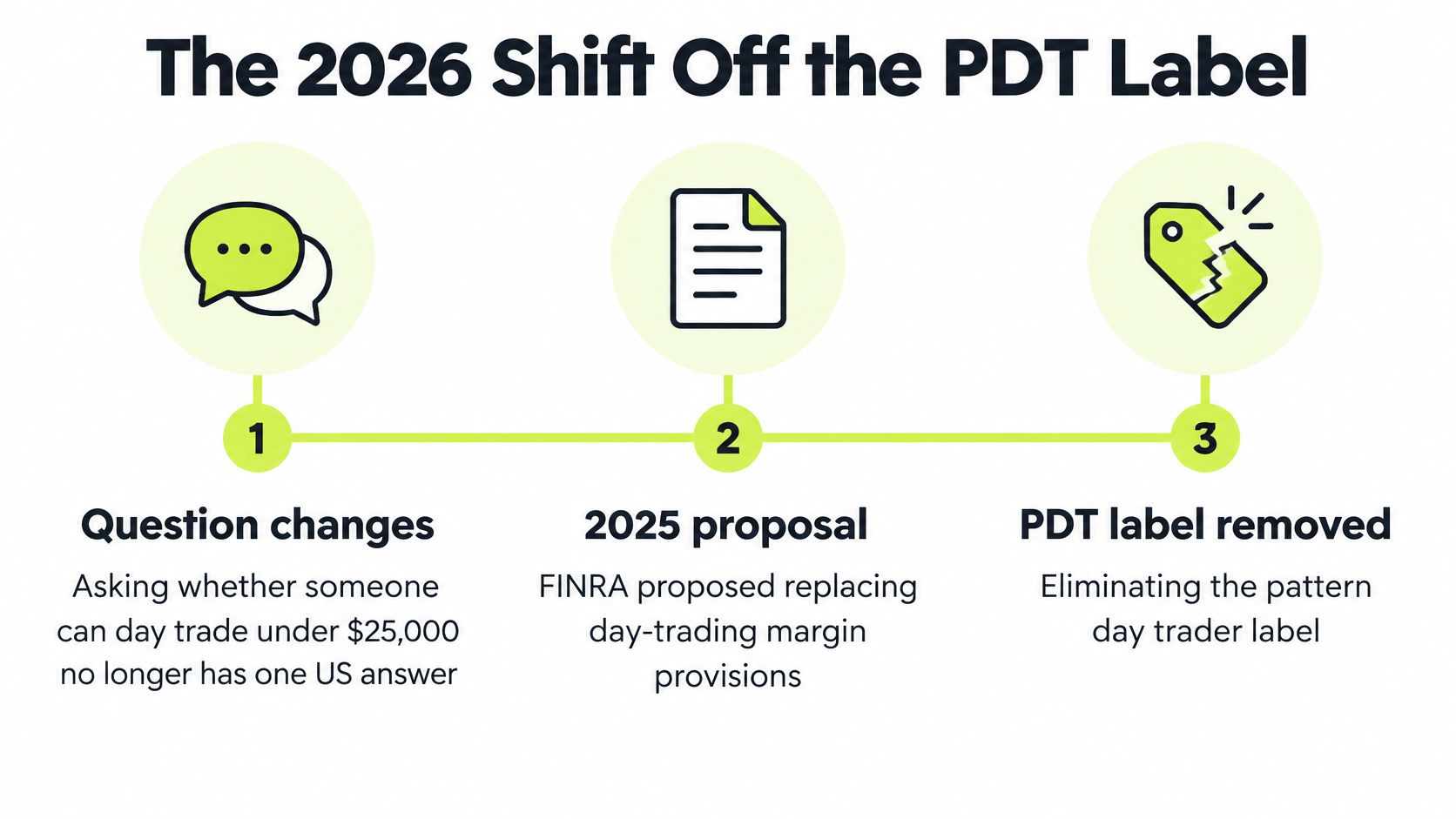
“Can I day trade with less than $25,000?” no longer has one U.S. answer. The decisive variable is the broker's implementation status, not a universal trade count.
Investor.gov's pattern day trader glossary still describes the longstanding test: at least four day trades within five business days when those trades exceeded 6 percent of total margin-account trades, then at least $25,000 in equity plus day-trading buying-power limits. FINRA's 2025 rule filing proposed replacing those day-trading margin provisions, including elimination of the pattern-day-trader designation. The adopted intraday-margin framework is scheduled to take effect June 4, 2026, and broker implementation is permitted through October 20, 2027. The new approach removes the trade-count label and the specific $25,000 requirement, and instead requires equity appropriate to actual intraday exposure.
Three dates, not one switch
Before a firm switches, the 2001 framework is still what that login enforces. The four-trade test, the 6 percent test, the equity floor, and four-times buying power all remain on that account.
June 4, 2026 is the regulatory effective date. It is not the date every customer screen changes.
October 20, 2027 is the end of the permitted implementation lag. Until a given firm flips, you cannot assume the label is gone because the calendar passed June 2026.
What changes on the morning after a notice
Two accounts at two brokers can sit on different rules on the same day. A strategy sized for the old four-times formula can be rejected after the switch, or allowed with a different cushion, because equity is now judged against the position you hold. Cash accounts stay a settlement problem. They do not pick up a pattern count just because a margin login nearby changed rules.
If you want activity that holds overnight instead of closing the same day, a swing-trading setup avoids the same-day round trip entirely. That choice does not replace the need to know which margin version the day-trading login is on.
Write the firm's rule version next to the day-trade log. On the morning after any conversion notice, re-check buying power before the first alert. Late and duplicate orders are an execution problem, handled in the pre-trade check, not by assuming the new formula will be kind.
Check Status Before the Next Round Trip
Rules fail in the gap between an alert and a flat position. FINRA's intraday margin overview frames the newer standard as risk-based: intraday equity stays proportionate to actual positions during the trading day, not to a historical trade count alone. That is why a late fill still matters after the signal has “finished.”
Run this check before any automated round trip.
- Confirm margin or cash for the account that will receive the order.
- Confirm the firm's rule version. Legacy pattern framework, or intraday margin already in force.
- On a legacy margin account, update four figures: the five-day day-trade count, the 6 percent ratio, equity against the floor, and unused buying power from the prior close.
- On a cash account, confirm the next buy uses settled funds only.
- Separate four states. An alert is not a submitted order. A submitted order is not a fill. A fill is not a flat position. A late alert, a partial fill, a reject, or an exit that does not fill can leave shares the strategy thinks are closed. Under the newer standard, that open risk still counts toward exposure.
- Do not send the order if it would designate the account, breach equity or buying power, or reuse unsettled cash. Pause new entries. Leave a valid risk-reducing exit able to work. Keep timestamps and the broker status on every attempt.
The log is the compliance record
Apply the same log outside the United States by mapping each line to that market's margin and settlement row. You remain responsible for TradingView, Robinhood, and Claude terms, including Robinhood's rules for Agentic Trading, and for any local law that applies to the trades.
We start in test mode: alerts are accepted and logged, and they are not sent to the broker until you switch to live mode. Review that log before you enable live orders. Alerts can arrive late, twice, or not at all. Markets move, and brokers reject orders. A backtest will not show a duplicate webhook or a stale buying-power figure. The log will.
Go live only after one real alert has been checked against buying power and the broker's current rule version. If that single alert does not match the row you looked up, fix the route before the next one fires.
Pineflows turns TradingView alerts into Robinhood market orders and keeps a test-mode log so you can match each alert to buying power and your broker's current day trade rules before anything goes live. Pause controls block new entries while valid exits stay available, and duplicate protection stops one alert from becoming two orders. When you are ready to run that check on a real alert, visit Pineflows.