September 26, 2026 · 13 min read · Pineflows team
Algo Trading for Retail Traders: A Practical Guide
Learn algo trading for retail traders with actionable strategies. Master backtesting, execution plumbing, risk controls, and automation tools like Pineflows.
Retail use of AI and algorithmic tools rose from 13% in 2025 to 19% in 2026, a 46% year-over-year increase. That growth makes one weakness impossible to ignore: many traders learn how to generate signals, but far fewer learn how to keep those signals reliable after they leave the backtest and reach a live broker.
You may be in that position now. Your Pine Script strategy looks clean in TradingView, the equity curve climbs, and the rules seem objective. Then a live alert arrives during a fast move. The order fills at a worse price, the connection times out, and a retry sends the same entry twice. The strategy didn't necessarily fail. The execution pipeline did.
Table of Contents
- The Algorithmic Trading Revolution You Are Missing
- Why Backtests Fail in Live Markets
- Building Your Automation Pipeline
- Risk Controls That Actually Protect Capital
- DIY Automation vs Purpose-Built Tools
- Your First Month Roadmap
- Common Misconceptions About Retail Algo Trading
- Your Execution Readiness Checklist
The Algorithmic Trading Revolution You Are Missing
Retail automation has moved beyond experimentation. The global retail investors' algorithmic trading market was valued at US$3,552.8 million in 2024 and is projected to reach US$7,175.2 million by 2030, implying a 12.7% CAGR from 2025 to 2030, according to Grand View Research's retail investor market outlook. The broader shift matters because broker APIs, TradingView alerts, and hosted execution tools have made rule-based trading available without an institutional technology stack.
The uncomfortable part is that accessibility has advanced faster than education. Beginner guides tend to focus on indicators, entries, and optimization. They spend less time on what happens when an alert is delayed, a webhook is retried, a broker rejects an order, or an exit arrives while the account state is stale.

The backtest looked better than the live account
Consider a common sequence. A trader builds a mean-reversion system, tests it against historical candles, and sees an attractive upward curve. The historical engine assumes signals arrive in order, orders fill according to simplified rules, and the account remains reachable whenever an action is required.
Live markets remove those assumptions. A price can move through the intended entry before the broker accepts the order. A limit order can remain unfilled while the strategy believes it participated. A network retry can repeat an instruction. If the system doesn't reconcile its own state with the broker's state, one missed message can affect every later decision.
Research on retail automation specifically identifies overfitting, under-modeled slippage and commissions, API outages, and connectivity loss as causes of live-trading failure, as discussed in this neutral overview of day-trading automation risks. These aren't exotic edge cases. They're ordinary operating conditions that a backtest can't reproduce unless you deliberately model them.
Practical rule: Treat the strategy and the execution pipeline as separate systems. A strong signal can't compensate for unreliable order handling.
Change the definition of success
The useful question isn't, “How attractive is the backtest?” It's, “Can the system prove what happened to every alert, order, fill, cancellation, and exit?”
For algo trading for retail traders, a solid setup should:
- Preserve signal intent: The live alert should represent the strategy logic that was tested, without hidden manual reinterpretation.
- Control state changes: The system should know whether a position exists, whether an entry is pending, and whether an exit remains active.
- Prevent repetition: A retried message shouldn't create a second position.
- Stop new risk safely: A pause mechanism should prevent fresh entries without disabling valid exits.
- Create evidence: Logs and payloads should make post-trade investigation possible.
Automation removes hesitation from execution, but it doesn't remove responsibility. It executes the assumptions you encoded, including the assumptions you forgot to test.
Why Backtests Fail in Live Markets
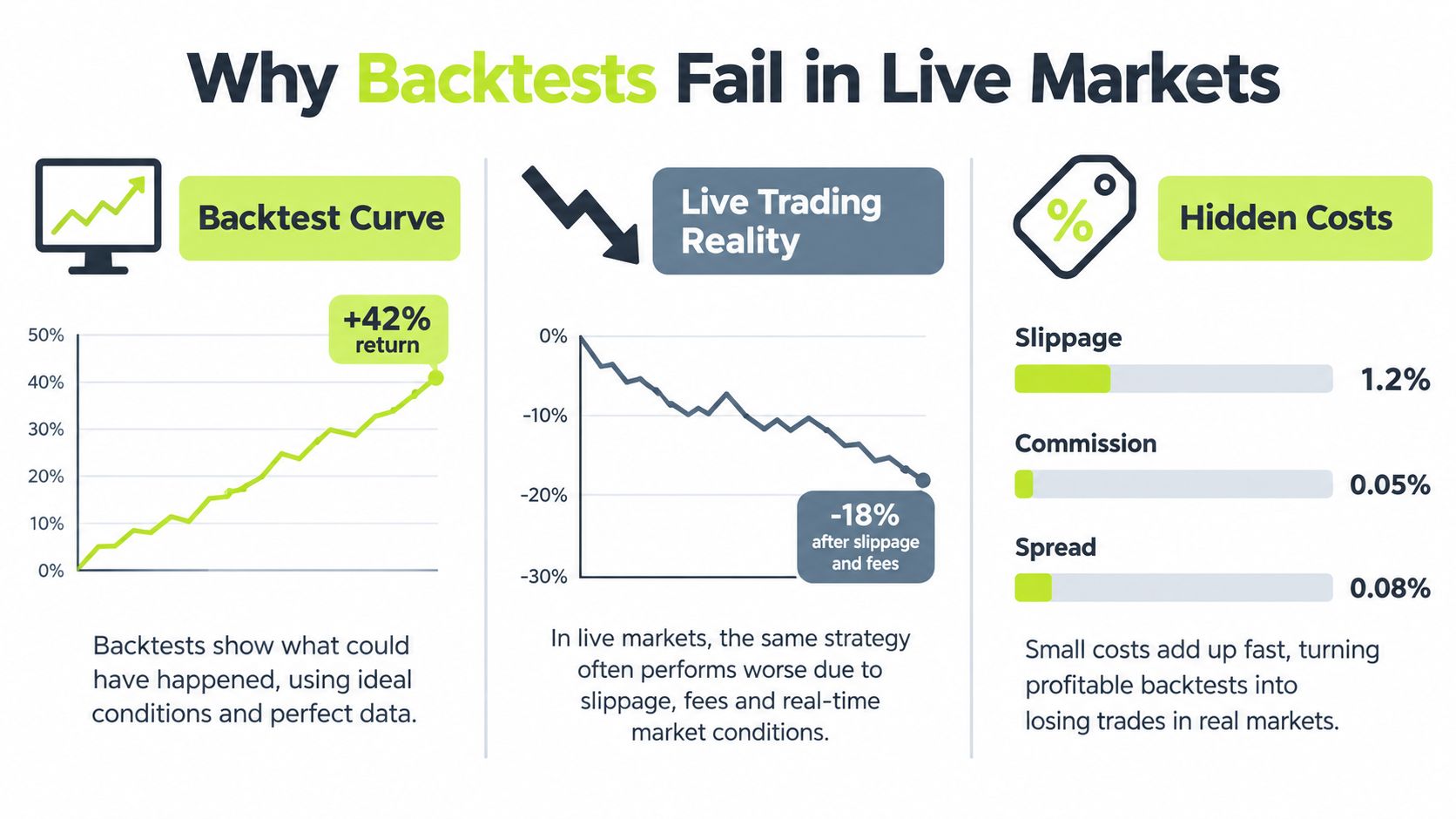
Backtests usually describe signal quality. Live trading also tests market access, timing, order semantics, and operational resilience. Those are different tests.
For a retail broker-routed system, execution commonly occurs in the tens to hundreds of milliseconds, and the important question is whether the gross edge survives spread, slippage, and commissions, as explained in LuxAlgo's discussion of latency standards in trading systems. If the expected advantage is only a few ticks, a modestly worse fill can remove it. Chasing microsecond performance usually misses the more relevant work, which is realistic cost modeling and better order selection.
Four sources of divergence
Historical fills are cleaner than live fills. A bar-based test may mark an order as filled because price touched a level. In the market, the order may sit behind other orders, encounter a changing spread, or miss the level entirely.
Costs accumulate at the trade level. Spread and slippage apply even when the direction is correct. A system can identify the right move and still lose money if the entry and exit costs consume the expected edge.
Cancellation behavior changes the strategy. Market-structure research found that algorithmic traders reduced bid-ask spreads by 0.28 basis points relative to retail traders, while institutional traders reduced them by 0.43 basis points. The same study found higher cancellation rates among algorithmic traders, which means apparent liquidity doesn't guarantee a completed fill. The findings are detailed in the empirical market-structure study published by Springer.
The account state can become stale. A signal may be generated while an earlier order is still pending. Without state checks, the next instruction can assume an empty account and submit another entry.
Model the path, not just the price
Before going live, separate your analysis into three layers:
| Layer | Question to answer |
|---|---|
| Signal | Would the rule have generated an alert at this point? |
| Order | What order type would have been submitted, and under what conditions could it fail to fill? |
| Account | What happens if the order is delayed, rejected, duplicated, partially filled, or canceled? |
The video below offers additional context on the difference between strategy testing and real execution.
A realistic review should compare expected and observed slippage, inspect rejected or delayed orders, and record whether exits remained available during interruptions. Don't assume every quote becomes a fill. Treat fill quality as an outcome that must be measured.
Building Your Automation Pipeline
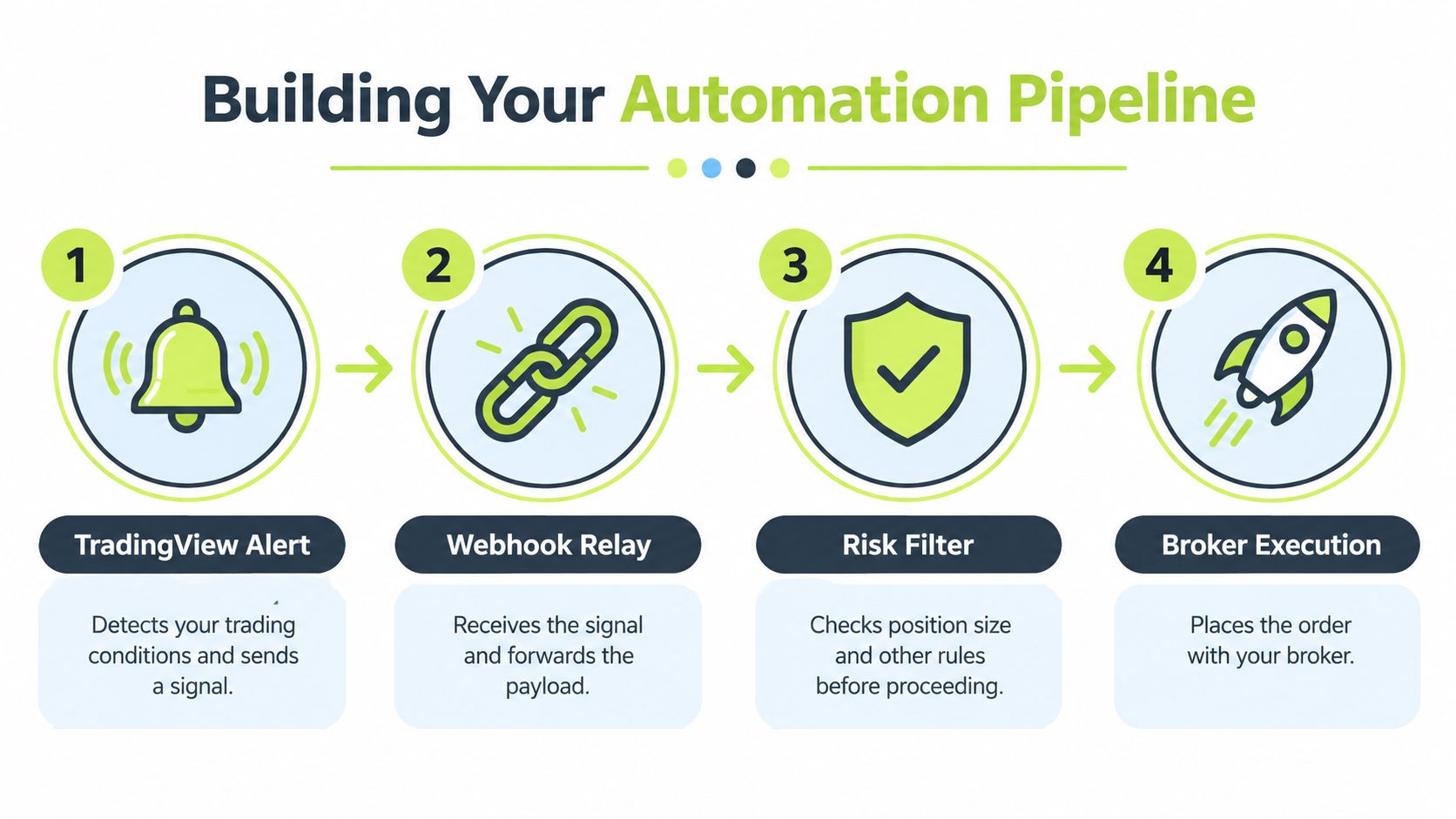
A retail automation pipeline normally has four jobs: receive the TradingView alert, pass its payload through a controlled relay, apply risk and duplication checks, and submit the order to the broker. The fewer unnecessary adapters between those stages, the easier the system is to inspect and troubleshoot.
Start with the signal source
Keep the strategy logic unchanged while you establish the connection. Most scripts need no edits beyond routing an alert to the supplied webhook, which reduces the risk of accidentally changing the tested rules during deployment.
TradingView webhook delivery requires a paid TradingView plan with two-factor authentication enabled. The alert should carry enough information for the receiving system to identify the instrument, action, position size, and unique event. A vague message creates ambiguity at the exact point where automation needs precision.
Use Pine Script automation documentation as a reference for the alert-to-order setup, but validate the actual payload your strategy produces. Don't rely on what you intended the script to send.
Verify before transmitting
A test-first workflow is safer than switching directly from backtest to live orders. Enable a mode that records incoming alerts without transmitting them to the broker, then send a real alert from the strategy. Inspect the received payload, timestamp, event identifier, interpreted action, and resulting status.
The setup is intended to finish in four guided steps in one sitting, with the first real alert verifying the flow. Strategy logic remains as backtested, and most scripts require no edits beyond routing an alert to the provided webhook. That first alert should be treated as an operational test, not as proof that the strategy is profitable.
Make duplicate prevention explicit
Every alert needs a unique event ID. If delivery is retried or messages arrive out of order, the system should recognize that the event was already processed and refuse to submit a second order.
A useful pipeline also exposes each conversion point:
- TradingView alert: The strategy generates a defined event.
- Webhook relay: The system receives and records the payload.
- Risk filter: The event passes position and account checks.
- Broker execution: The order is submitted and its status is confirmed.
The benefit isn't only convenience. It gives you a chain of evidence when live behavior differs from the chart.
Risk Controls That Actually Protect Capital
Risk controls should change system behavior, not merely describe good intentions. A live pipeline needs safeguards that work while alerts are arriving and orders are changing state.
Pause new risk, preserve existing protection
The most useful pause control is asymmetric. It blocks new entries and cancels pending entry orders created by the automation, while keeping valid exit orders available for existing positions.
That distinction matters during uncertainty. If the broker connection behaves strangely or the strategy produces unexpected alerts, you want to stop adding exposure without removing the instructions that can reduce exposure. A global off switch that cancels everything may leave an open position unmanaged.
Deduplicate every event
A repeated alert isn't necessarily a new trading decision. It may be a network retry, a delayed message, or a duplicate generated by the source platform.
Per-alert event IDs provide an idempotent control. The system records the identifier before or during processing, then rejects a later copy of the same event. This protects against duplicate entries and also makes out-of-order delivery easier to investigate.
A retry should be safe by design. If the same message can create a second position, the pipeline is treating transport noise as trading intent.
Preserve an audit trail
A useful audit trail includes the incoming payload, event ID, processing status, order request, broker response, and fill details. Human-readable records let you answer whether the signal arrived, whether it passed the risk filter, and whether the broker accepted the instruction.
Credential handling belongs in the same safety model. One-click Google sign-in can avoid storing broker passwords in the automation service, while a connector that interprets Pine Script can reduce manual parameter transcription. Neither feature replaces review, but both reduce avoidable configuration mistakes.
The strongest setup uses layers:
- Pause control limits fresh exposure.
- Event deduplication prevents repeated instructions.
- Payload inspection exposes what the system interpreted.
- Status checks distinguish submission from execution.
- Logs support post-trade review and incident handling.
No single control is sufficient. Reliability comes from making each failure mode harder to turn into a live position.
DIY Automation vs Purpose-Built Tools
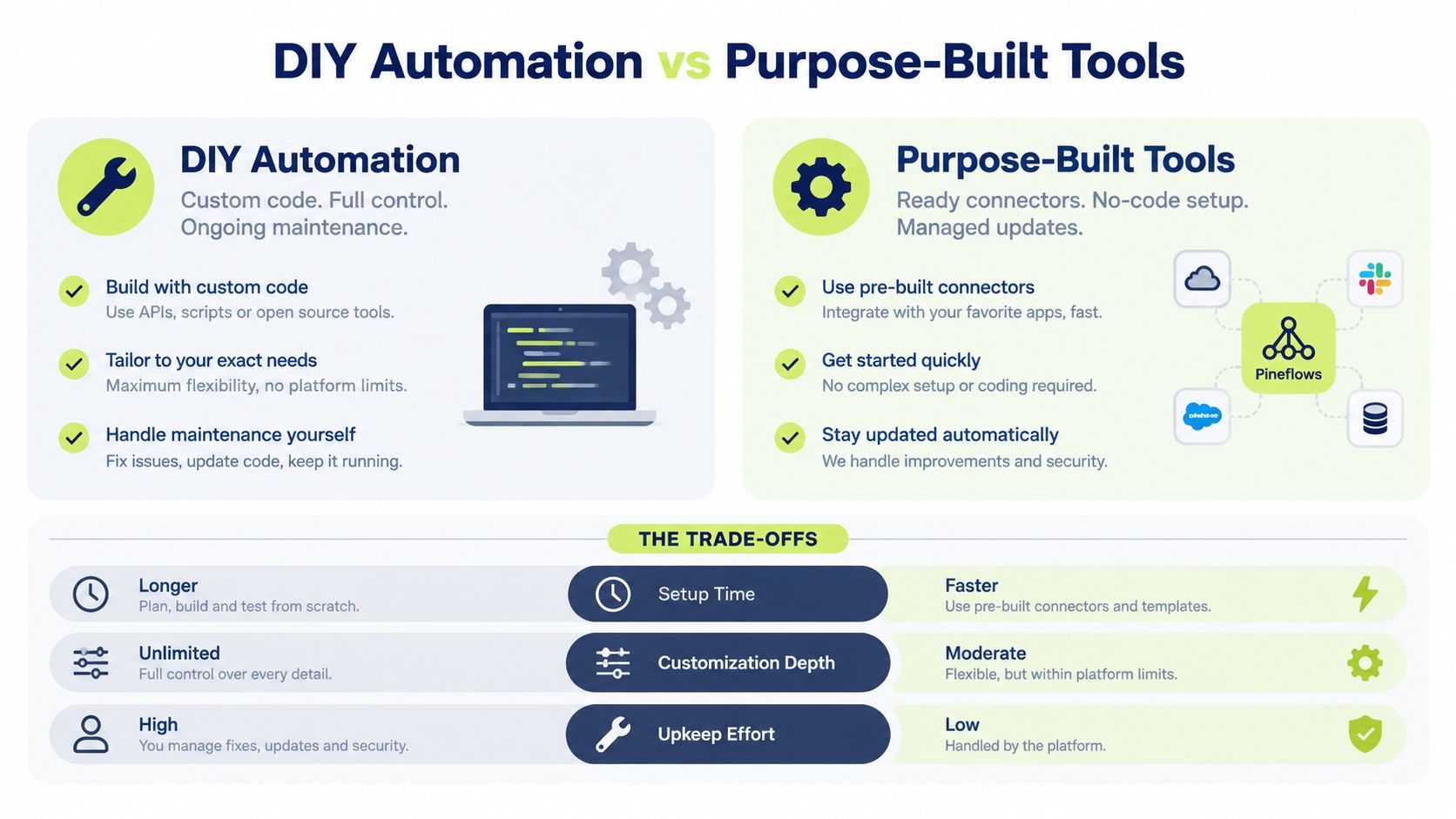
Building your own bridge gives you control, but control includes every maintenance obligation. You must secure authentication, handle broker API changes, manage rate limits, reconcile account state, capture errors, and decide what happens when a request times out.
A focused tool narrows the problem. It may support fewer brokers or order workflows, but it can concentrate on a defined path from TradingView alerts to broker execution. For a retail trader, that trade-off often favors reliability over theoretical flexibility.
Compare the real workload
| Decision factor | DIY bridge | Purpose-built pipeline |
|---|---|---|
| Setup | You assemble the webhook, broker connection, state logic, and logs | The main components are already connected |
| Customization | Broad, provided you can build and maintain it | Narrower, but easier to validate |
| Failure handling | You define retries, reconciliation, and duplicate rules | Safeguards may be included in the workflow |
| Maintenance | You own broker changes, bugs, hosting, and monitoring | The service maintains its supported integration |
| Auditability | You must design the records and inspection tools | Logs and status views may be part of the product |
A custom Python bridge can make sense when you need unusual instruments, portfolio logic, bespoke data, or a broker that isn't supported by a managed connector. It also makes sense when you already have the engineering discipline to test failure paths rather than only successful trades.
For a trader whose priority is dependable TradingView-to-Robinhood execution, a focused route removes adapter complexity. The Robinhood connection documentation illustrates the kind of broker-specific setup that a managed workflow can standardize.
Choose based on your actual constraint
DIY is not automatically more professional. It can produce a precisely adapted system, but every extra component creates another place where an alert can be lost, repeated, or misinterpreted.
Purpose-built tools aren't automatically safer either. You still need to understand order types, account permissions, risk sizing, and broker behavior. The practical choice is simple: build when customization is essential and you can maintain the full system, or use a focused pipeline when your main requirement is a transparent, testable execution path.
Your First Month Roadmap
A first month should build evidence gradually. The objective isn't to reach live trading quickly. It's to learn whether the complete chain behaves predictably under controlled conditions.
Week one, prove delivery without capital
Keep test mode enabled. Send alerts from the actual TradingView strategy and inspect whether each payload contains the expected action, instrument, quantity, and event ID. Record missing alerts, malformed messages, and any delay that changes the intended order.
Don't optimize the strategy during this stage. Changing signal logic while testing delivery makes it difficult to identify whether a later problem came from the strategy or the pipeline.
Week two, use deliberately small exposure
Move to live execution only after the alert path is understandable. Use conservative position sizing and keep the pause control accessible. The first live alert should be treated as a verification checkpoint, not an opportunity to maximize returns.
Check whether broker confirmations match the system's interpretation. A submitted order isn't the same as a filled order, and a filled entry should have a corresponding exit path.
Weeks three and four, review behavior
Review every event and compare actual fills with backtest assumptions. Track the operational measures that matter:
- Alert-to-order conversion: Did valid alerts produce the intended order requests?
- Duplicate prevention: Did repeated or retried events remain single events?
- Observed slippage: How did live fills compare with modeled execution costs?
- Pause usage: Did the control behave as expected when new entries were blocked?
By the end of the month, you should be able to reconstruct any trade from signal to execution confirmation. If you can't, reduce exposure and fix the evidence gap before adding complexity.
Common Misconceptions About Retail Algo Trading
A better backtest guarantees a better live result. It doesn't. Overfitting and unrealistic assumptions about costs can produce a beautiful historical curve that has little resilience. Coverage of retail automation failure modes highlights how overfitting, under-modeled slippage and commissions, outages, and connectivity failures can turn a promising system into a live liability.
Automation removes emotional risk. It removes some hesitation, but it can also execute a bad decision faster and more consistently. Without pause controls, size limits, and status checks, automation turns a mistake into a repeated process.
You need advanced programming skills. Coding knowledge helps when you need custom logic, but alert-based systems can reduce the amount of infrastructure a retail trader must build. Tools that interpret Pine Script can also reduce manual configuration, although the trader still needs to verify the resulting parameters.
Latency is always the main cost. For retail systems, spread and slippage often matter more than raw speed. A broker-routed system working in the tens to hundreds of milliseconds can be suitable for strategies whose edge survives realistic costs. The wrong order type or an unfilled limit order can matter more than shaving time from the connection.
Automated trading is passive. It isn't. Markets change, brokers update behavior, and software can fail. Monitoring execution health is part of the strategy, just as reviewing drawdown and signal quality is.
The more useful definition of success is operational: reliable execution, enforced risk controls, and documented improvement. Backtest returns remain relevant, but they shouldn't be the only standard.
Your Execution Readiness Checklist
Before enabling live orders, verify each item with an actual test:
- Webhook delivery: Send a test alert and confirm that the complete payload is received.
- Test mode: Confirm that test alerts are logged without reaching the broker.
- Pause behavior: Activate the pause and verify that new entries stop while valid exits remain available.
- Event IDs: Review a logged event and confirm that a repeated ID cannot create another order.
- Payload inspection: Check the interpreted action, instrument, quantity, and timestamp.
- Credential safety: Confirm that broker passwords and reusable tokens aren't stored in the automation workflow.
- Risk parameters: Define position sizing and loss boundaries before live activation.
- Status evidence: Confirm that submission, broker acceptance, and fill status are distinguishable.
Use the webhook documentation when checking the delivery path, then repeat the checklist after strategy changes, platform updates, or broker changes. Execution readiness isn't a one-time approval. It's an operating discipline.
Automation amplifies both sound process and careless assumptions. Your safeguards decide which one reaches the broker.
Pineflows turns TradingView alerts from Pine Script strategies into executable Robinhood orders through a test-first pipeline with webhook delivery, duplicate-event protection, pause controls, status checks, and audit-friendly payload visibility. Visit Pineflows to review the workflow and see whether it fits your approach to reliable retail algo trading.