October 6, 2026 · 16 min read · Pineflows team
7 Stock Trading Signals Software Picks for 2026
Compare 7 stock trading signals software platforms for scanners, alerts, backtesting, automation, and execution workflows in 2026.
The strongest stock trading signals software isn't necessarily the platform that produces the most alerts. An alert is only a proposal. Before it becomes a trade, the system must deliver it, interpret it, validate it, prevent duplicates, route it to the right broker, and record what happened. A backtest can describe historical behavior, but it can't prove that a strategy will retain an edge after out-of-sample testing, changing market conditions, and transaction costs. A 2023 study of thousands of technical-trading rules found that recently successful rules generally failed to remain successful in future out-of-sample periods, while transaction costs caused technical-trading portfolios to underperform buy-and-hold portfolios most of the time. The study's findings make the comparison standard clear.
This list evaluates seven platforms across the complete signal-to-execution pipeline, including discovery, delivery, testing, automation, broker connectivity, and auditability. The selection includes scanners, rule-building platforms, prescriptive rating systems, and Pineflows, an execution bridge for TradingView alerts and Robinhood orders. These tools can support research and workflow automation, but none should be treated as a promise of trading results.
Table of Contents
- 1. Connect TradingView alerts to Robinhood with Pineflows
- 2. Trade Ideas
- 3. TrendSpider
- 4. VectorVest
- 5. FINVIZ Elite
- 6. Scanz
- 7. TC2000
- Top 7 Stock Trading Signals Comparison
- Match the Signal Layer to the Execution Layer
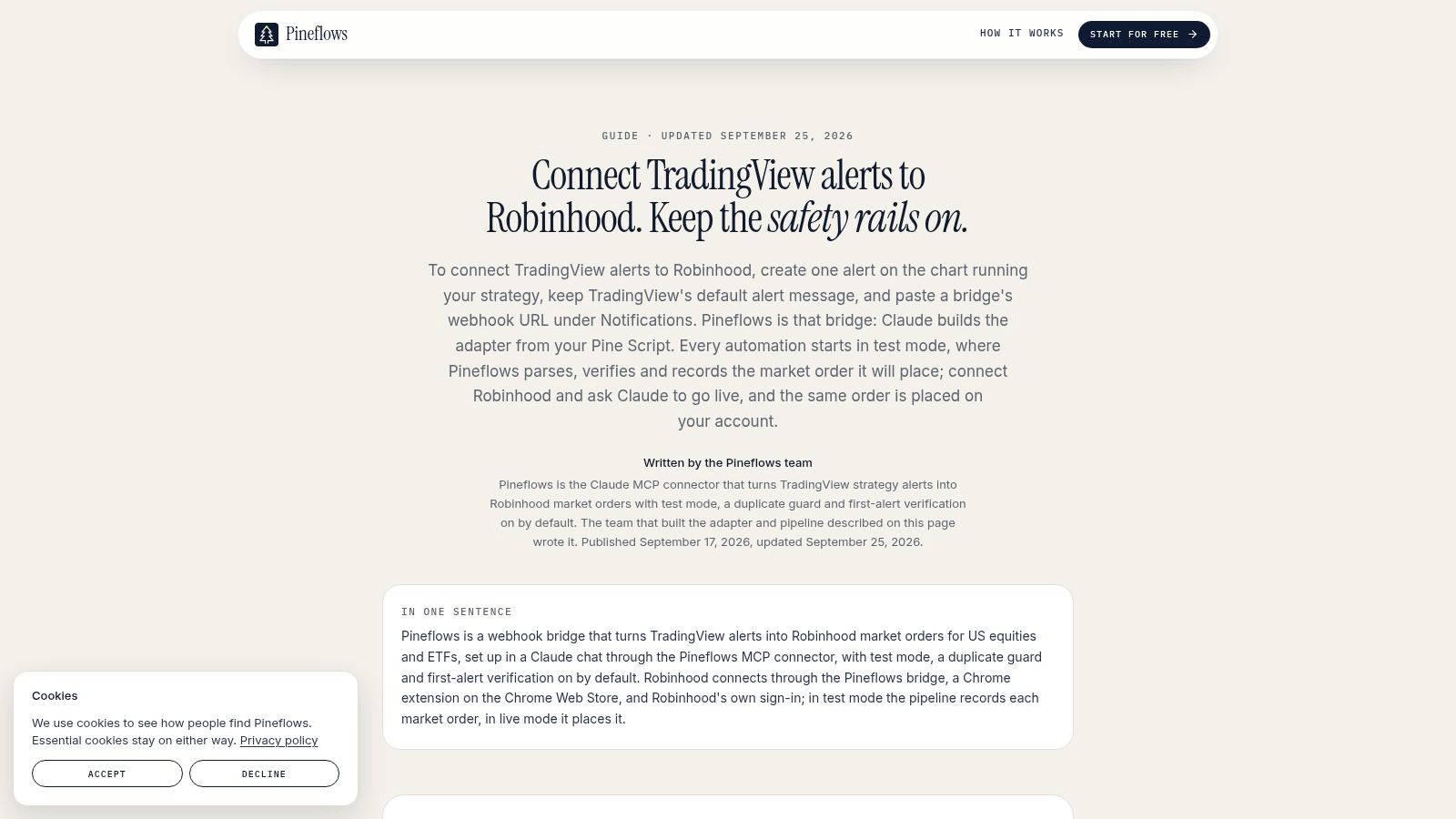
1. Connect TradingView alerts to Robinhood with Pineflows
Pineflows is the most execution-focused option in this list. It doesn't try to replace TradingView as a charting or strategy environment. Instead, it addresses the operational gap between a Pine Script alert and a Robinhood order.
A trader configures a TradingView webhook, and Pineflows interprets the alert before submitting the corresponding order to Robinhood. Its Claude connector can read Pine Script and propose parameters for entries, exits, instruments, position sizing, and routing. That makes the bridge particularly useful for traders who already have a tested TradingView strategy but don't want to build or maintain a custom adapter.
The important distinction is that Pineflows treats delivery as an auditable workflow rather than a simple webhook handoff. Incoming alerts can be logged in test mode before live trading is enabled. Each event includes a human-readable payload, delivery receipts, timestamps, status checks, fill details, and an event ID designed to prevent the same alert from creating duplicate exposure.
Why execution evidence matters
Execution reliability isn't signal accuracy. A technically correct alert may arrive late, be delivered more than once, arrive out of order, or reach the system while the broker is unavailable. IOSCO identifies timing and pricing risk, operational failures, technical glitches, and cyber incidents as possible sources of harm in automated or imitative trading systems. Its report on automated and imitative trading risks supports a practical conclusion: a workflow needs failure states and human override, not only automation.
Pineflows includes a global pause control, logged events, payload inspection, and idempotent event handling. The pause control blocks new entries and cancels Pineflows-originated entry orders while keeping valid exits available for risk handling. Those controls don't improve a strategy's predictive power, but they make it easier to determine whether an alert became an order, whether it filled, and whether a duplicate was blocked.
The trade-off is scope. Pineflows is designed specifically for TradingView strategies routed to Robinhood, with a focus on US equities and ETFs. Traders using another broker or asset class will need a different execution layer. The workflow also depends on a paid TradingView plan with two-factor authentication and reliable webhook delivery. For users who want observable TradingView-to-Robinhood automation rather than another signal feed, that narrow scope is a feature. For multi-broker users, it's a limitation.
For practical guidance on the webhook side, see how TradingView webhooks work. Pineflows is best for traders who value test-first deployment, pause controls, duplicate protection, and an evidence trail around every order.
2. Trade Ideas
Trade Ideas is built for traders who want real-time opportunity discovery rather than a simple end-of-day stock list. Its core workflow combines streaming market data, a large alert and filter library, AI-assisted signals through Holly, backtesting through OddsMaker, paper trading, and in-app order routing through Brokerage Plus.
That combination gives it a stronger discovery-to-simulation path than a lightweight screener. A trader can use real-time alerts to find momentum, reversal, or event-driven setups, then examine how a strategy behaved historically or test the workflow in a paper environment before routing orders through a supported brokerage connection.
Strong discovery, heavier operating burden
Trade Ideas is particularly suited to intraday traders who need alerts while the market is moving. The platform's value isn't just that it identifies candidates. It provides a context-rich environment in which users can filter opportunities, inspect strategy behavior, and decide whether a signal belongs in a repeatable process.
Holly can surface curated strategy ideas with associated risk levels, but users still need to understand what produced an alert and how it translates into an order. AI-generated or curated signals shouldn't be confused with validated live-market edge. Historical technical-signal research has repeatedly found mixed results across eras and asset classes, with reported profitability vulnerable to data snooping, rule selection, and transaction-cost assumptions. The 2007 review of technical analysis research is a useful reason to inspect the underlying rules rather than judge a tool by its alert count.
Practical rule: Treat an alert as a research input until you've verified its rule, timing, intended instrument, position size, and execution result.
The platform's main weakness is complexity. New users may find its interface dense because the product exposes many real-time tools at once. It also sits toward the higher-cost end of the screener market, although no price comparison should be treated as a performance comparison. Brokerage Plus creates a more connected path to execution than a scanner that only sends notifications, but users should still verify supported brokers, order states, rejected orders, and fill records.
Trade Ideas is the strongest fit here for fast intraday discovery with a serious simulation workflow. It isn't the best choice for someone whose primary need is a narrowly scoped TradingView-to-broker bridge. Readers comparing the broader automation category can also review automated stock trading software workflows.
3. TrendSpider
TrendSpider occupies the middle ground between visual technical analysis and systematic automation. It helps traders turn chart-based ideas into scanners, alerts, backtests, scheduled scans, and conditional trading bots without requiring a fully custom development environment.
Its multi-timeframe scanning is useful when a setup depends on conditions across different chart intervals. Automated pattern detection, anchored VWAP, and Raindrop charts support visual investigation, while the strategy tester lets users examine whether a rule behaves consistently across historical data. Webhook alerts and scheduled scans extend the workflow beyond the application itself.
A useful bridge from idea to rule
TrendSpider's main advantage is translation. Many traders begin with a discretionary observation, such as a breakout after consolidation or a moving-average relationship across timeframes. The platform gives them tools to express that observation as conditions that can be scanned and alerted.
That doesn't mean the platform removes interpretation. A strategy still needs explicit assumptions about entries, exits, position sizing, market hours, slippage, and what happens when multiple alerts arrive close together. Backtest results also need out-of-sample scrutiny. The stock-trading-signals literature shows why a rule that looks strong in the period used to discover it may not remain strong in later data.
The product's Trading Bots and webhook features make it more automation-ready than a charting tool that only displays signals. However, broker routing options are less extensive than those of broker-native platforms, and intraday backtesting or deeper data access can vary by plan. Users should therefore distinguish three separate questions:
- Signal construction: Can the platform express the rule accurately?
- Signal delivery: Can it send the alert at the required time and with a complete payload?
- Order execution: Does another system validate and route the event reliably?
TrendSpider answers the first two well for many rule-based workflows. The third may require an external broker connector or execution service. Its AI Sidekick can assist with analysis, but AI assistance doesn't replace a reproducible rule definition or an audit record.
TrendSpider is a good fit for swing and intraday traders who want to convert visual ideas into systematic alerts. It suits users who need more automation scaffolding than FINVIZ Elite, but don't necessarily need the real-time specialist environment of Trade Ideas or Scanz.
4. VectorVest
VectorVest takes a more prescriptive approach than the other platforms. Rather than asking users to assemble every condition themselves, it rates stocks with daily Buy, Sell, or Hold guidance based on its proprietary Value, Safety, and Timing measures.
That design reduces the number of decisions a new user must make. Watchlists and alerts can be connected to trading plans, while AutoTimer and WatchDog support a more structured process around market timing and technical price conditions. The platform also provides education and live coaching as part of its subscription experience, which may help users who want guidance alongside the software.
Clarity comes at the expense of transparency
VectorVest's strength is decisiveness. A trader who doesn't want to build a custom scanner or write formulas can receive a defined rating framework and use it to organize candidates. Its coverage extends across US, Canadian, Australian, and European markets, although real-time data access depends on the relevant market and subscription tier.
The trade-off is that the methodology is proprietary. Users can follow the ratings, but they have less direct control over the construction of the signal than they would with a platform such as TrendSpider or TC2000. That matters for anyone who wants to reproduce a backtest, alter a condition, or compare a signal's historical behavior with live execution.
A rating also isn't an order instruction. Even when a platform gives a clear Buy or Sell indication, the user still has to decide the instrument, size, order type, timing, and exit behavior. A signal-centric interface can make that final step feel simpler than it is.
A prescriptive rating reduces guesswork, but it doesn't remove the need to document how a rating became a position.
VectorVest is best for swing and position traders who prefer rules-based guidance, watchlist alerts, and onboarding support over DIY signal engineering. It isn't the natural choice for a trader who needs Pine Script compatibility, granular webhook payloads, or broker-level event reconciliation. Its value is concentrated in the signal layer and decision framework, not in a universal execution pipeline.
5. FINVIZ Elite
FINVIZ Elite is the lightweight choice in this comparison. It focuses on fast screening, real-time quotes, intraday charts, auto-refreshing views, premarket and after-hours information, and alerts across price, screeners, portfolios, and calendars.
The platform is easy to understand because it doesn't try to become a complete automated trading workstation. A trader can define filters, refresh the screen, inspect a chart, and export results for a separate workflow. That makes it effective for daily signal triage, especially when the objective is to narrow a large universe into a manageable watchlist.
Efficient discovery without a full execution layer
FINVIZ Elite's advantage is speed of use, not deep strategy automation. Its filters can help traders identify price, volume, valuation, technical, and ETF-related conditions, while CSV or Excel export supports custom analysis outside the platform. Real-time quotes and intraday charts make the product more useful for active monitoring than a delayed basic screener.
The limitation is equally clear. FINVIZ Elite doesn't provide the same strategy backtesting environment as TrendSpider or Trade Ideas, and its broker integrations are limited. A user who wants to move from a screen result to a verified broker order must create that additional process manually or through another tool.
That separation can be healthy if the trader understands it. Discovery software doesn't need to pretend that it validates a strategy or confirms a fill. The user can inspect the screen, document the setup, and make an independent execution decision. But the separation becomes risky when someone assumes that an alert or exported list proves that an order was placed.
FINVIZ Elite is a strong fit for traders who value quick, low-overhead screening and don't need embedded order routing. It works particularly well as the discovery layer in a broader process. It isn't the right pick for users seeking automated conversion of signals into broker orders or detailed event-level auditability.
6. Scanz
Scanz is designed around real-time intraday discovery. Its scanning environment covers momentum, breakouts, gaps, VWAP conditions, news, SEC filings, Level 2, and time-and-sales data. That makes it a specialist tool for traders who depend on market movement, order-book information, and news-driven changes rather than slower portfolio research.
The platform's desktop, web, and mobile access support saved scans and watchlists across different environments. Premarket and after-hours scanning are central to the workflow, which is useful for traders who identify candidates before the regular session or monitor developments after it.
The specialist scanner trade-off
Scanz is strongest when the trader already knows what an actionable intraday setup looks like. A deep filter set can reduce manual searching, and real-time news and filing scanners can bring information into the same decision environment as price and tape data. That can be more practical for a momentum trader than a general-purpose screener with broad but shallow coverage.
The product doesn't automatically solve the transition from idea to order. Broker integrations are limited or described as in development, so the user may still need a separate execution layer. This distinction matters because a fast scanner can produce a timely opportunity without proving that a later manual order reached the broker at the intended price.
Scanz's higher professional tiers are materially more expensive than many web-first tools, making it a poor fit for users who only need occasional screening. Its value depends on whether real-time intraday data, news, and tape analysis are central to the trader's process.
Execution question: After Scanz identifies a setup, can you record the alert time, order-submission time, broker acknowledgment, and fill time?
Scanz is the strongest choice in this list for traders who prioritize real-time momentum, gap, news, and order-book discovery. It should be paired with explicit manual or automated execution controls rather than treated as a complete signal-to-order system.
7. TC2000
TC2000 is a long-established US-equities platform that combines charting, watchlists, real-time screening, alerts, and custom formula logic through its Personal Criteria Formulas. EasyScan lets traders sort and scan conditions in real time, while PCF gives experienced users more control over how a setup is defined.
That flexibility makes TC2000 useful for traders who want to codify a repeatable idea without building an external application. A moving-average relationship, price condition, volume event, or multi-condition watchlist rule can become a dynamic signal rather than a chart the trader has to inspect manually.
Flexible signal logic with a contained ecosystem
TC2000 supports premarket and post-market modes, news through MT Newswires, desktop, web, and mobile access, and paper trading. Users can also route trades through TC2000 Brokerage, giving the platform a closer relationship between screening and execution than FINVIZ Elite.
Still, the workflow is mainly focused on US equities. Traders who need broad multi-asset coverage or a large selection of external brokers may find the ecosystem restrictive. Some users may also find parts of the interface dated compared with newer web-first products, although mature charting and scan workflows remain valuable when they match the user's needs.
The important comparison is between flexibility and transparency. PCF provides more direct control than a proprietary rating system, but the user still needs to document how the formula behaves in historical and live conditions. A signal's logic should be preserved alongside its timestamp, instrument, intended size, order status, and fill details.
For traders comparing the final step in this process, trade execution software considerations help clarify why screening and routing should be evaluated separately. TC2000 is a strong fit for traders who want powerful US-equity signal construction, efficient chart-to-watchlist workflows, and optional paper or live trading through its affiliated brokerage. It is less suitable for users who want TradingView webhook compatibility or broad broker neutrality.
Top 7 Stock Trading Signals Comparison
| Tool | 🔄 Implementation complexity | ⚡ Resource requirements | 📊 Expected outcomes / Quality (⭐) | 💡 Ideal use cases | Key advantages |
|---|---|---|---|---|---|
| Connect TradingView alerts to Robinhood | 🔄 Low, guided one‑sitting setup with AI connector | ⚡ Low dev effort; requires TradingView paid plan + Pineflows Pilot; Robinhood account | 📊 Verifiable live orders, low latency, auditable execution, ⭐⭐⭐⭐ | 💡 Traders on Robinhood wanting fast TradingView-to-broker automation for US equities/ETFs | True automation with safety defaults; audit logs; Pine Script parsing via Claude; quick one‑click sign‑in |
| Trade Ideas | 🔄 Medium‑High, feature-rich UI, steeper learning curve | ⚡ High, subscription cost, streaming data, Brokerage Plus for routing | 📊 Fast, statistically framed intraday signals with backtest support, ⭐⭐⭐⭐ | 💡 Active day traders seeking AI signal discovery, intraday scanning and simulated routing | AI engine (Holly), very fast scanners, OddsMaker backtesting, robust paper trading |
| TrendSpider | 🔄 Medium, visual rule-building, trading bots and scans | ⚡ Moderate, subscription tiers affect data/backtest depth and webhook bots | 📊 Strong TA automation and repeatable rule-based signals, ⭐⭐⭐⭐ | 💡 Swing/intraday traders converting discretionary ideas into systematic alerts | Multi‑timeframe scans, automated pattern detection, trading bots, visual strategy tools |
| VectorVest | 🔄 Low, prescriptive, signal-first workflow (less DIY) | ⚡ Moderate, subscription, coaching; multi‑market data on higher tiers | 📊 Clear daily ratings and market timing guidance, ⭐⭐⭐ | 💡 Swing/position traders wanting prescriptive buy/sell/timing signals with education | Daily Value/Safety/Timing ratings, AutoTimer plans, built‑in coaching and onboarding |
| FINVIZ Elite | 🔄 Low, minimal setup, quick to learn | ⚡ Low, affordable web subscription, lightweight data needs | 📊 Efficient screener and alert discovery, limited backtesting, ⭐⭐⭐ | 💡 Traders needing fast signal triage, unlimited alerts and CSV export for workflows | Fast, intuitive screener; real‑time quotes; unlimited alerts; data export |
| Scanz | 🔄 Medium‑High, advanced tape/Level 2 workflows | ⚡ High, pricier tiers for Level 2, time & sales and real‑time news | 📊 Excellent intraday/tape-driven signals with pre/post coverage, ⭐⭐⭐⭐ | 💡 Intraday momentum, gap and news/tape traders requiring Level 2 and real‑time filters | 400+ real‑time filters, Level 2 & time‑and‑sales, real‑time news/SEC scanners |
| TC2000 | 🔄 Medium, PCF scripting plus EasyScan; approachable but deep | ⚡ Moderate, subscription; optional brokerage routing for live trades | 📊 Flexible, codifiable scans and alerts for US equities, ⭐⭐⭐⭐ | 💡 US‑equity traders who want to codify setups using PCF and run real‑time scans | Powerful PCF formulas, EasyScan, extensive alerts, paper trading and routing options |
Match the Signal Layer to the Execution Layer
There isn't one universal winner among stock trading signals software because these products solve different parts of the trading workflow. A fast scanner, a backtesting platform, a proprietary rating service, and an execution bridge should not be judged by the same standard.
Choose Trade Ideas when rapid intraday discovery, streaming alerts, AI-assisted ideas, paper trading, and in-app routing matter most. Its strength is the research and opportunity layer for active traders who need a dense real-time environment. Choose Scanz when momentum, gaps, news, Level 2, time and sales, and premarket or after-hours scanning are central to the strategy. Both tools can identify opportunities quickly, but users still need to verify what happens after the alert.
Choose TrendSpider or TC2000 when the priority is building repeatable signals from explicit rules. TrendSpider offers a strong bridge from visual analysis to scanners, backtests, bots, and webhooks. TC2000 offers flexible US-equity formulas, real-time scans, alerts, and an affiliated brokerage workflow. Neither tool turns historical performance into guaranteed future edge. The broader evidence shows that signal profitability can weaken after researchers address data snooping, out-of-sample selection, and transaction costs.
Choose VectorVest when you want prescriptive ratings, market timing guidance, watchlist alerts, and education rather than a fully transparent DIY signal engine. Choose FINVIZ Elite when efficient screening and alert-based triage matter more than embedded backtesting or broker routing. These platforms can be valuable discovery layers, but they require a separate process for validation and execution.
Choose Pineflows when the core requirement is routing TradingView alerts into Robinhood with a test-first workflow. Its distinguishing features are logs-only testing before live activation, pause controls, event-ID duplicate protection, payload inspection, delivery receipts, timestamps, status checks, and fill details. That doesn't make the underlying TradingView strategy more accurate. It makes the path from strategy alert to broker order easier to inspect and control.
Before relying on live execution, document the workflow:
- Define the signal source: Record the exact TradingView rule, scanner condition, rating process, or formula that creates the alert.
- Verify timing and payloads: Check when the alert was generated, received, validated, and submitted, and confirm that the instrument, side, size, and exit information are complete.
- Test without live exposure: Use paper trading, simulation, or logs-only mode before transmitting orders to a broker.
- Confirm compatibility: Verify the broker, asset class, market-hours assumptions, supported order types, and account permissions.
- Establish safeguards: Use pause controls, duplicate prevention, event IDs, and explicit handling for rejected, delayed, out-of-order, or partially filled orders.
- Reconcile every event: Compare delivery receipts, broker acknowledgments, order statuses, and fill records before treating automation as dependable.
The most useful comparison question isn't “Which platform has the best signals?” It's “Which part of my pipeline is weakest?” If discovery is the bottleneck, start with Trade Ideas, Scanz, FINVIZ Elite, or VectorVest. If rule construction is the problem, look at TrendSpider or TC2000. If the strategy already exists in TradingView and the missing piece is observable Robinhood execution, Pineflows is the focused option.
Pineflows turns TradingView Pine Script alerts into executable Robinhood orders with test-first logging, pause controls, duplicate protection, and per-event execution records. Visit Pineflows to evaluate whether its observable signal-to-order workflow fits your TradingView strategy and Robinhood account.