# Manual Trading vs Automated Trading: A 2026 Guide
> Manual trading vs automated trading explained for retail traders. Compare execution speed, risk, backtesting, and see how TradingView
Source: https://pineflows.com/blog/manual-trading-vs-automated-trading
Published: 2026-10-17
Updated: 2026-10-17
Tags: manual trading, automated trading, TradingView automation, Robinhood algo trading, Pine Script execution
You can tell yourself the hard part of trading is finding a good setup. In practice, the hard part is getting from signal to fill without hesitation, duplication, or silent failure. If a TradingView alert fires while you're staring at a Robinhood tab, the question isn't whether you can click fast enough. It's whether every step in that chain is visible, repeatable, and recoverable when something goes wrong.
| Dimension | Manual Trading | Automated Trading |
|---|---|---|
| Execution path | You read, decide, size, and click | Software monitors, rules decide, orders route |
| Strength | Judgment in unusual situations | Repeatability in routine situations |
| Weak point | Delay, fatigue, inconsistent action | Logic errors, outages, duplicate events |
| Best use | Discretionary or rare signals | Repetitive, rule-based signals |
| Risk control | Human oversight in the moment | Testing, logging, idempotency, pause controls |
## Table of Contents
- [Decision Reliability Behind Manual vs Automated Trading](#decision-reliability-behind-manual-vs-automated-trading)
- [Think in terms of reliability, not just speed](#think-in-terms-of-reliability-not-just-speed)
- [What Manual and Automated Trading Mean Today](#what-manual-and-automated-trading-mean-today)
- [The difference is operational, not philosophical](#the-difference-is-operational-not-philosophical)
- [Latency, Backtesting, and the Live-Execution Gap](#latency-backtesting-and-the-live-execution-gap)
- [Measure the execution chain, not just the idea](#measure-the-execution-chain-not-just-the-idea)
- [Where Automation Fails in Predictable Ways](#where-automation-fails-in-predictable-ways)
- [The hidden failures are predictable](#the-hidden-failures-are-predictable)
- [Running a TradingView to Robinhood Automation Pipeline](#running-a-tradingview-to-robinhood-automation-pipeline)
- [A practical flow that stays auditable](#a-practical-flow-that-stays-auditable)
- [Security, Regulatory, and Operational Considerations](#security-regulatory-and-operational-considerations)
- [The controls that reduce risk](#the-controls-that-reduce-risk)
- [Choosing Manual, Automated, or Hybrid for Your Strategy](#choosing-manual-automated-or-hybrid-for-your-strategy)
- [Use the strategy itself as the filter](#use-the-strategy-itself-as-the-filter)
- [Pre-Launch Checklist and Final Recommendation](#pre-launch-checklist-and-final-recommendation)
## Decision Reliability Behind Manual vs Automated Trading
A retail trader feels this choice in a familiar moment. The TradingView alert lands, the chart looks valid, and the broker tab is already open. Now the clock starts. You still have to confirm the signal, check size, and decide whether the order reaches the broker before the move is gone.
That is why **manual trading vs automated trading** is a weak shorthand. The decision goes beyond who clicks the button. It covers trust in the whole execution chain, from alert delivery to broker acknowledgment to final fill.
### Think in terms of reliability, not just speed
Markets have run on automation for years. A Bank for International Settlements speech said that by 2010, electronic and algorithmic methods executed approximately **60–70% of trading value in the United States** and about **50% in Europe** ([BIS speech](https://www.bis.org/speeches/20101202-electronic-trading-and-financial-markets.pdf)). That matters because automation is now part of the market's basic plumbing.
Speed still matters less than reliability. Automated systems can watch continuously, apply rules the same way every time, and submit orders at machine speed. Manual traders bring judgment and flexibility, but they also depend on human attention at the exact moment the market moves. The trade-off is clear: automation gives consistency and scale, while manual execution gives discretion.
> **Practical rule:** if you cannot explain what happens when an alert is duplicated, delayed, or missed, you do not have a trading system yet. You have a hope.
That is the standard worth using. Traders do not need another argument about whether bots are faster. They need a way to measure whether the trade they intended became the broker state they wanted. Decision-to-fill reliability is the right lens, and it is the one that matters most when the order flow has to hold up in live use.
## What Manual and Automated Trading Mean Today
Manual trading is straightforward to describe and messy to execute well. You read the signal, judge the context, decide whether it still belongs in play, and place the order yourself in the broker interface. That gives you full discretion, but you pay for it in latency, fatigue, and uneven sizing or timing.
Automated trading moves that work into software. A pipeline watches for the signal, applies predefined rules, and routes the order to the broker. The true trade-off is not speed versus judgment. It is whether the order path can be trusted to turn a valid signal into the intended fill without human error.
### The difference is operational, not philosophical
The same setup can run in very different ways. A trader can stay fully manual, use alerts only as prompts, or let software handle the order once the signal appears. Those are separate workflows, and they should be treated that way.
| Dimension | Manual Trading | Automated Trading |
|---|---|---|
| Signal handling | Human reads and interprets the alert | Software evaluates the alert against rules |
| Order entry | Typed or clicked by hand | Routed automatically through a workflow |
| Human role | Decision maker at every step | Designer, supervisor, and reviewer |
| Main risk | Delay and inconsistency | Bad logic, broken connectivity, bad monitoring |
| Best strength | Contextual judgment | Repeatable execution |
Manual trading still has a place when the setup depends on news context, discretionary reads, or exception handling. Automated trading fits best when the rule can be written cleanly and checked the same way every time. A rule like “buy when the alert triggers and the session is still open” can be encoded. A rule like “buy only if this feels strong after the candle closes and the tape looks right” cannot.
That is why the failure mode matters more than the label. As covered in the SEC's algorithmic trading report earlier in this guide, automation can break in code, connectivity, or controls, and those failures show up as bad orders, missed orders, or broken order routing. Manual trading fails differently, through hesitation, distraction, or inconsistent decisions. Choose the workflow that matches the level of control your strategy can support.
## Latency, Backtesting, and the Live-Execution Gap
Speed matters because it changes what fills and what slips away. A Commodity Futures Trading Commission analysis found that automated traders generally quote or trade faster than manual traders, and in E-mini futures, half of automated trading volume was executed within **5 seconds**, compared with only one-quarter of manual trading volume ([CFTC analysis](https://www.cftc.gov/sites/default/files/idc/groups/public/@economicanalysis/documents/file/oce_automatedtrading.pdf)). That gap is real, and for alert-driven retail strategies it's the difference between getting the intended entry and chasing price.
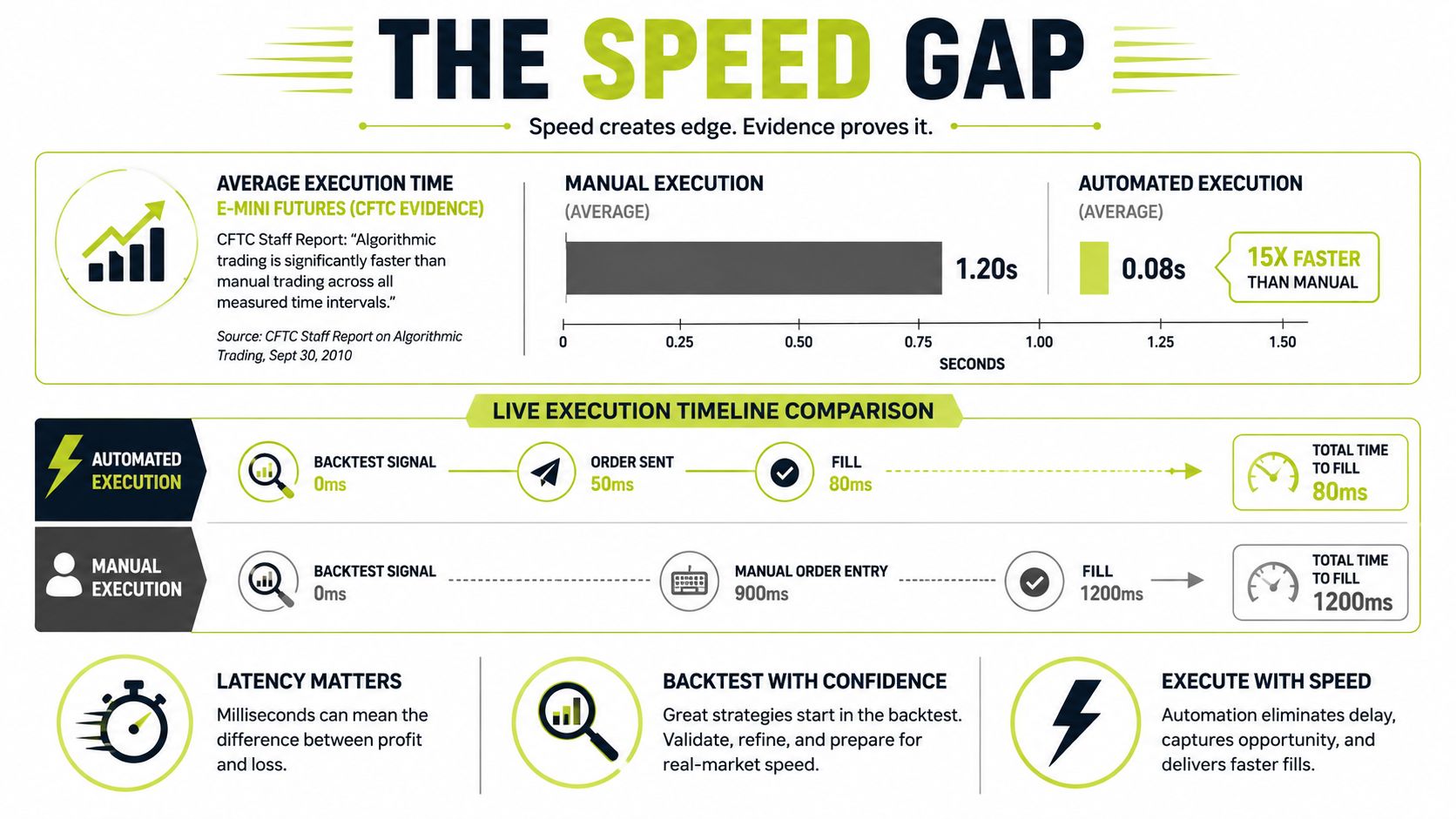
A fast system is still not a good system if the strategy edge is weak. Backtests can make a setup look cleaner than it really is because they ignore the mess that shows up live, slippage, rejected orders, missed alerts, and the trader's own hesitation. The live-execution gap is where many “good” ideas fail.
### Measure the execution chain, not just the idea
If you want to know whether a setup is working, track the path from alert to fill instead of staring at equity alone.
- **Alert-to-submission latency:** how long it takes from the TradingView alert to the order leaving the system.
- **Broker acknowledgment latency:** how quickly the broker confirms receipt.
- **Fill latency:** how long it takes to get a real fill after the order is sent.
- **Implementation shortfall:** the difference between the intended price and the actual fill outcome.
- **Rejected-order rate:** how often the broker refuses the order.
- **Missed-signal rate:** how often a valid alert never becomes a trade.
> **Short version:** if you don't timestamp the workflow, you can't separate a bad strategy from a bad execution path.
For retail traders, that matters more than a polished backtest curve. A strategy can look good on paper and still lose money live because the fill happens too late or the trade never reaches the broker. The opposite can happen too, a mediocre idea can be executed cleanly and end up less damaging than the same idea run manually with sloppy timing.
The right conclusion isn't that automation wins because it's faster. It's that automation gives you measurable timing, while manual execution hides the delays inside human behavior. That makes automation easier to evaluate, which is a huge advantage when you care about process quality instead of just headline returns. For a practical way to paper-trade this step before going live, see [how to paper trade in TradingView](https://pineflows.com/blog/how-to-paper-trade-in-tradingview).
Video reference for the same execution gap:
## Where Automation Fails in Predictable Ways
Automation fails in boring, repeatable ways. An alert fires twice, a webhook arrives late, the broker is briefly unavailable, or the strategy keeps trading through a session you meant to skip. A workflow that looks disciplined in testing can turn noisy in production fast.
FINRA warns that auto-trading can create losses before investors realize transactions occurred, and it flags third-party cyberattacks and data-access risks as part of the problem ([FINRA guidance](https://www.finra.org/investors/insights/auto-trading-unregistered-entities)). As noted earlier, the SEC also treats malfunctioning or incorrectly deployed algorithms as a structural risk. Software alone does not reduce risk; controls like logging, deduplication, and pause behavior are what reduce it.
### The hidden failures are predictable
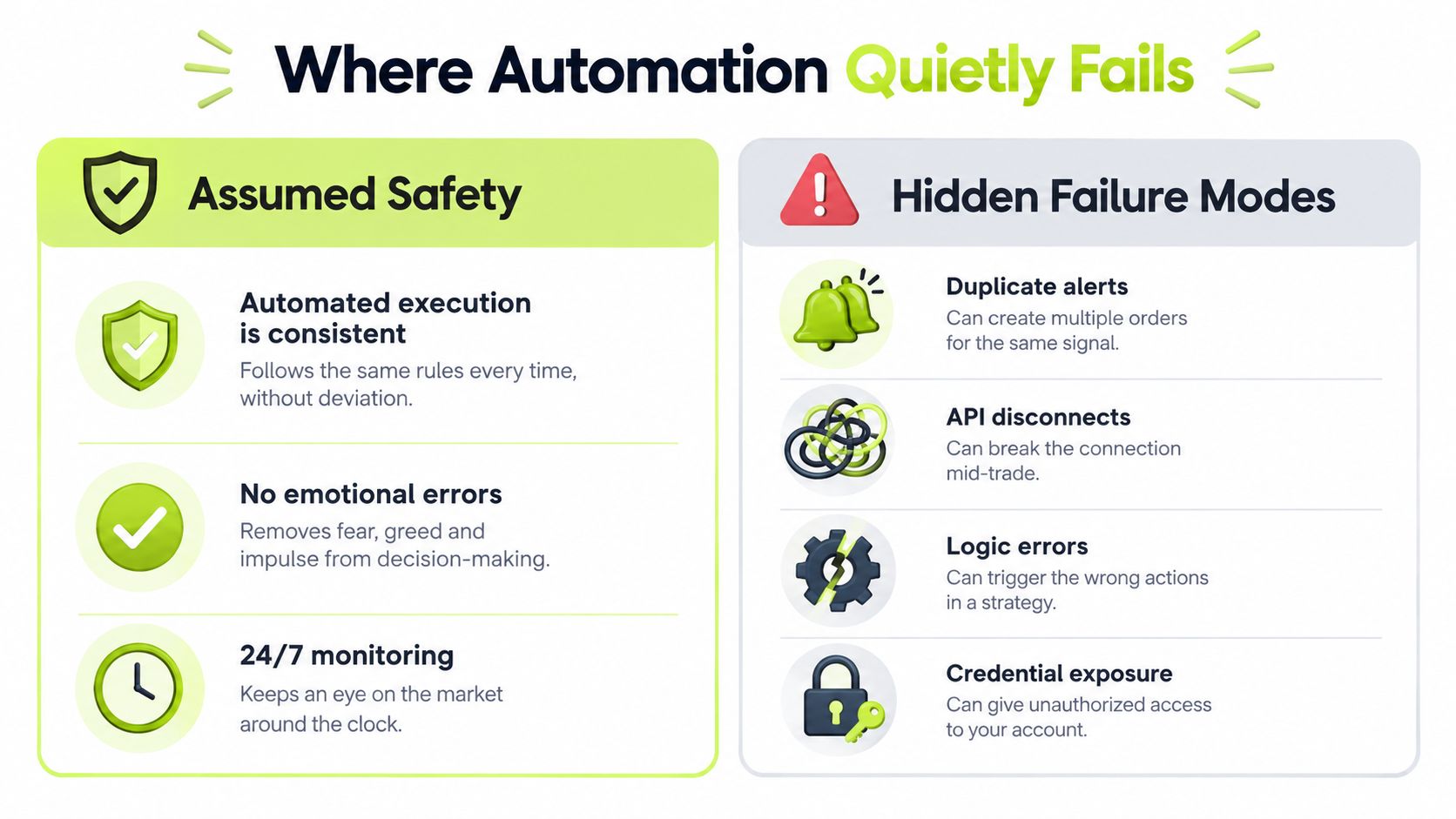
The sales pitch says automation removes emotion and runs around the clock. That part is true. The part that gets missed is how easily an unattended workflow repeats the same mistake until you stop it.
- **Duplicate alerts:** one signal becomes multiple orders if the system does not deduplicate.
- **Out-of-order delivery:** a stale alert can arrive after the market has already moved.
- **Broker outage:** a webhook can fail into a dead connection if retry logic is not visible.
- **Logic errors:** a bad rule can fire on every qualifying event.
- **Credential exposure:** storing reusable broker secrets expands the attack surface.
The Royal Economic Society study found no reduction in bubble size or frequency when participants could use trading robots, while early robot-enabled rounds showed wider bid-ask spreads and more frequent flash crashes or price surges (Royal Economic Society study). That is the reminder retail traders need. Deterministic execution is not the same thing as safer market behavior.
Automation is safest when it is observable. If you can see state, block duplicates, pause entries, and preserve exits, you can manage the risk. If you cannot, you have only hidden the manual problem inside a script.
## Running a TradingView to Robinhood Automation Pipeline
A clean retail setup is straightforward. Keep the strategy in TradingView, trigger the alert from Pine Script, and send the webhook into a broker order with logging, checks, and a hard stop when something looks off. Pineflows is one option built for that workflow, turning TradingView alerts into Robinhood orders with test mode, per-alert event IDs, and pause controls.
The sequence matters more than the brand: start with a script you already trust and end with a broker action you can inspect.
### A practical flow that stays auditable
1. **Author the strategy in TradingView.** Keep the logic as close as possible to the version you backtested.
2. **Route the alert through a webhook.** The alert should carry enough structure for the downstream system to interpret it.
3. **Convert the webhook into an order.** The workflow should attach timestamps, status checks, and fill details before it marks the event complete.
4. **Review the receipts.** You need human-readable payloads and logs so you can see exactly what happened.
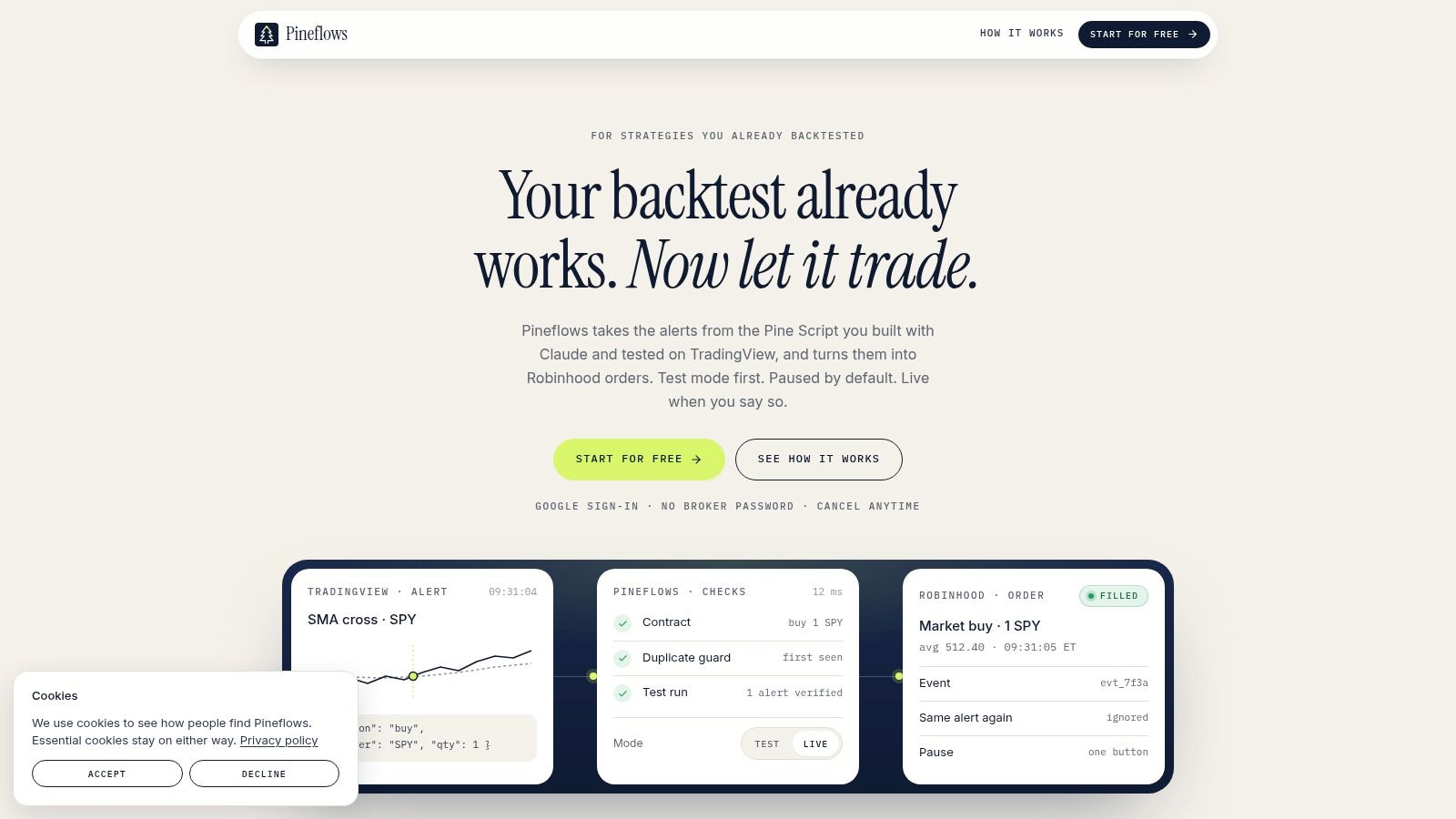
The safeguards matter more than the routing. A default test mode that logs alerts without sending orders lets you verify the path before capital is exposed. Per-alert event IDs prevent duplicate entries from becoming duplicate positions. A pause control that blocks new entries while preserving valid exits gives you a way to stop fresh risk without trapping a position you still need to unwind.
Pineflows' public pricing page lists a single plan, **Pineflows Pilot**, at **$29 per month** with a **7-day trial** that begins after onboarding, and it says no Robinhood credentials are created or stored within Pineflows at any time ([Pineflows pricing](https://pineflows.com)). That detail matters because credential handling affects execution reliability. If the system never holds your broker password, it removes one category of failure and one category of concern.
For traders who want to see how Robinhood execution fits into a broader workflow, the Robinhood guide later in this article is a useful companion. The point is the same in both places. A good pipeline cuts manual friction while keeping every step visible.
## Security, Regulatory, and Operational Considerations
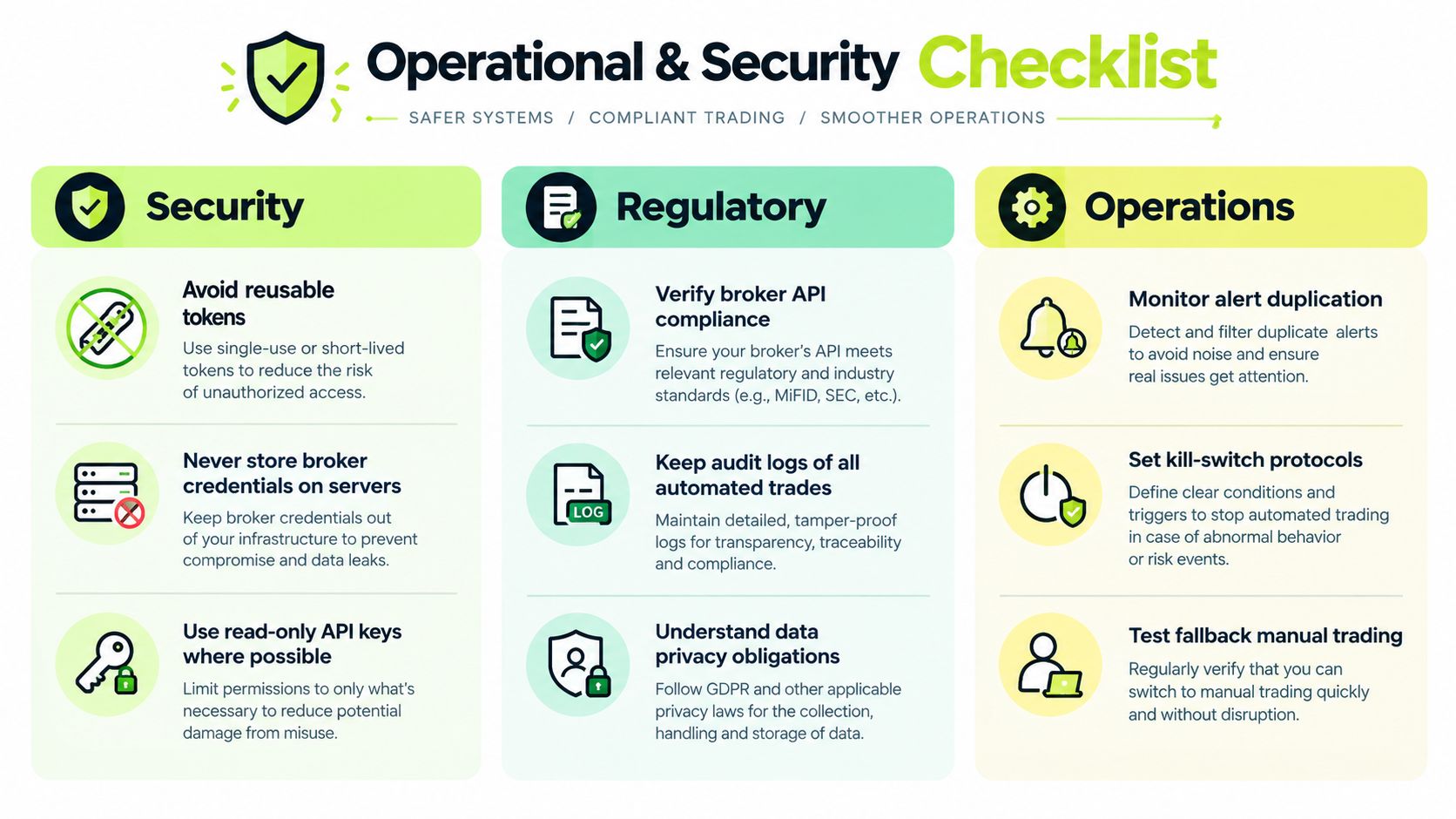
A retail automation stack should begin with access control. Give the workflow only the permissions it needs, keep broker credentials out of the automation layer, and avoid any setup that asks for reusable tokens unless you fully understand why they are required. That reduces the blast radius if a tool misbehaves.
The regulatory side is practical, not abstract. The SEC report on algorithmic trading treats automation as a source of malfunction and market risk, and FINRA guidance for retail investors points to the problems that can arise when trades move before the trader notices or when third parties get access. Retail automation is still usable. It just needs guardrails.
### The controls that reduce risk
- **Use observable state.** You should be able to see whether an alert is pending, sent, filled, or rejected.
- **Use idempotency.** One event should map to one order, not one event plus a retry storm.
- **Keep exits available.** A pause should stop new risk, not block a necessary exit.
- **Reject stale signals.** If the alert is no longer valid, the system should refuse it.
- **Respect market hours and broker status.** Do not send orders into a session that cannot support them.
- **Size positions explicitly.** Never let the script invent exposure you did not authorize.
The discipline problem matters just as much. Keep the live workflow aligned with the backtested logic unless you are deliberately testing a change. Once live and simulated behavior drift apart, you are no longer measuring the same strategy.
For setup details and platform fit, [Pineflows' Robinhood stock trading guide](https://pineflows.com/blog/robinhood-stock-trading) is worth reading if you are evaluating a TradingView-to-Robinhood route. The decision-to-fill question is the one to watch. A good pipeline makes every step visible, blocks duplicate orders, and gives you a clean pause path before real capital is exposed.
## Choosing Manual, Automated, or Hybrid for Your Strategy
The decision comes down to the shape of your edge. If the setup depends on news, judgment, or a rare context you can't encode cleanly, manual trading is the safer choice. If the setup is repetitive and rule-based, automation is the better tool. If the strategy has both parts, hybrid is usually the honest answer.
### Use the strategy itself as the filter
Ask five questions before you commit.
- **Signal frequency:** If setups appear often, automation saves you from human inconsistency.
- **Latency sensitivity:** If small timing differences matter, manual clicking is the wrong bottleneck.
- **Account size relative to risk:** If the position is large enough to matter emotionally, automation can help remove hesitation.
- **Exit complexity:** If exits require multiple actions, software reduces entry mistakes and missed steps.
- **Tolerance for unattended risk:** If you can't sleep while a trade is open without oversight, don't pretend that automation solved your anxiety.
> **Bottom line:** hybrid works when the machine handles repetition and you keep authority over exceptions.
That's where a test-first pipeline helps. A workflow with clear pause behavior, duplicate protection, and visible state lets you hand off entries without handing over judgment. You still decide when to use the system, when to stop it, and when to step in manually. For traders building that kind of mixed setup, [this quant trading software overview](https://pineflows.com/blog/quant-trading-software) is a useful way to think about the stack.
The binary debate between manual and automated trading misses the core issue. Most traders do better with a designed mix, not a tribe. Human judgment belongs in strategy choice and exception handling. Software belongs in repeatable execution.
## Pre-Launch Checklist and Final Recommendation
Before you go live, verify the basics. The backtest should still match the live logic. Alert-to-fill timing should be measured, not assumed. Duplicate-event handling should be tested. Pause behavior should block new entries without breaking valid exits. Credential handling should stay with the broker, not migrate into a system that doesn't need it.
If your edge is contextual or low-frequency, stay manual. If your signals are repeatable and timing-sensitive, automate the execution. If you're in the middle, use a hybrid setup with observable state, idempotent event handling, and an explicit pause control. That's the safest way to separate **decision-to-fill reliability** from wishful thinking.
---
Pineflows turns TradingView alerts into Robinhood orders with test mode, timestamped event handling, and pause controls, which makes it useful if you care about execution discipline instead of just fast clicks. If you want to move from manual fills to a workflow you can inspect, test, and pause on demand, visit [Pineflows](https://pineflows.com) and see how the pipeline is set up.