# 10 Copy Trading Software Tools for Retail Traders in 2026
> Compare 10 copy trading software platforms for retail traders: features, brokers, automation, risk controls, pricing and best use cases in 2026.
Source: https://pineflows.com/blog/copy-trading-software
Published: 2026-10-12
Updated: 2026-10-12
Tags: copy trading software, social trading platforms, copy trading platforms, automated copy trading, copy trading brokers
You're staring at the same problem a lot of retail traders face. You want copy trading software, but the core question isn't which logo looks safest, it's who decides the trade. Is it a social leader you mirror through a broker, a risk-normalized index, an exchange's built-in copy module, or your own TradingView strategy routed to a broker with rules you control?
That distinction matters because the trade control model shapes everything that follows. Some tools make it easy to follow a popular trader, but leave you exposed to the leader's timing and position sizing. Others normalize risk or automate signals, which can be safer for some setups and less flexible for others. A few are built for traders who already have a tested strategy and just want clean execution, auditability, and a pause switch.
This list groups 10 platforms by who really drives the trade, not by hype. I'm comparing them on broker dependence, risk controls, automation depth, and the kind of trader they fit best. If you already know whether you want mirrored social trading, exchange-native copying, or strategy-to-broker automation, the right option gets obvious fast.
## Table of Contents
- [1. eToro CopyTrader](#1-etoro-copytrader)
- [2. ZuluTrade](#2-zulutrade)
- [What tends to work here](#what-tends-to-work-here)
- [3. MetaTrader Signals](#3-metatrader-signals)
- [4. Collective2 AutoTrade](#4-collective2-autotrade)
- [5. Darwinex](#5-darwinex)
- [6. Pineflows](#6-pineflows)
- [7. Binance Copy Trading](#7-binance-copy-trading)
- [8. Bybit Copy Trading](#8-bybit-copy-trading)
- [9. Bitget Copy Trading](#9-bitget-copy-trading)
- [10. KuCoin Copy Trading](#10-kucoin-copy-trading)
- [What to watch](#what-to-watch)
- [Top 10 Copy Trading Platforms: Feature Comparison](#top-10-copy-trading-platforms-feature-comparison)
- [Matching Copy Trading Software to Your Trading Setup](#matching-copy-trading-software-to-your-trading-setup)
## 1. eToro CopyTrader
eToro CopyTrader is the classic choice when you want a social leader and a broker in the same place. You pick an investor profile, allocate funds, and the platform mirrors open positions and new trades proportionally through the copy relationship. The built-in **Copy Stop-Loss** gives you a portfolio-level way to cap losses, which is one of the few controls that makes social copying feel less reckless.
The day-to-day appeal is simple. The community is mature, the discovery tools are strong, and the profile pages make it easier to compare traders than on a bare-bones broker app. The catch is that product availability changes by country, and the U.S. offering is narrower than the global version. Users also complain about market coverage at the edges of the session and about fee visibility, so you still need to read the current terms carefully on [eToro CopyTrader](https://www.etoro.com/en-us/copytrader/).
> **Practical rule:** use the profile stats as a starting point, not a final answer. A polished feed can make a trader look better than their execution would justify.
For traders who want a familiar social layer and don't want to stitch together separate brokers and copy tools, eToro fits well. For anyone who wants full control over routing, fill logic, or custom automation, it's less suitable than a dedicated signal pipeline.
## 2. ZuluTrade
ZuluTrade sits in the broker-agnostic camp, which is the main reason people use it. You connect a supported broker, pick leaders, and let the platform copy their strategies. That setup is useful if you like your current broker and don't want to move funds just to add copy functionality.
The practical benefit is separation. Discovery, allocation, and follower controls live in ZuluTrade, while execution still happens at the broker you choose. That keeps account custody where it already is, but it also means your results depend on the broker integration, the instrument set, and the quality of your connection. The protective layer, including ZuluGuard, is the part to pay attention to if you're worried about strategy drift or a leader changing behavior without warning.
### What tends to work here
- **Broker flexibility:** Keep your existing broker and add copy trading on top.
- **Allocation discipline:** Set per-strategy sizing instead of dumping one block of capital into a single leader.
- **Monitoring:** Use the mobile app for checks, but don't treat it as “set and forget.”
The weak spot is polish. The interface can feel more functional than elegant, and the charting depth isn't what pro chart-first traders expect. Check current fees and supported instruments on [ZuluTrade](https://www.zulutrade.com) before opening anything live.
## 3. MetaTrader Signals
MetaTrader Signals is the built-in marketplace for MT4 and MT5 users who want copy trading inside the terminal they already know. You subscribe to a provider's signal, and MetaTrader mirrors the trades in your account. For traders who live in MT all day, that tight integration is a real advantage.
The market depth is the big attraction. You can browse a large catalog of free and paid signals inside the platform, and the signal pages usually include enough detail to do more than guess. Slippage and deviation controls matter here because the copied trade is still broker- and terminal-dependent. If the provider enters on one feed and you fill on another, the live result can drift quickly.
I'd treat MetaTrader Signals as a convenience layer, not a magic performance layer. Provider quality varies a lot, so diligence matters more than the marketplace branding. If you're already using MT4 or MT5, it can be a neat upgrade. If you're choosing a platform primarily for copy trading, there are cleaner setups.
For a broader look at signal routing and execution flow, the workflow is worth comparing with [Trading Signal Software for Automated Execution](https://pineflows.com/blog/trading-signal-software).
## 4. Collective2 AutoTrade
A strategy page can look attractive until the fills hit a live account. Collective2 AutoTrade is built for that moment. You subscribe to a strategy, connect a brokerage account, and let the platform route orders across stocks, options, futures, or forex. The split between marketplace and execution keeps the cost and the trade logic easier to inspect.
Execution quality is the real test. Collective2 tries to show fills in a way that is closer to broker-reported results than to backtest polish, which helps if you care about how a strategy behaves under live conditions. It also gives you scaling controls, so you can start with smaller exposure instead of copying full size from day one. If you build around automation, the API and partner edition make it more than a retail copy feed. For a broader view of how order routing and automation fit together, see [Automated stock trading software](https://pineflows.com/blog/automated-stock-trading-software).
Where it fits is pretty clear. Traders who split capital across multiple markets can use it across asset classes. Allocators who want to size each strategy deliberately get more control than a blunt mirror-copy setup. The fee structure is visible, but costs can still climb once plan fees, strategy fees, and commissions are all in the picture.
The trade-off is vetting. Strategy quality varies a lot, and a stack of subscriptions can get expensive fast. Collective2 suits users who want more control over sizing and routing than a simple social copy feed.
## 5. Darwinex
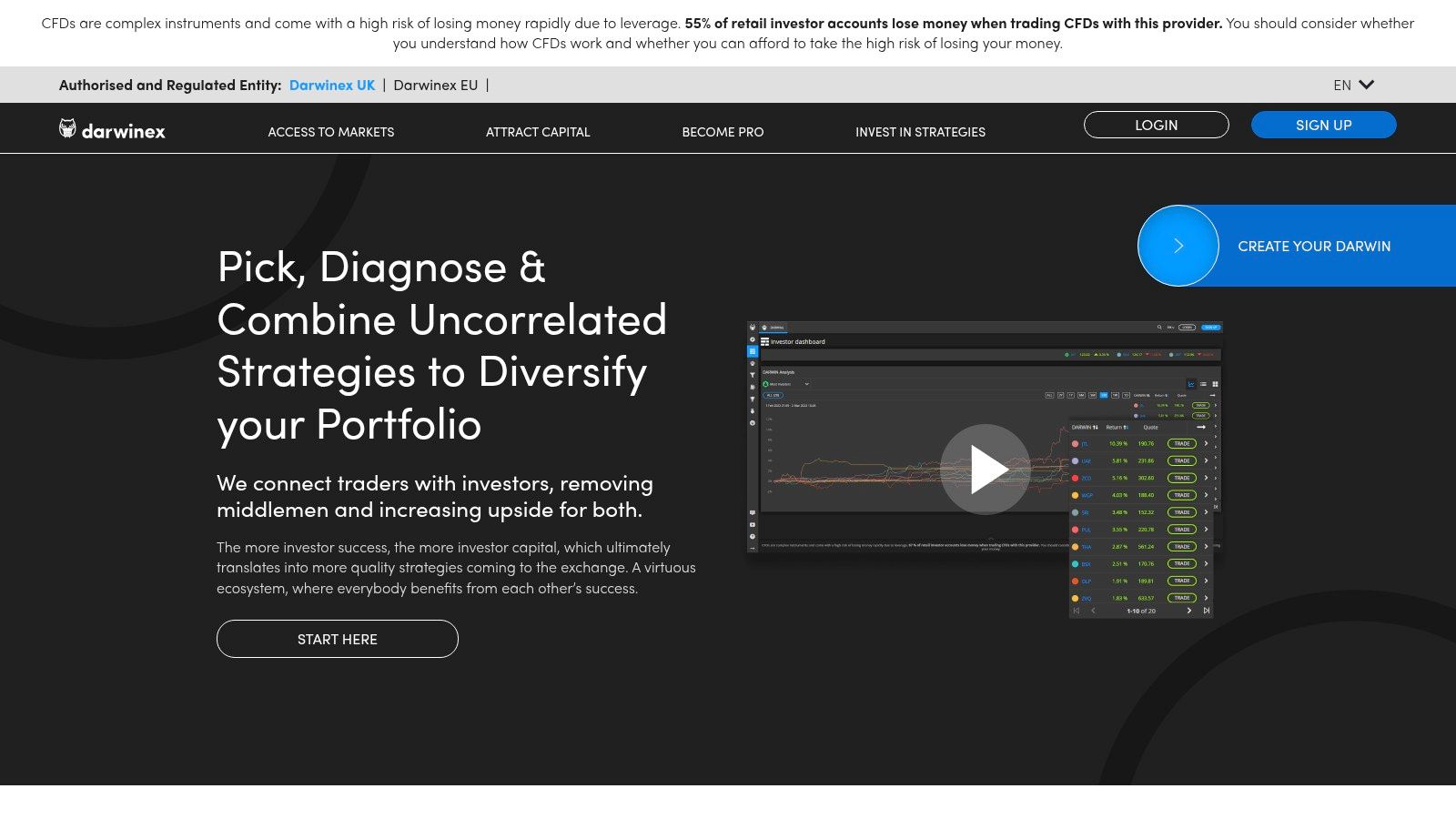
Darwinex is for traders who don't want raw trade mirroring. Instead, it turns strategies into investable DARWIN indices, then normalizes risk around a target monthly VaR band. That means the investor is copying a risk-engine version of the strategy, not a direct replay of the lead account.
That difference is the whole point. If you've been burned by followers taking on hidden debt or oversized positions, Darwinex's structure can feel more disciplined. The fee model is also more formalized, with performance fees and a management fee framework around investor capital. There's an INDX pooled option too, which suits people who want a more index-like approach rather than betting on one leader.
> The upside is governance and risk normalization. The trade-off is that it's not a one-to-one copier, so the investor experience won't match the signal account line for line.
That mismatch is intentional, but it still matters. If you want exact replication, this isn't the right tool. If you want a copy model that tries to standardize risk before capital is exposed, Darwinex is one of the more thoughtful approaches. Start with the investor pages on [Darwinex](https://www.darwinex.com/investors) and check jurisdiction-specific onboarding before assuming access.
## 6. Pineflows
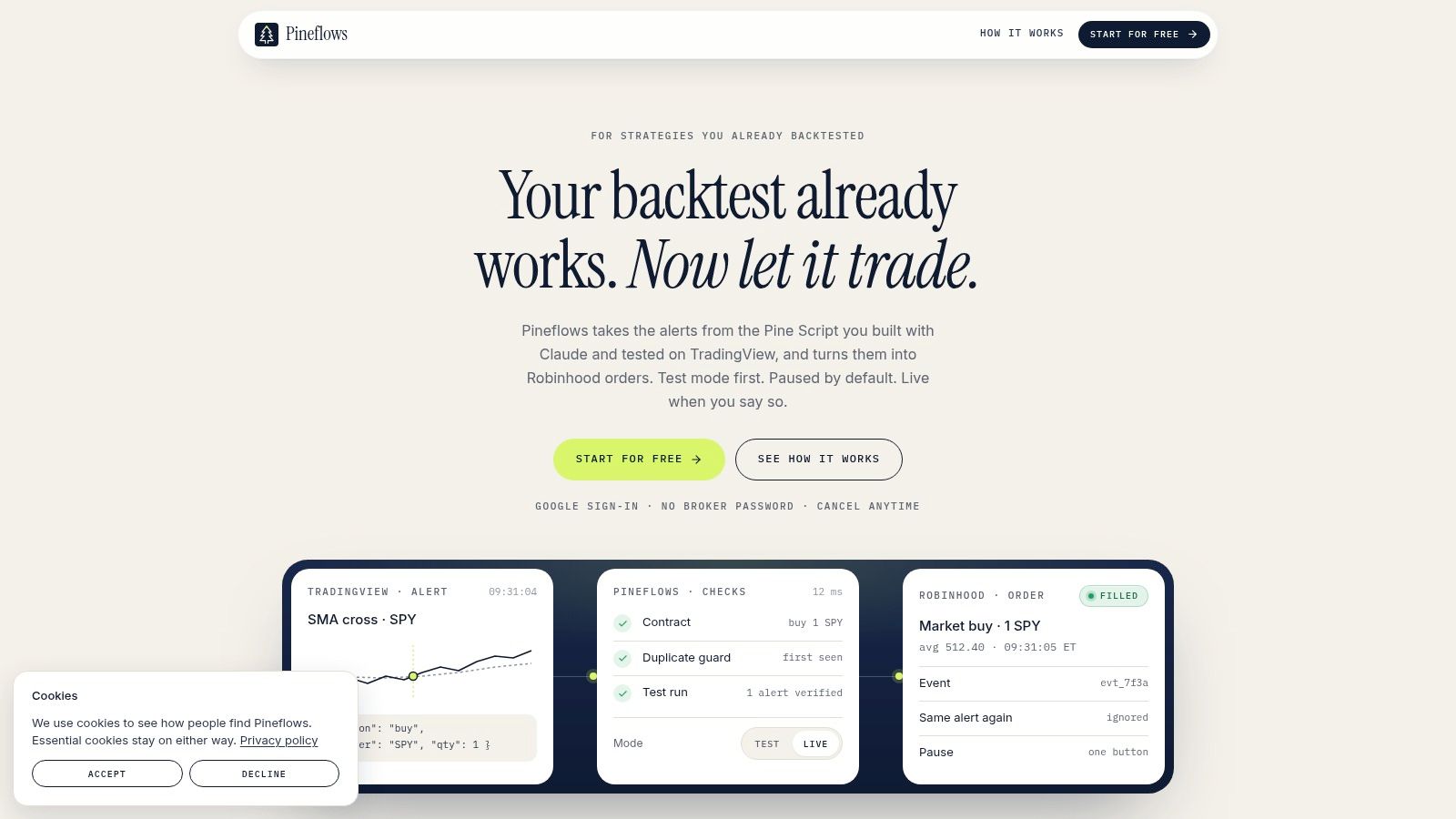
A trader with a TradingView strategy and a Robinhood account usually wants one thing: the order routed exactly as planned. Pineflows handles that path. It turns TradingView alerts from Pine Script into executable Robinhood orders, with test mode and audit-friendly event tracking. Pineflows is a controlled automation layer, your strategy decides, the pipeline executes.
Setup is guided. You sign in with Google, connect Claude so it can interpret the script and suggest entries, exits, instruments, and sizing, then create one TradingView webhook alert. Pineflows starts in test mode and paused by default, so alerts are logged instead of sent to Robinhood until live trading is switched on. That default keeps the first real fill visible and reduces the risk of accidental orders.
The trust layer is the main differentiator. Pineflows does not ask for Robinhood passwords. Event IDs stop duplicate alerts from becoming duplicate orders, and each event includes timestamps, status checks, delivery receipts, and payload inspection for review. The global pause control blocks new entries while preserving valid exits, which helps contain risk without freezing the whole workflow.
There are clear limits. Pineflows is limited to Robinhood, and you need a paid TradingView plan with two-factor authentication. Pricing is a single-tier subscription at $29/month with a 7-day trial that starts after onboarding. For traders who want deterministic execution from their own strategy, that is a focused trade-off. Learn more at [Pineflows](https://pineflows.com).
## 7. Binance Copy Trading
A Binance account is enough to test the exchange's copy trading feature, which is why it suits traders who already keep funds there and want to stay inside one platform. It covers select spot markets and, in some regions, derivatives. The setup is simple enough, but availability still depends on where you live.
What pulls traders in is the liquidity pool and the single-app workflow. You can follow a wider set of traders, work across more coin pairs, and manage allocations without leaving the exchange. Binance also adds onboarding prompts, allocation controls, and leaderboards, which makes the first setup less intimidating than a raw futures screen. For readers comparing automation styles, [this guide to trading bots for beginners](https://pineflows.com/blog/trading-bots-for-beginners) is a useful follow-up on how copy execution differs from manual trading.
The trade-off is control versus exposure. Regional access changes, and U.S. residents are often blocked from the feature. Crypto margin risk can build fast, so position caps matter more than platform polish. Binance Copy Trading works best for users who already understand the exchange and can size carefully. Before you rely on it, check current eligibility directly on [Binance](https://www.binance.com).
## 8. Bybit Copy Trading
Few exchange copy modules ship as fast as Bybit's. Classic and Pro modes arrived alongside TradFi copy promotions, so the feature feels tied to the platform's active release cycle rather than parked on the side. That matters if you want a module that keeps changing with the rest of the exchange.
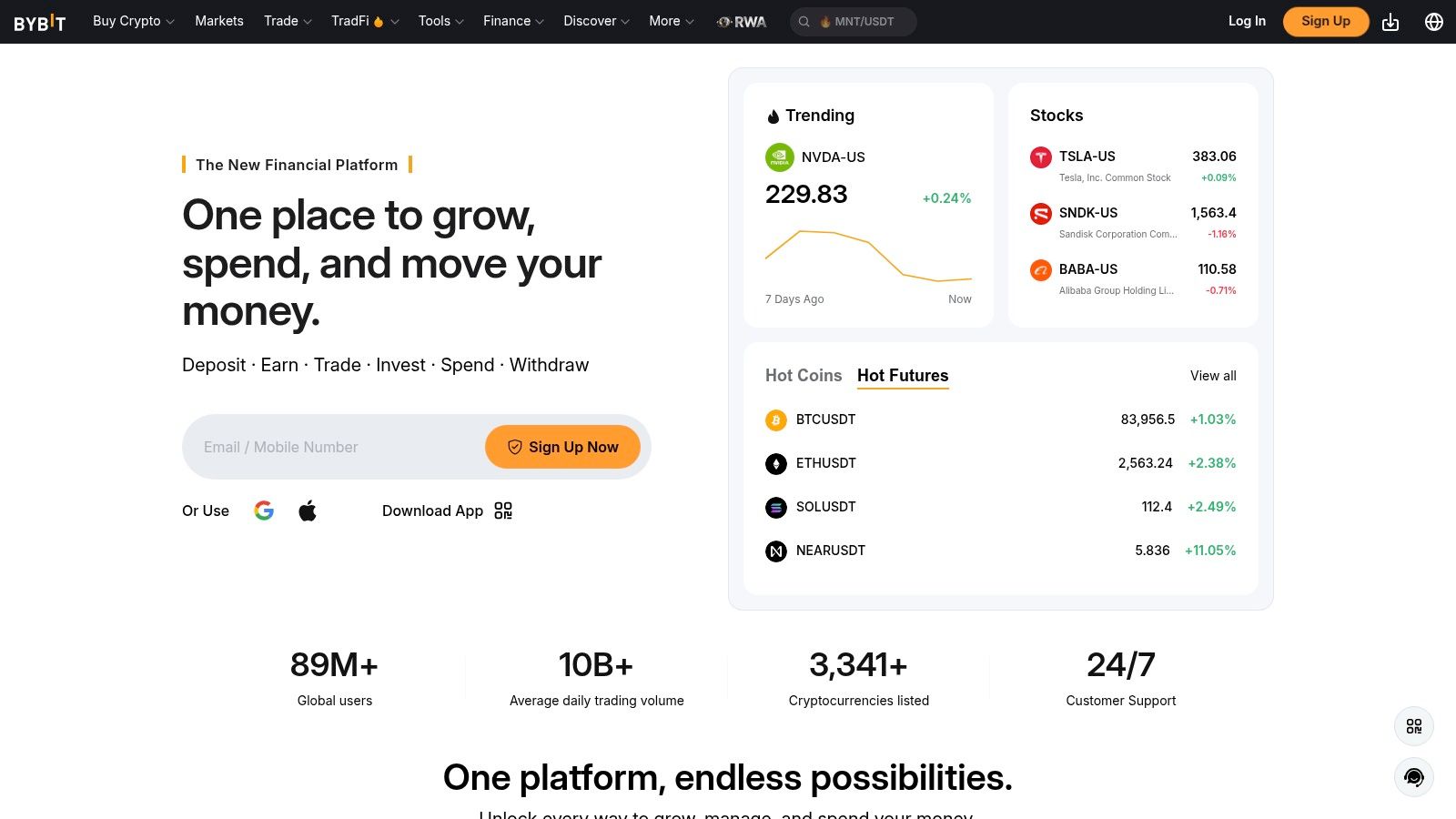
Classic suits users who want a straightforward follower setup. Pro gives more room to control the workflow, which is useful if you care about sizing and execution detail instead of pure mirroring. That split makes Bybit more flexible than a one-mode copy tool.
The trade-off is the same one that comes with exchange-hosted copy trading. You still depend on Bybit's regional availability, and derivatives-heavy accounts can turn small sizing mistakes into bigger losses fast. The interface can be polished and the product cadence can be strong, but over-allocation still decides the outcome.
**Best fit**
- **Existing Bybit users:** Works well if your funds are already on the exchange.
- **Derivatives-focused traders:** Better if you understand futures risk and liquidation pressure.
- **Control-seeking followers:** Pro mode gives more discretion than pure mirror copying.
Before funding, confirm which of the two modes your region gets at [Bybit](https://www.bybit.com).
## 9. Bitget Copy Trading
Bitget is interesting because it blends social copying, bot copy trading, and some CFD copy trading in one place. That mix gives you more mode choice than the average exchange module, and the profit-share setup is easy to understand. Lead traders get paid only when the copied trade is profitable, which makes the pricing logic more intuitive than models that charge on losses too.
That structure also changes behavior. Traders who earn only on profitable copied trades have a reason to care about follow-through, not just headline vanity metrics. The bot copy angle matters too, because not every follower wants a human lead trader. Some users want a rules-based system that behaves more like an automation layer, and Bitget gives them that option without forcing them to switch products.
The risk side is obvious. Exchange and regional restrictions still apply, and futures or CFD copying with borrowed funds can get ugly fast if you size too aggressively. The “zero fee” label on some CFD portfolios should not be read as zero risk, only zero fee under specific terms. Read the current copy rules on [Bitget Copy Trading](https://www.bitget.com/copy-trading/overview) before funding anything.
## 10. KuCoin Copy Trading
KuCoin Copy Trading fits traders who already use KuCoin for spot, bots, or account-level features and want copying added to that same setup. The system separates Lead Traders from Copy Traders and gives leaders a management portal, so it feels more controlled than a casual social feed.
Integration is the core selling point here. If your orders, balances, and account tools already sit on KuCoin, copy trading is easy to keep in one place. The downside is that the convenience only lasts inside that ecosystem, and fee terms, profit-share rules, and eligibility can change, so they need a fresh check before you commit new capital.
### What to watch
- **Role clarity:** Confirm whether you are following a lead trader or trying to run a lead account yourself.
- **Policy changes:** Treat fee logic and profit-share terms as current, not permanent.
- **Regional access:** Check availability and restrictions before you fund the account.
KuCoin Copy Trading pays off when the rest of your trading already happens there. Outside that setup, the convenience premium disappears quickly. Review the current details on [KuCoin](https://www.kucoin.com) before relying on older screenshots or forum posts.
## Top 10 Copy Trading Platforms: Feature Comparison
| Provider | Core features ✨ | UX / Reliability ★ | Price / Value 💰 | Target audience 👥 | Unique edge ✨ |
|---|---:|:---:|:---:|:---|---|
| eToro CopyTrader | Social copy portfolios, proportional copying, Copy Stop‑Loss | ★★★★☆ | 💰 No extra CopyTrader fee (trading costs apply) | 👥 Social investors seeking discovery & portfolios | ✨ Mature community, profile-driven discovery |
| ZuluTrade | Broker-agnostic marketplace, per-strategy allocation, demo mode | ★★★☆☆ | 💰 Broker-dependent fees & spreads | 👥 Users who want to keep their broker | ✨ ZuluGuard protective layer, multi-broker support |
| MetaTrader Signals (MQL5) | In‑platform signals, slippage controls, VPS-friendly | ★★★★☆ | 💰 Some free/paid signals; terminal free | 👥 MT4/MT5 traders wanting tight integration | ✨ Native MT terminal marketplace & detailed stats |
| Collective2 AutoTrade | Multi-asset AutoTrade, scaling controls, broker links | ★★★☆☆ | 💰 Platform plan + strategy fees + broker costs | 👥 Subscribers seeking multi-asset automation | ✨ Transparent fee split & API/partner options |
| Darwinex (DARWIN) | Risk engine (VaR normalization), performance fees, INDX | ★★★★☆ | 💰 Management + performance fees per DARWIN | 👥 Investors wanting risk-standardized exposure | ✨ Risk-normalized investable indices (not 1:1) |
| **Pineflows** 🏆 | TradingView → Robinhood webhook, idempotent events, pause control | ★★★★★ | 💰 $29/month (Pineflows Pilot), 7‑day trial | 👥 Backtested TradingView traders using Robinhood | ✨ Test‑first, full audit trail, no broker creds stored 🏆 |
| Binance Copy Trading | Spot & selective futures copy, leaderboards, in-app onboarding | ★★★★☆ | 💰 Exchange fees; no separate copy fee (region dep.) | 👥 Crypto traders seeking deep liquidity | ✨ Wide coin pool & tight exchange integration |
| Bybit Copy Trading | Classic/Pro modes, derivatives integration, position controls | ★★★★☆ | 💰 Exchange fees; eligibility varies by region | 👥 Bybit derivatives users & active traders | ✨ Multiple copy modes + frequent product updates |
| Bitget Copy Trading | Profit-share leads, bot copy modes, CFD portfolios | ★★★☆☆ | 💰 Profit-share on profits; exchange fees | 👥 Users preferring bot & profit-share copy models | ✨ Profit-share model + bot-copy automation |
| KuCoin Copy Trading | Lead/Copy roles, management portal, trader programs | ★★★☆☆ | 💰 Exchange fees; profit-share/terms can change | 👥 KuCoin users & lead traders | ✨ Role-based leader tools & VIP programs |
## Matching Copy Trading Software to Your Trading Setup
Start with the control model you can live with. If you want a mirrored social leader, tools like eToro, ZuluTrade, MetaTrader Signals, Bitget, or KuCoin make sense. If you want a risk-normalized index rather than raw trade mirroring, Darwinex is the more disciplined fit. If you want exchange-native convenience, Binance and Bybit are strong only when their regional rules and margin settings match your account. If you already built a TradingView strategy and want execution you can audit, Pineflows is the clearest option because it treats routing, logging, test mode, and pause controls as first-class features.
The next filter is broker dependence. Some tools lock you into a specific venue. Others, like ZuluTrade or Collective2, let you keep a separate broker relationship and layer copy logic on top. That sounds minor until a platform goes down, a market closes, or a fill behaves differently from the leader's entry. The more independent the execution layer is from the signal source, the more you should care about reconciliation, duplicate suppression, and order-status logging.
Risk controls should come before aesthetics. A good leaderboard doesn't protect you from borrowed exposure, latency, slippage, or a leader changing style midstream. The safer platforms make it easy to cap exposure, pause entries, preserve exits, and review the actual fills after the fact. That's why test mode matters. It's the fastest way to see whether the software behaves the way the dashboard claims.
If you're choosing for a retail account, verify regional eligibility and current fee terms on the provider's site before funding anything. Then run the setup in test mode or with a small allocation. After the first month, inspect the audit trail, the stop controls, and the difference between intended and filled orders. Keep the platform only if it matches how you trade, not how the marketing page says you should.
---
Pineflows is built for traders who want their own TradingView strategy to execute cleanly on Robinhood, with test mode, pause controls, duplicate protection, and a full audit trail. If you care more about verified automation than social leaderboard chasing, visit [Pineflows](https://pineflows.com) and see whether that control model fits your setup.