# Cash Secured Put Selling: A Practical Guide for Traders
> Learn cash secured put selling from setup to exit. Covers strike selection, breakeven math, risk management, and automation tips for retail traders.
Source: https://pineflows.com/blog/cash-secured-put-selling
Published: 2026-10-20
Updated: 2026-10-20
Tags: cash secured put selling, options income, put writing, TradingView alerts, Robinhood automation
You've got a stock on your watchlist, a lower price where you'd consider buying, and an options chain offering cash for making that commitment today. Selling the put looks cleaner than chasing the shares. Then you notice how much cash the order ties up, and a more useful question replaces the income calculation: would you still want this purchase if the stock fell hard before expiration?
**Cash secured put selling is an underwriting decision.** You're accepting someone else's downside risk for a premium. The trade deserves the same scrutiny as buying the shares, plus an execution plan for the obligation you've sold.
## Table of Contents
- [What Cash Secured Put Selling Actually Is](#what-cash-secured-put-selling-actually-is)
- [What you're agreeing to buy](#what-youre-agreeing-to-buy)
- [The account test](#the-account-test)
- [The Long-Run Numbers Behind the Trade](#the-long-run-numbers-behind-the-trade)
- [Read the whole return profile](#read-the-whole-return-profile)
- [Premium isn't investment return](#premium-isnt-investment-return)
- [Setting Up the Trade From Selection to Order Entry](#setting-up-the-trade-from-selection-to-order-entry)
- [Underwrite before you price](#underwrite-before-you-price)
- [From chain check to order ticket](#from-chain-check-to-order-ticket)
- [Two Worked Examples With Visible P&L](#two-worked-examples-with-visible-p-and-l)
- [Comparing Two Cash-Secured Put Setups](#comparing-two-cash-secured-put-setups)
- [Follow the position through expiration](#follow-the-position-through-expiration)
- [Managing the Trade and Handling Assignment](#managing-the-trade-and-handling-assignment)
- [Re-underwrite the position](#re-underwrite-the-position)
- [Three exits, three different trades](#three-exits-three-different-trades)
- [Automating Alerts and Execution Responsibly](#automating-alerts-and-execution-responsibly)
- [A Pre-Live Checklist and Common Mistakes](#a-pre-live-checklist-and-common-mistakes)
- [Keep this beside the order screen](#keep-this-beside-the-order-screen)
## What Cash Secured Put Selling Actually Is
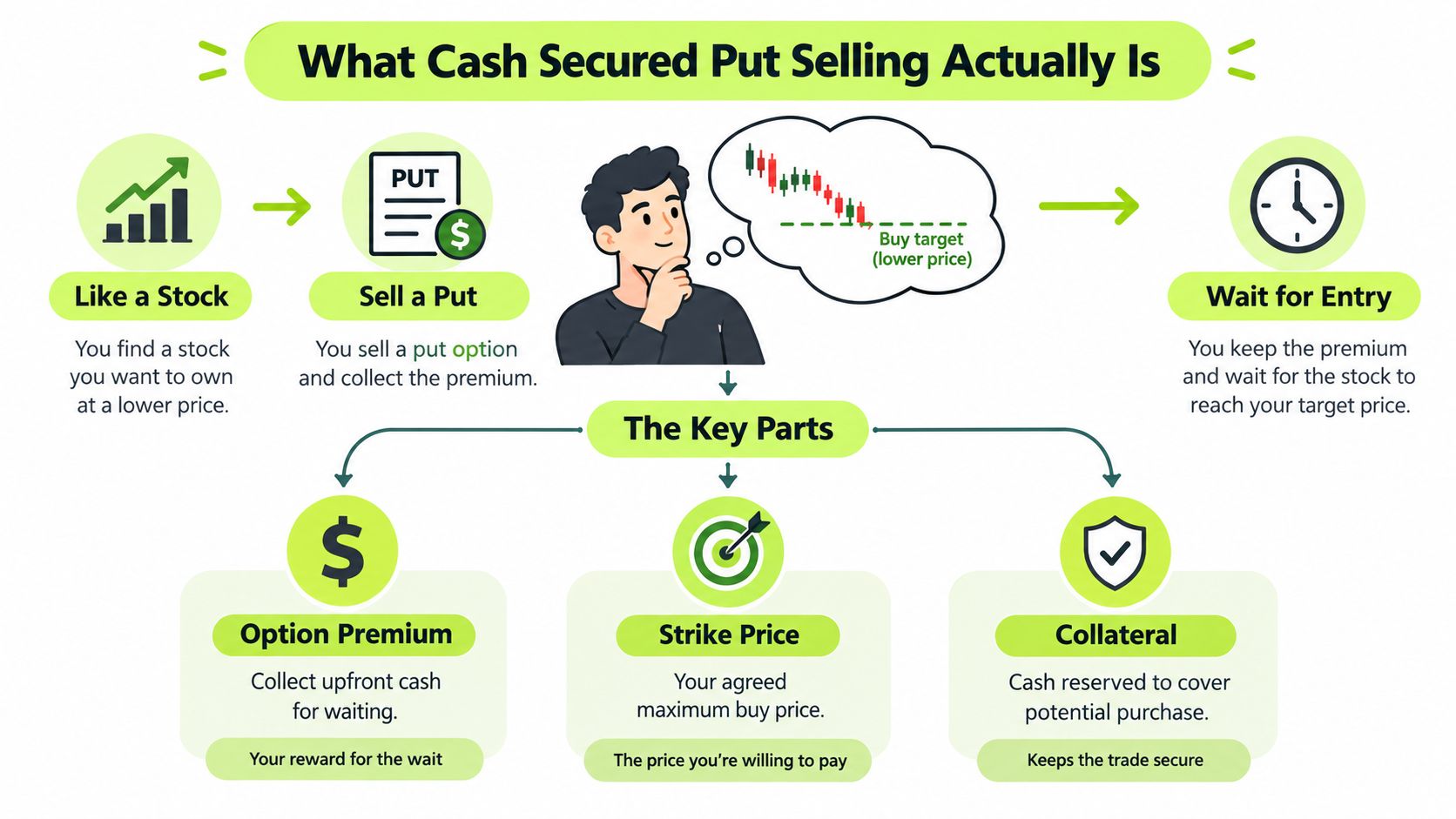
A **cash-secured put** combines a short put position with cash reserved for the purchase it could require. You submit a sell-to-open order, receive premium, and accept an obligation to buy the underlying shares at the strike if assigned. Unlike an unsecured or margin-dependent position, you've funded that purchase rather than relying on borrowing capacity.
The mechanics below separate the payment you receive from the obligation you accept.
### What you're agreeing to buy
For a standard U.S. equity-options contract, the purchase obligation is **strike price × 100 shares**, with the received premium reducing the net funding requirement, as described in [FINRA's explanation of options obligations](https://www.finra.org/investors/investing/investment-products/Options). Keep the premium available if you're counting it toward that funding.
The strike is your contractual purchase price, not a promise that the shares will remain worth that much. A stock can trade well below your agreed entry before you become its owner.
- **Above the strike at expiration:** The put can expire worthless, leaving you with the premium and no shares.
- **Assigned:** You pay the agreed strike and receive the shares, even when their market value is lower.
- **Before expiration:** Don't treat the scheduled expiration date as your only possible purchase date. Assignment is an obligation, not an appointment you control.
### The account test
Before opening the trade, inspect the account rather than just the options chain. Confirm that options permissions are in place, cash is available, and other orders haven't committed the same funds elsewhere. Use your broker's displayed collateral requirement as the operational check.
> **Practical rule:** If receiving the shares would force you to sell something else, reconsider whether the position belongs in a cash-secured workflow.
The simplest explanation is also the most useful: you're collecting a fee for agreeing to buy shares on specified terms. That's different from placing a cancellable stock limit order. Once you've sold the option, changing your mind requires managing an existing position, potentially at a loss.
## The Long-Run Numbers Behind the Trade
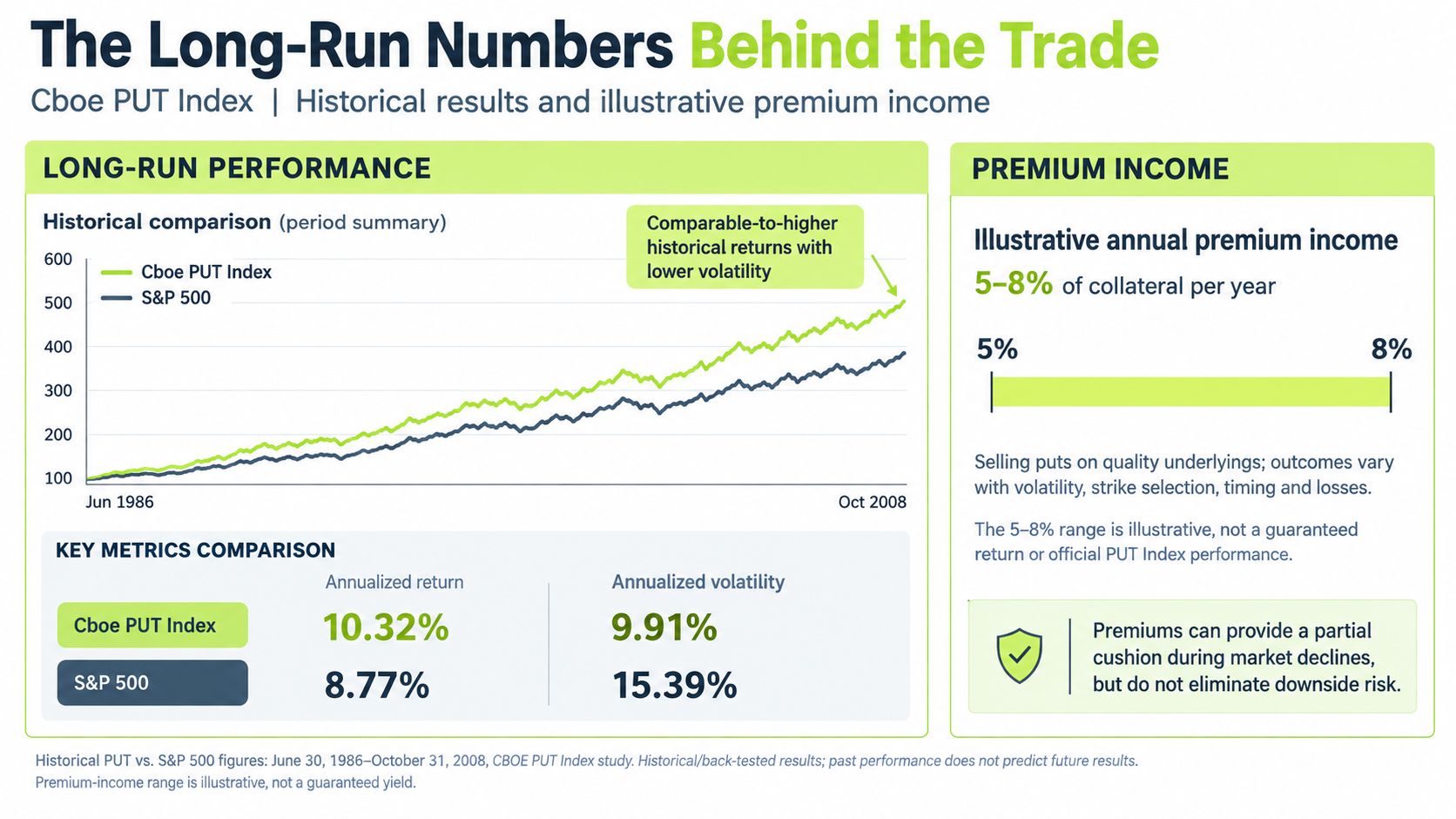
The **Cboe S&P 500 PutWrite Index**, or PUT, is a useful benchmark because it represents a systematic strategy rather than a collection of attractive option credits. It sells monthly at-the-money index puts against cash collateral. That makes it a reference for the economics of underwriting, not a return forecast for your stock watchlist.
The historical comparison should be read as a total-return and risk comparison, not an income target.
### Read the whole return profile
Through August 31, 2023, PUT's annualized return was **9.40%**, versus **9.91%** for the S&P 500; annualized volatility was **10.26% versus 15.38%**, and maximum drawdown was **−32.66% versus −50.96%**, according to [Cboe's long-run put-writing comparison](https://www.cboe.com/insights/posts/generating-income-and-managing-risk-cash-secured-put-writing-in-a-low-equity-return-environment/).
The same Cboe comparison reports outperformance in **95%** of rolling periods when the market's one-year return was negative, **69%** when returns were between **0% and 5%**, and **75%** when returns were between **5% and 10%**. Those are conditional historical comparisons, not probabilities that your next put will make money.
Lower volatility didn't mean a small worst-case loss. The benchmark still experienced a substantial drawdown, and an individual company doesn't provide the diversification of an index.
### Premium isn't investment return
During 2006–2015, average annual **gross premiums** were **24.1%** for monthly PUT writing and **39.3%** for a weekly rollover version, before exposure losses, costs, financing, taxes, and implementation frictions, according to [Cboe's study of weekly and monthly PutWrite indexes](https://ir.cboe.com/news/news-details/2016/New-Study-On-Weekly-Monthly-SP-500-PutWrite-Indexes-Released-01-27-2016/default.aspx).
> A premium ledger records what you collected. A performance ledger also records what you lost to collect it.
That distinction matters when reviewing [backtested trading strategies](https://pineflows.com/blog/backtested-trading-strategies). Require equity curves that include losing positions, collateral, and realistic execution assumptions. Reject tests that count credits as profits while leaving underwater shares out of the result.
For a complementary walkthrough of the trading approach, use the video alongside those accounting checks.
The practical conclusion isn't that put writing beats holding stocks. It's that the trade-off changes with the market: you exchange participation in strong advances for premium income while retaining meaningful downside exposure.
## Setting Up the Trade From Selection to Order Entry
The ticket looks harmless right up to the fill. Then the position screen shows a short put that can become shares, cash already spoken for, and a reason for owning the company that needs to sound better than “the credit looked fat.” Treat the sale as underwriting. You are agreeing in advance to buy the business at the strike if the counterparty exercises, so price that obligation before you admire the fee for standing ready.
### Underwrite before you price
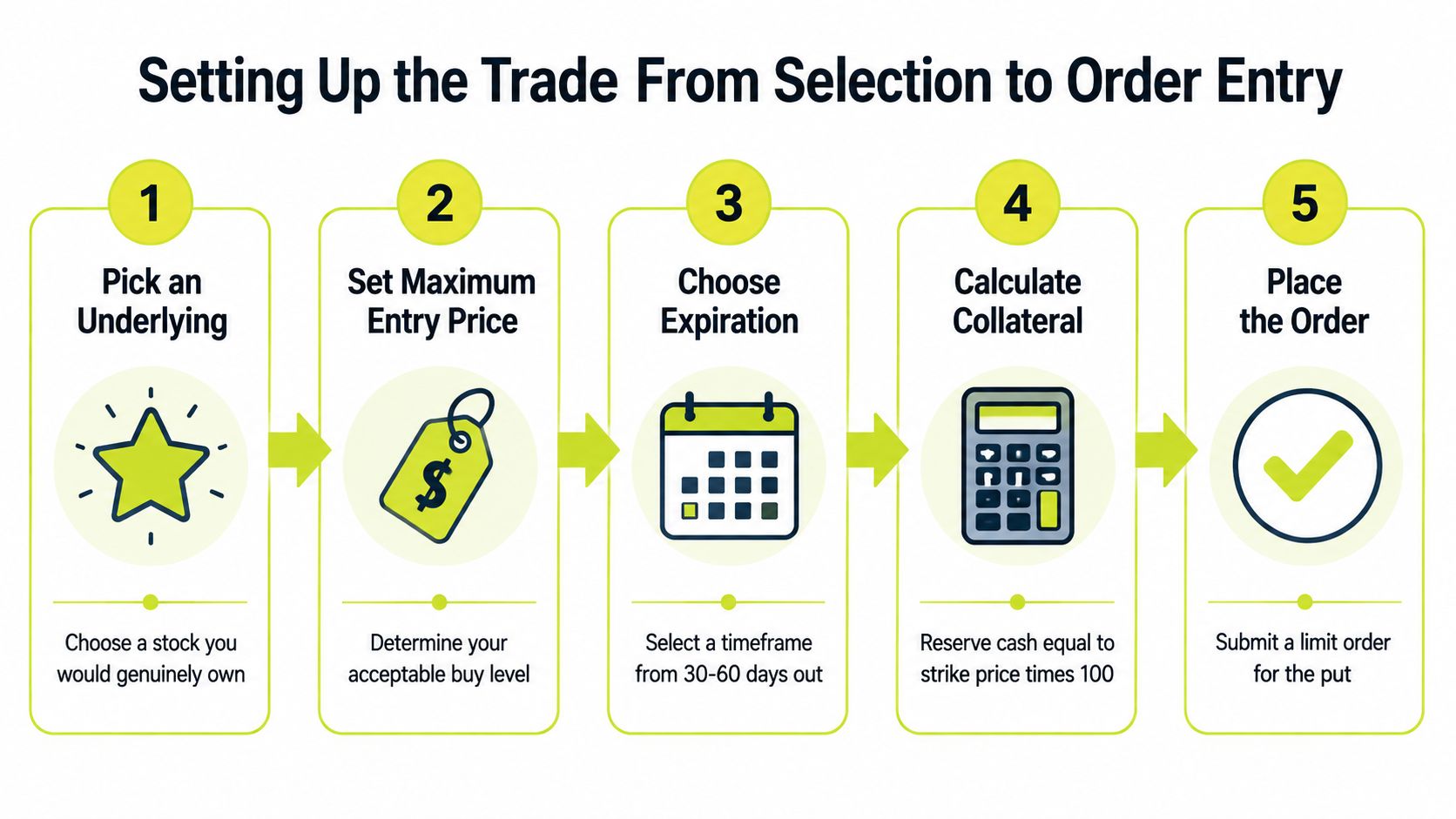
Set the purchase decision in plain language: why this company, what evidence would prove the thesis wrong, and the highest price you would accept during a weak tape. Keep that number independent of the chain. If the strike has to creep upward before the trade feels worthwhile, the premium is negotiating against your discipline.
Expiration is a supervision window, so choose a date you can monitor through earnings, guidance, rate headlines, and thin holiday trading. Then read the contract like a lender reading collateral: delta tells you how quickly the position starts behaving like stock, the bid and ask show how much credit you may give back on entry or exit, open interest needs to be checked beside live size, and implied volatility needs a reason buyers are paying for insurance. A rich offer still needs an explanation.
### From chain check to order ticket
Carry forward the same arithmetic used earlier: **break-even equals strike minus premium per share**, before commissions, fees, taxes, and the emotional cost of owning a falling name. Verify that reserved cash covers the full assignment obligation at quantity, then inspect the ticket field by field: underlying, put, expiration, strike, multiplier, **sell-to-open**, and limit price.
Use a **limit order** when you enter manually so the minimum acceptable credit is explicit. A limit still can sit unfilled, and a midpoint display is a reference, not a promise. If a TradingView alert routes you toward a Robinhood order flow, let it start the review instead of finishing it. Keep the [Robinhood stock trading workflow](https://pineflows.com/blog/robinhood-stock-trading) beside the option ticket for account mechanics, while the contract selection stays under the underwriting test.
After execution, record the fill you received, attach the ownership thesis, and write the management conditions you agreed to before adrenaline had a vote. If you would resist owning shares at break-even during a bad week, the credit already gave its answer.
## Two Worked Examples With Visible P&L
A useful comparison doesn't need invented market quotes. Use the following **symbolic setups** to calculate the payoff from contracts available in your account. The conservative and aggressive labels describe intended positioning, not verified probabilities or recommendations.
Let **L** represent a lower-strike put and **H** a higher-strike put on the same underlying. Each has its own quoted premium and expiration; don't assume the higher-strike contract is better merely because its credit looks larger.
### Comparing Two Cash-Secured Put Setups
| Setup | Conservative lower-delta put | Aggressive higher-delta put |
|---|---|---|
| Strike | Kₗ | Kₕ |
| Premium per share | Pₗ | Pₕ |
| Contract share multiplier | M | M |
| Net funding requirement | M × (Kₗ − Pₗ) | M × (Kₕ − Pₕ) |
| Economic break-even | Kₗ − Pₗ | Kₕ − Pₕ |
| Maximum gross profit | M × Pₗ | M × Pₕ |
| Maximum loss if shares become worthless | M × (Kₗ − Pₗ) | M × (Kₕ − Pₕ) |
| Gross premium yield on net funding | Pₗ ÷ (Kₗ − Pₗ) | Pₕ ÷ (Kₕ − Pₕ) |
These are payoff identities, not return observations. Use actual executed premiums, and subtract applicable costs separately.
### Follow the position through expiration
**Example L, the lower-strike sale:** Suppose the underlying finishes above its strike. The gross expiration profit is the premium received, regardless of how far the stock rallied. If the shares finish below the strike but above break-even, the premium still exceeds the share-value shortfall.
**Example H, the higher-strike sale:** Suppose the underlying finishes below break-even. The combined expiration P&L is **M × (ending share price − Kₕ + Pₕ)**. Assignment doesn't create that economic loss from nothing; it converts the existing exposure into a stock position.
The same terminal-price comparison makes the opportunity cost visible:
- **Stock rises:** Both sellers may retain their credits, but neither receives the stock's full upside.
- **Stock stays flat:** The result depends on where that unchanged price sits relative to each strike.
- **Stock falls:** Compare the ending price with each break-even, not merely with the original stock price.
Before expiration, these terminal formulas aren't sufficient to explain the option's quoted value. If you close early, use **premium collected minus repurchase cost**, adjusted for expenses, to calculate realized P&L.
Don't annualize the table's premium yield and call it an expected return. That assumes repeatable terms and leaves the adverse purchase outcomes unresolved. The important comparison is whether the credit compensates you for the specific obligation, not which column produces the more attractive yield.
## Managing the Trade and Handling Assignment
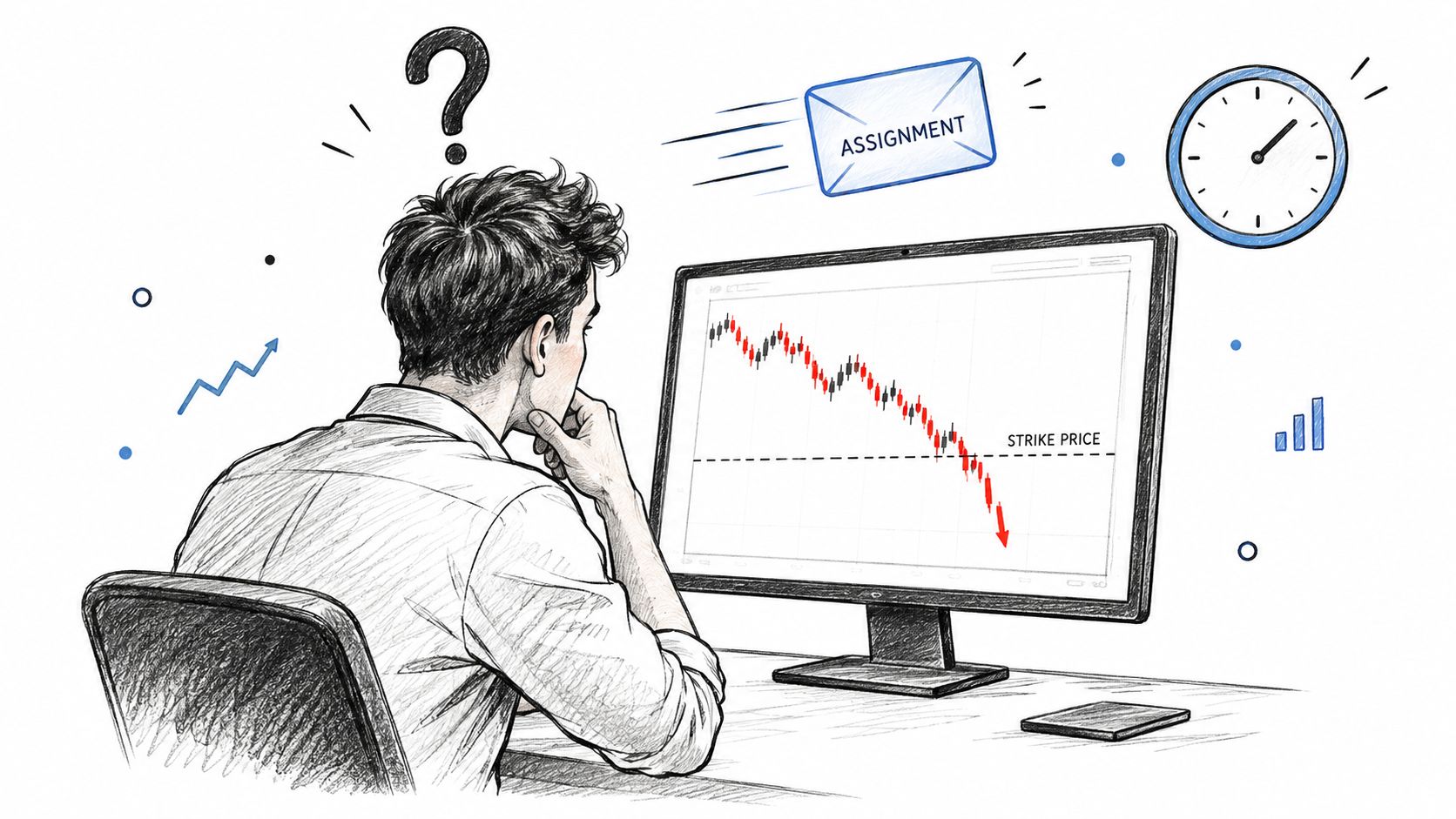
The screen that matters is the one you open after an overnight decline. Your short put sits underwater, the original entry price feels distant, and the buyback quote stings. None of that tells you whether holding, rolling, or closing is the right call.
Start with the stock you would own today, not the one you researched before the news.
### Re-underwrite the position
For American-style options, assignment can occur **on any business day**, the odds climb as puts move deeper in the money and approach expiration, and the notification can lag the event itself, according to the [Options Industry Council's assignment guidance](https://www.optionseducation.org/referencelibrary/faq/options-assignment). A plan built around receiving a convenient warning first will fail you.
So run the same checks you would run on a fresh sale. Has new information changed what the shares are worth? A lower price doesn't repair a damaged business case. Does the resulting stock position still fit next to your related holdings, and what happens if your other short puts also turn into purchase obligations? Compare the premium now on offer against the uncertainty you would keep underwriting, because high implied volatility alone isn't a reason to extend. Then weigh the collateral: is holding this obligation better than freeing the cash for another use?
### Three exits, three different trades
| Action | What changes | When it earns its place |
|---|---|---|
| Buy to close | You pay to remove the remaining obligation, and any loss becomes realized | The thesis broke, or the remaining credit doesn't compensate for the exposure retained |
| Roll | You close the current contract and open a later or lower-strike one | The revised ownership case still works and the replacement passes a fresh underwriting check |
| Accept assignment | Collateral converts into shares at the strike | You would buy the stock at this price with today's information, and the allocation fits |
A net credit on the roll doesn't erase the first trade's result. Moving to a lower strike usually means giving something up elsewhere, whether duration, premium, or both, so treat the replacement as a new decision rather than a continuation of the old one.
Taking shares shouldn't be the default just because assignment appeared in the original plan. Selling a covered call afterward doesn't automatically repair a purchase you no longer want.
> Cash collateral addresses funding. It doesn't establish a floor under the shares you receive.
For positions already in profit, compare the remaining credit with the obligation you must retain to earn it. Buying back early can remove exposure and release cash, but it also gives up potential remaining profit. Decide based on the current trade, not a need to label every exit a win.
A written assignment plan won't protect you from loss. It protects you from improvising the entire decision while the position screen is red.
## Automating Alerts and Execution Responsibly
Your alert level fails during a broad selloff, TradingView fires, and the routing service is ready to act within seconds. That is exactly when the underwriting question changes. The signal may still be valid, while the resulting obligation may no longer fit the stock, the account, or the price you would accept.
For a TradingView-to-Robinhood workflow, start with a [test-first approach to automating TradingView alerts](https://pineflows.com/blog/automate-tradingview-alerts). Prove that the connector can carry the intended option contract, sell-to-open instruction, quantity, limit price, and collateral handling before live capital enters the process. Stock-order support does not establish options-order support, and a market-order integration cannot express a limit-price requirement it was never built to understand.
Run the first stage in test mode. Compare every incoming alert with the order it would have produced, and log alert receipt, order submission, broker acceptance, and execution separately. Delivery is not a fill. Require duplicate detection so one repeated condition cannot create an additional position without an explicit decision.
Rehearse the failures before relying on the successes. An unavailable contract should fail visibly, a rejected order should remain rejected, and a repeated event should not attempt a hidden retry. A paused strategy should prevent new exposure while leaving valid buy-to-close instructions available.
Check TradingView plan eligibility and authentication requirements during setup. Keep broker credentials inside the broker's authorization process rather than placing passwords or reusable access tokens in configuration messages. Review the broker account against the routing log until each status has a clear meaning.
Automation can shorten the distance between a reviewed decision and an order. It should not turn a firing alert into an obligation you would reject after looking at the position screen.
## A Pre-Live Checklist and Common Mistakes
Before going live, write a compact trade ticket that captures the decision rather than just the contract. Someone reading it should understand why you chose the underlying, what would change your mind, and how you intend to respond.
### Keep this beside the order screen
- **Ownership case:** State why the shares belong in your portfolio.
- **Reserved funding:** Confirm that the account can carry the obligation without relying on another position's sale.
- **Entry discipline:** Check that the economic purchase price matches your valuation.
- **Management conditions:** Record what would lead you to close, replace the contract, or retain the shares.
- **Execution controls:** Inspect the contract and order instructions, then verify the fill.
- **Automation boundary:** Document which decisions remain manual and how you'll stop new entries.
The recurring mistake is changing the ownership standard to keep collecting premium. That includes reaching for unfamiliar stocks, accepting event exposure you haven't assessed, and tolerating poor execution because the headline credit looks generous.
> **Before submitting:** Ask whether you'd approve the obligation without seeing its premium first.
Treat time decay as part of the trade, not a substitute for reviewing price risk. Likewise, don't let a winning streak justify larger commitments without reconsidering portfolio exposure.
Your parameters should reflect the underlying, market conditions, available liquidity, and your capacity to manage the position. The useful discipline is repeatable decision-making, not an unchanging strike or expiration rule.
---
[Pineflows](https://pineflows.com) turns TradingView strategy alerts into executable Robinhood orders through a test-first pipeline with pause controls and an auditable event history. Visit to evaluate the routing workflow, verify supported instruments and order types, and test your alerts before enabling live execution.