# Best Algo Trading Platform for Retail Traders in 2026
> Find the best algo trading platform in 2026 with a side-by-side comparison of features, safeguards, latency, and pricing—plus a fit-based shortlist and audit
Source: https://pineflows.com/blog/best-algo-trading-platform
Published: 2026-10-18
Updated: 2026-10-18
Tags: best algo trading platform, algo trading, trading automation, TradingView alerts, Robinhood
Most advice about the **best algo trading platform** starts in the wrong place. A long list of indicators, supported brokers, and coding languages won't tell you whether a repeated TradingView alert becomes an unwanted position in Robinhood. Start with what happens when delivery fails, an order status is ambiguous, or you need to stop new entries without disabling exits.
My recommendation is straightforward: choose the narrowest platform that supports your strategy and lets you prove what happened. Don't buy more automation until you can observe and control the automation you already have.
## Table of Contents
- [Why the Best Algo Trading Platform Is Not the One With the Most Features](#why-the-best-algo-trading-platform-is-not-the-one-with-the-most-features)
- [Compare operating behavior before features](#compare-operating-behavior-before-features)
- [Treat ambiguous execution as a deployment blocker](#treat-ambiguous-execution-as-a-deployment-blocker)
- [The Operational Safeguards a Platform Must Provide](#the-operational-safeguards-a-platform-must-provide)
- [Make these deployment requirements](#make-these-deployment-requirements)
- [Score evidence rather than promises](#score-evidence-rather-than-promises)
- [Latency, Routing, and What Actually Matters for a Strategy](#latency-routing-and-what-actually-matters-for-a-strategy)
- [Match the infrastructure to the signal horizon](#match-the-infrastructure-to-the-signal-horizon)
- [Measure outcomes, not a headline speed](#measure-outcomes-not-a-headline-speed)
- [Side-by-Side Comparison Across Retail, Quant, and Institutional Options](#side-by-side-comparison-across-retail-quant-and-institutional-options)
- [Algo Trading Platforms Compared by Safeguard and Strategy Fit](#algo-trading-platforms-compared-by-safeguard-and-strategy-fit)
- [Where each architecture earns its place](#where-each-architecture-earns-its-place)
- [Evaluate the safeguards outside the table too](#evaluate-the-safeguards-outside-the-table-too)
- [Running a Pre-Deployment Readiness Test on Any Platform](#running-a-pre-deployment-readiness-test-on-any-platform)
- [Validate the alert without creating exposure](#validate-the-alert-without-creating-exposure)
- [Prove the broker path separately](#prove-the-broker-path-separately)
- [Pineflows' Place in the Algo Trading Platform Landscape](#pineflows-place-in-the-algo-trading-platform-landscape)
- [A narrower integration can be the appropriate choice](#a-narrower-integration-can-be-the-appropriate-choice)
- [Understand the scope of its controls](#understand-the-scope-of-its-controls)
- [Matching the Right Platform to Your Trader Profile](#matching-the-right-platform-to-your-trader-profile)
- [The TradingView-only retail trader](#the-tradingview-only-retail-trader)
- [The quant hobbyist](#the-quant-hobbyist)
- [The newer trader](#the-newer-trader)
- [Decision Checklist Before You Turn Live Trading On](#decision-checklist-before-you-turn-live-trading-on)
## Why the Best Algo Trading Platform Is Not the One With the Most Features
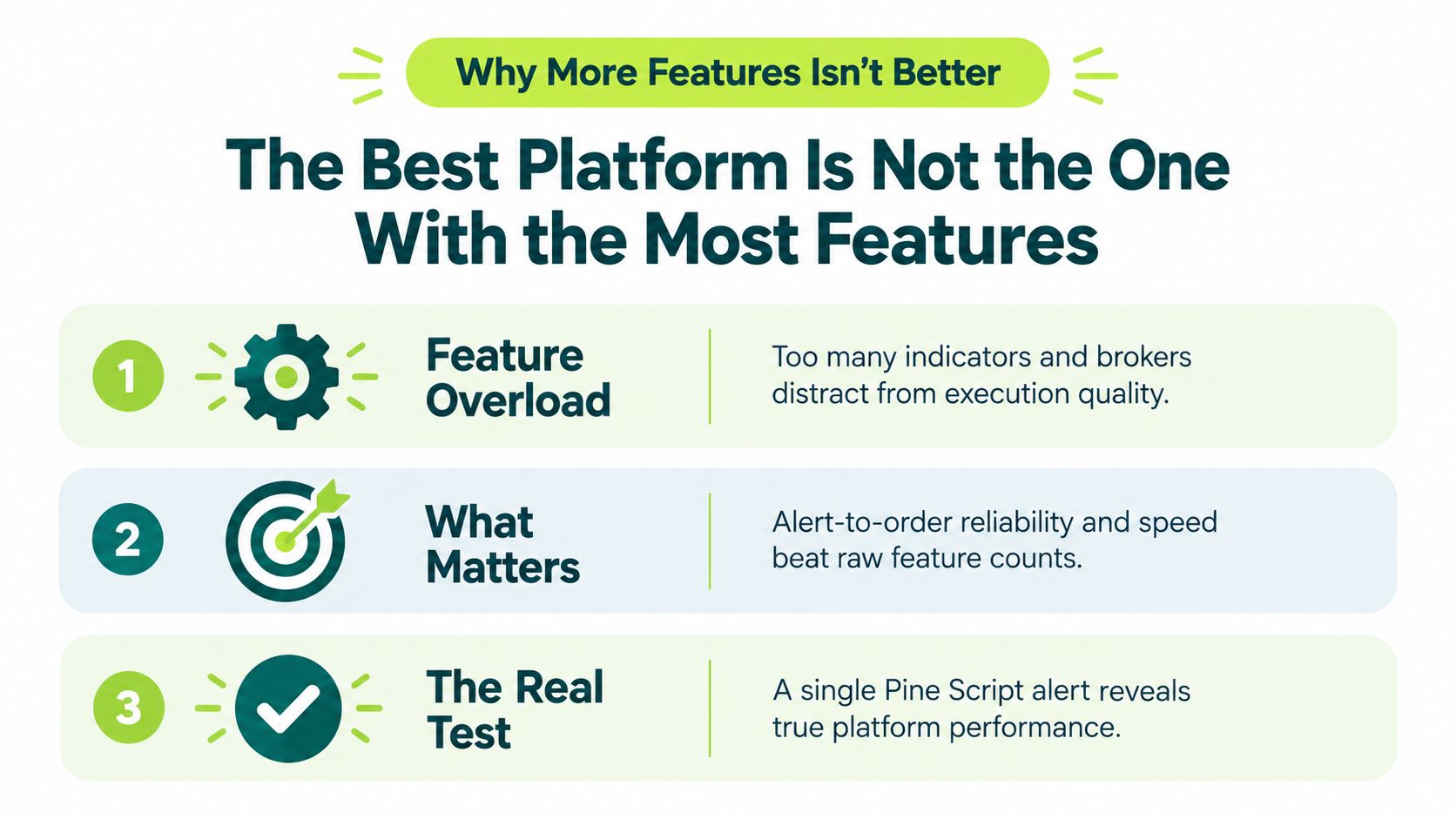
Feature count is a poor proxy for execution quality. A platform can support advanced research while leaving you unable to distinguish an alert received from an order accepted, or an order accepted from a trade filled. Those distinctions matter once your Pine Script strategy controls real exposure.
The market's historical transformation explains why. Between **2005 and 2009**, NYSE consolidated average daily share volume increased **181%**, daily trades rose **662%**, and average execution time for small, immediately executable orders fell from **10.1 seconds to 0.7 seconds**, according to the [BIS review of fast-paced electronic markets](https://www.bis.org/publications/monitoring-fast-paced-electronic-markets.pdf). More activity and faster processing made reliable order handling and accurate execution records increasingly important.
### Compare operating behavior before features
Use this initial filter before opening a pricing page:
| Evaluation question | Feature-first comparison | Execution-first comparison |
|---|---|---|
| Can it automate my strategy? | Counts integrations | Verifies alert semantics and supported orders |
| Is it fast? | Quotes API response time | Measures the complete delivery and execution path |
| Is it safe to deploy? | Lists risk-management features | Demonstrates testing, duplicate handling, and emergency controls |
| Did it work? | Shows a successful webhook | Links the alert to broker status and fill evidence |
For a TradingView-to-Robinhood workflow, your requirement isn't an impressive dashboard. It's a faithful translation of the strategy's intent into broker orders, with enough evidence to investigate a discrepancy. A green webhook response doesn't establish that the broker filled the requested quantity.
The useful distinction is simplicity with accountability, not simplicity at any cost.
### Treat ambiguous execution as a deployment blocker
Ask the vendor to demonstrate a rejected order, a repeated alert, and an interrupted workflow. Watch whether the interface identifies what happened and tells you what remains unresolved.
> **Practical rule:** A platform hasn't demonstrated reliable execution until you've seen how it handles an unsuccessful event.
Don't assume a larger broker list improves your setup. If you trade a Pine Script strategy through Robinhood, unused adapters don't help you reconcile that strategy's position with your account. Evaluate the workflow you'll run, not the workflows advertised beside it.
## The Operational Safeguards a Platform Must Provide
Automation requires controls because it can repeat a mistake as efficiently as it repeats a valid instruction. A correct entry condition doesn't protect you from repeated delivery, stale state, or an operator who can't tell whether submission succeeded.
**FINRA's 2015 guidance** addressed algorithm development, deployment, testing, and post-implementation monitoring; the SEC also describes **2016 registration requirements** for people responsible for designing, significantly modifying, or supervising algorithmic strategies. Its discussion of the **2010 Flash Crash** sits alongside findings that most academic studies associate algorithmic and high-frequency trading with reduced short-term volatility, illustrating that outcomes depend on design and safeguards, as summarized in the [SEC report on algorithmic trading](https://www.sec.gov/about/reports-publications/special-studies/algo_trading_report_2020.pdf).
Those institutional lessons are useful design benchmarks, not a claim that every retail user has the same regulatory obligations.
### Make these deployment requirements
- **Test-first defaults:** Incoming alerts should be inspectable before the system can transmit broker orders. Testing must be an operating mode, not an informal promise to use small size.
- **Explicit live activation:** The transition should be deliberate and visible. Editing an alert or reconnecting an account shouldn't change the execution mode without notice.
- **Event-level idempotency:** Processing the same event again must not create another order. Ask what identifies an event and how retries retain that identity.
- **Human-readable payloads:** You should be able to inspect the intended instrument, action, quantity, and event identifier without reverse-engineering an opaque message.
- **Pause behavior that preserves exits:** Stopping entries must not strand existing exposure. Clarify what happens to pending entries and which exits remain eligible.
- **Credential boundaries:** Establish who authenticates the brokerage connection and what secrets the automation service can access. Never paste broker passwords into chat or support forms.
- **An event-to-order audit trail:** Records should distinguish receipt, validation, submission, broker acknowledgment, rejection, cancellation, and fill where those states apply.
### Score evidence rather than promises
Mark each requirement **demonstrated**, **documented but untested**, or **unavailable**. Don't give a reassuring feature label the same weight as a completed test.
For a chart-based Robinhood strategy, duplicate suppression and order-state visibility deserve immediate attention. An alert can be syntactically correct while representing the wrong action for the position held. The vendor must make that mismatch diagnosable.
Use the [trade execution software evaluation guide](https://pineflows.com/blog/trade-execution-software) to frame questions around the execution workflow rather than the signal-generation interface. If a vendor can't explain its state transitions in plain language, don't compensate by trusting its marketing.
## Latency, Routing, and What Actually Matters for a Strategy
Don't compare an entire automation pipeline with another vendor's isolated API measurement. Start the clock at the event your strategy reacts to, and stop it at the outcome you need to verify.
The execution path below is a useful starting map, but broker arrival isn't the finish line.
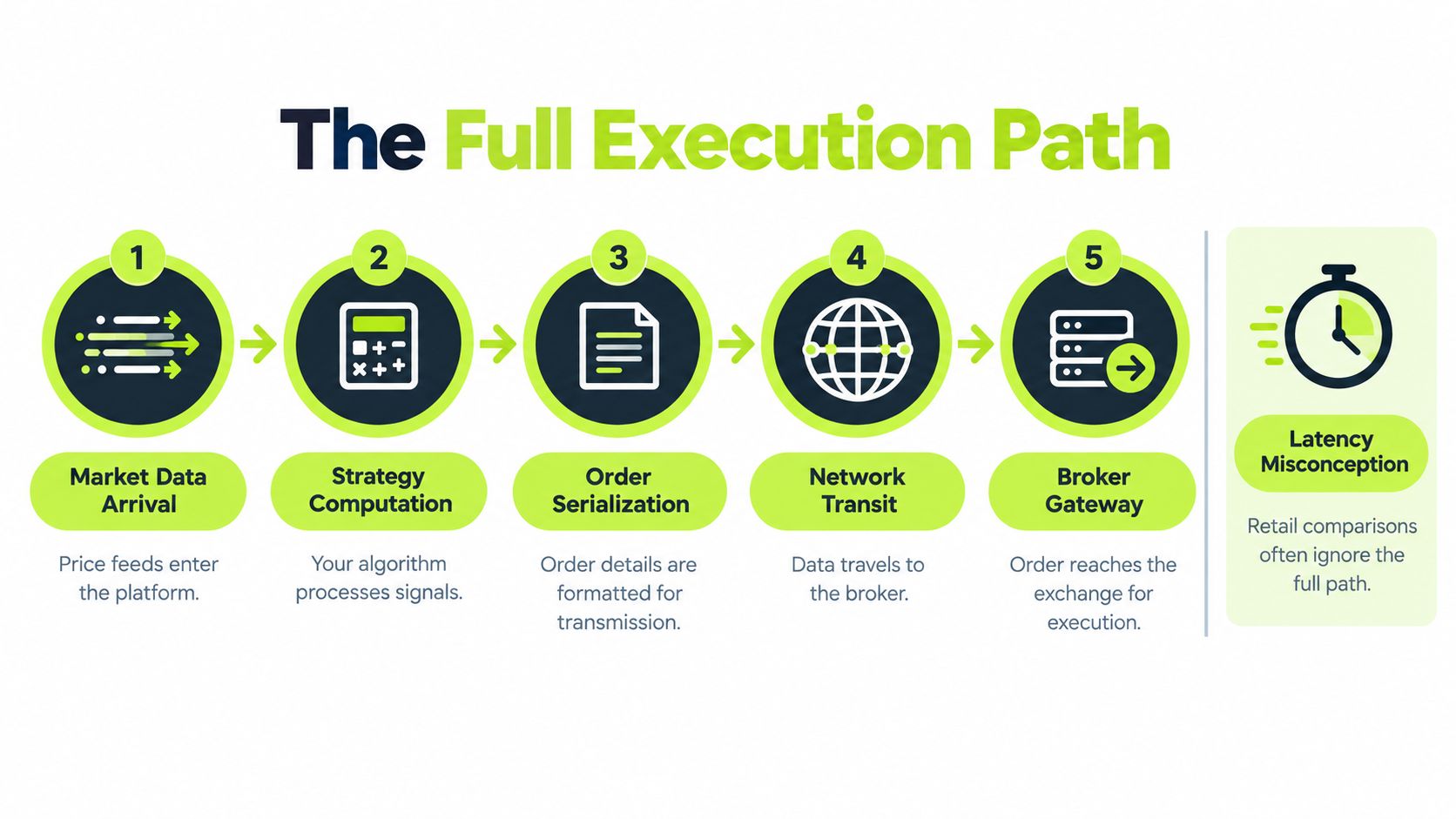
After market-data arrival, strategy computation, order serialization, and network transit, the broker still has to process and route the order. Acknowledgment and fill are separate outcomes. Measuring only the webhook receiver ignores everything downstream.
### Match the infrastructure to the signal horizon
A [published comparison of algorithm deployment infrastructure](https://www.breakingalpha.io/insights/api-integration-requirements-algorithm-deployment) places typical direct-exchange connectivity at approximately **0.1–5 ms**, consolidated market-data providers at **10–100 ms**, cloud data services at **50–200 ms**, and broker APIs at **100–500 ms**. These are infrastructure categories, not promised end-to-end measurements for your account, and you shouldn't add them together as a universal budget.
For bar-close or slower signal-driven intraday and swing strategies, prioritize deterministic delivery and broker-state reconciliation. If your edge depends on reacting to order-book changes before other participants, a retail webhook pipeline is the wrong starting architecture.
Execution research reinforces that distinction: an imbalance-based policy in liquid U.S. Treasury bonds operating at approximately **1 ms** reduced liquidation cost by about **one-third of the spread** against a naive TWAP benchmark when trading frequency remained near **one trade per minute**, according to the [study of latency and liquidity in Treasury execution](https://www.smallake.kr/wp-content/uploads/2015/09/SSRN-id2661618.pdf). That result describes a specific policy and market, not an expected benefit for retail equity automation.
### Measure outcomes, not a headline speed
Record the following during controlled testing:
- **Submit-to-acknowledgment:** How long until the broker confirms receipt?
- **Cancel round-trip:** When does cancellation become confirmed rather than merely requested?
- **Fill confirmation:** When can you reconcile executed quantity and price?
- **Timeouts and tail latency:** Capture slow cases, including p95/p99, rather than hiding them in an average.
- **Implementation shortfall:** Compare actual execution with the strategy's expected execution reference.
The supplied video provides an additional viewing resource.
Use the [Robinhood stock trading workflow guide](https://pineflows.com/blog/robinhood-stock-trading) when checking broker-specific behavior. Your acceptance criterion should be a strategy-compatible execution path, not an attractive latency number measured somewhere else.
## Side-by-Side Comparison Across Retail, Quant, and Institutional Options
Compare architectures before brands. TradingView-native services, Python research frameworks, and institutional execution stacks solve different problems, so a universal winner would conceal the tradeoffs you need to understand.
The table is an **evaluation guide**, not a verified product ranking. Require documentation and demonstrations before assigning a pass to any particular implementation.
### Algo Trading Platforms Compared by Safeguard and Strategy Fit
| Tier | Test-first default | Event idempotency | Pause with exits intact | Audit trail | Backtest fidelity | Typical latency fit | Pricing posture |
|---|---|---|---|---|---|---|---|
| TradingView-native retail | Verify service default | Require event-ID evidence | Demonstrate entry and exit distinction | Require alert-to-fill traceability | Preserve Pine logic; reconcile live fills | Bar-close and slower signal-driven execution | Check subscription and external dependencies |
| Python quant framework | Configure explicitly | Build or verify execution-layer handling | Design strategy-aware controls | Instrument the complete workflow | Customize assumptions and simulation logic | Depends on deployment and broker connection | Evaluate software plus engineering and hosting |
| Institutional execution stack | Require a staged environment | Inspect gateway and order-management behavior | Verify scope across active orders | Evaluate lifecycle records and reconciliation | Depends on research and execution integration | Specialized low-latency requirements | Obtain a complete infrastructure and support quote |
### Where each architecture earns its place
**TradingView-native retail automation** is the natural starting point when Pine Script is already your strategy's source of truth. The important advantage is avoiding an unnecessary translation into another language. Verify whether the service preserves entry and exit semantics, which brokers it supports, and whether its order types match the backtest's assumptions.
Don't confuse minimal script edits with identical live results. A strategy modeled with price-constrained orders needs explicit review if the execution service transmits market orders. Compatibility means matching intended behavior, not merely accepting a webhook.
**Python quant frameworks** suit traders who want control over simulation, portfolio logic, and execution code. My assessment is that they offer more room to model unusual assumptions, but that flexibility also leaves more operational responsibilities with the builder. Backtest sophistication isn't a substitute for retry handling or account reconciliation.
**Institutional stacks** belong on the shortlist when direct connectivity and exchange-aware execution are genuine strategy requirements. They aren't automatically safer because they're advanced. Ask how the research model connects to order management, who owns production monitoring, and how operators recover from uncertain order state.
> Don't pay for institutional infrastructure to compensate for an untested retail workflow.
### Evaluate the safeguards outside the table too
The remaining requirements need direct inspection: readable payloads, credential ownership, and an unmistakable live activation step. Those aren't architecture-level guarantees.
For pricing, compare the complete operating burden. A retail subscription may still require TradingView access; a self-built system may require hosting, monitoring, and maintenance; a specialized stack may require connectivity and support arrangements. Don't equate a low software price with a low-cost production system.
Broker breadth deserves the same discipline. Additional adapters are useful when you need them, but each configuration must be validated. Choose breadth for a trading requirement, not as a proxy for quality.
## Running a Pre-Deployment Readiness Test on Any Platform
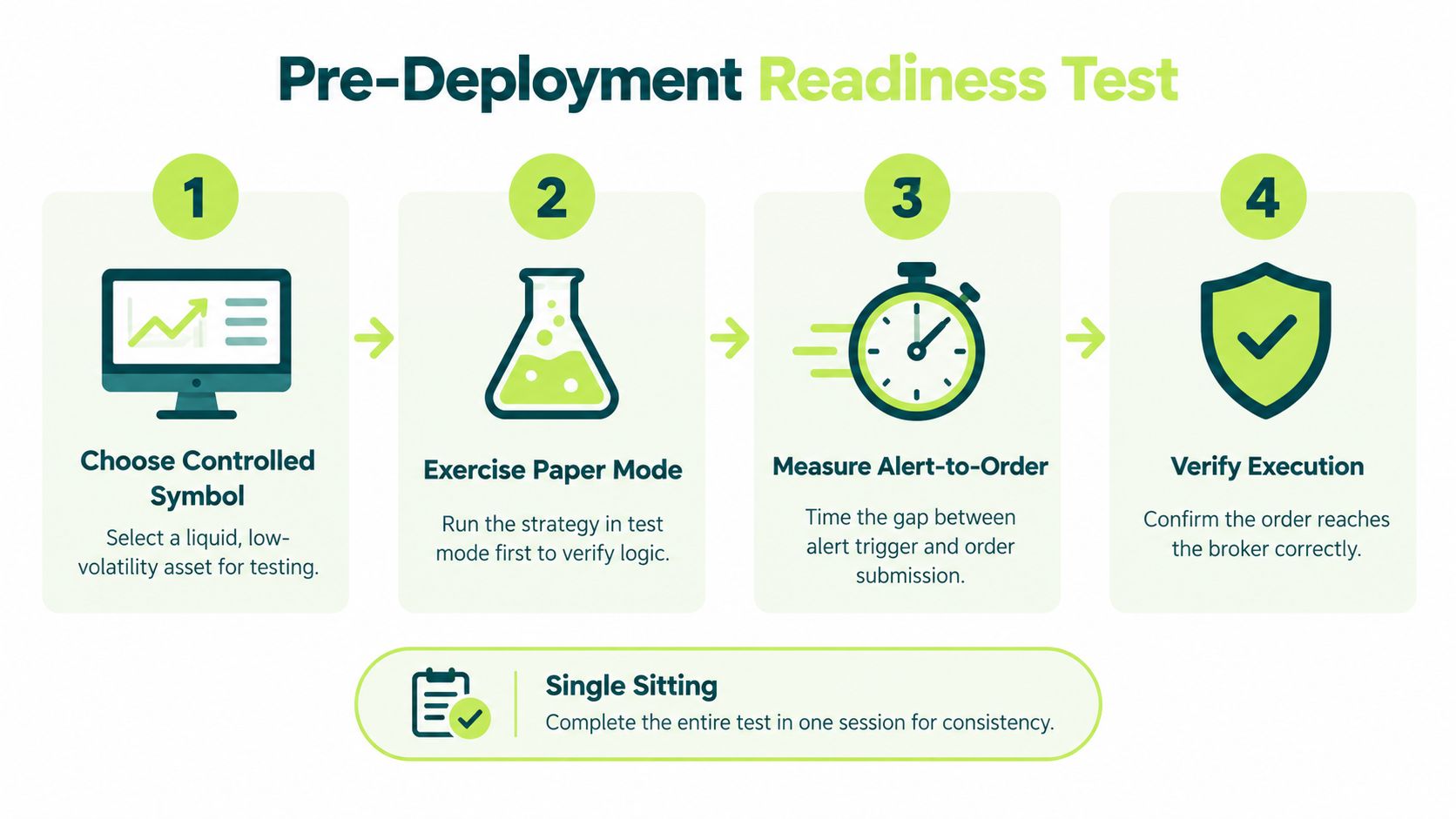
A readiness test should expose the difficult cases before you increase exposure. Use a controlled symbol, a deliberately constrained order size, and written expected outcomes. Keep the strategy configuration fixed while testing the execution path so you can identify the source of discrepancies.
The sequence below separates signal validation from actual broker execution.
### Validate the alert without creating exposure
Start in test mode and inspect the payload against the Pine Script condition that generated it. Confirm the instrument, direction, sizing interpretation, timestamp, and event identity. If an assistant proposed automation parameters, compare them directly with the script rather than treating generated configuration as validated code.
A log-only test mode proves receipt and interpretation, **not broker execution**. The [guide to paper trading in TradingView](https://pineflows.com/blog/how-to-paper-trade-in-tradingview) is useful for separating simulated strategy behavior from the downstream routing test.
- **Replay a known duplicate:** Preserve its event identity. Check that the system records the repeated delivery without creating another execution instruction.
- **Inspect unsupported instructions:** Establish what happens when a requested order type or instrument isn't supported. A visible refusal is preferable to an undocumented substitution.
- **Check authentication ownership:** Identify the connection mechanism and confirm that nobody requires broker credentials in a message or form.
- **Review incomplete events:** Ask how the system handles an interrupted submission when acceptance is unknown. Retrying blindly is not an acceptable recovery policy.
### Prove the broker path separately
Only after test-mode evidence is clean should you explicitly activate a controlled live test, if you choose to accept that exposure. Compare the submitted instruction with broker acknowledgment, executed quantity, fill price, and resulting account position. Don't mark the test complete merely because the platform displays “sent.”
Then exercise the emergency control. Establish that new entries stop, pending entry orders receive the intended treatment, and legitimate risk exits remain available. Record the observed behavior, including unresolved cancellations.
For the publisher's Pilot workflow, the default is a log-only test mode until live trading is explicitly enabled. Setup also requires a paid TradingView plan with two-factor authentication enabled, so confirm those prerequisites before troubleshooting delivery.
> **Release gate:** An unresolved order is a reason to stop deployment, not a reason to send the instruction again.
Retain the test records as your baseline. Repeat the relevant checks after changing alert construction, sizing rules, broker connections, or execution configuration.
## Pineflows' Place in the Algo Trading Platform Landscape
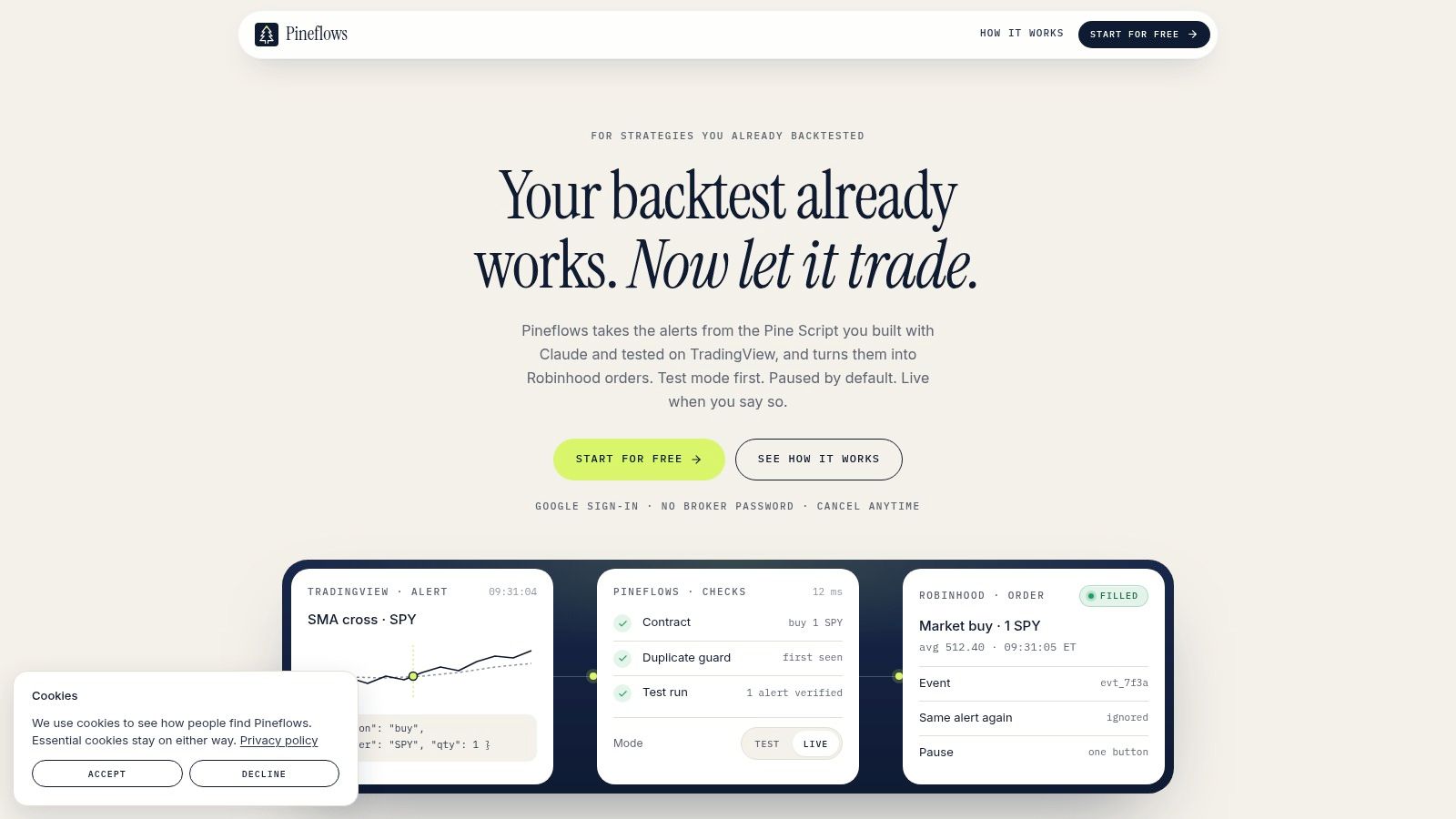
Pineflows is an option for the narrower **TradingView-to-Robinhood execution** workflow: it converts Pine Script strategy alerts into Robinhood market orders and provides test-mode logging, event-ID duplicate handling, payload inspection, delivery receipts, and order-status records. Its role is execution software, not a substitute for assessing whether the strategy itself is sound.
The product interface provides a concrete reference for that focused workflow.
### A narrower integration can be the appropriate choice
For someone already committed to Pine Script and Robinhood, I'd evaluate this category before considering a general-purpose execution framework. There's no reason to introduce a language rewrite and additional broker adapters unless the strategy needs them. Preserving the existing logic makes configuration review more focused.
That doesn't remove the need to examine how the strategy expresses orders. The publisher says most scripts need no edits beyond webhook routing, but the trader still needs to verify sizing, instrument mapping, and execution assumptions. Market-order routing is a specific capability, not a universal translation of every backtested order.
The documented credential boundary is also relevant: Google sign-in is used for service access, and Robinhood credentials aren't created or stored within the service. Keep service authentication and broker authorization conceptually separate when reviewing the setup.
### Understand the scope of its controls
Its pause behavior blocks new entries, cancels service-originated entry orders, and keeps valid exits available. That scope matters: don't assume an automation service controls unrelated orders you entered elsewhere in the brokerage account.
The same caution applies to event-ID handling. Verify the identity assigned to an actual alert and retain it in the audit record. The operator should still investigate contradictory strategy events or an uncertain broker state rather than assuming deduplication resolves every sequencing problem.
This narrower approach is worth evaluating when:
- **Pine Script remains authoritative:** You want routing, not a rewritten research environment.
- **Robinhood is the intended destination:** Additional broker coverage isn't a current requirement.
- **Market orders suit the strategy:** You've reviewed the difference between simulated and actual execution.
- **Operational review is a priority:** You want inspectable events before accepting live exposure.
It isn't the architecture I'd choose for tick-sensitive market making, bespoke venue connectivity, or a strategy requiring multi-broker routing. Those requirements justify a different execution layer. A focused tool is appropriate because it matches the job, not because narrowness guarantees better fills or profitable trading.
## Matching the Right Platform to Your Trader Profile
Your choice should follow the work you need to do, not the identity you want as a trader. A Pine Script author doesn't automatically need a Python production stack, and a newer trader doesn't need live execution just because a strategy has a backtest.
### The TradingView-only retail trader
Your strategy already runs in TradingView, and Robinhood is your intended execution account. Start by evaluating a webhook-based retail service that preserves the alert's meaning without an unnecessary rewrite.
**Verify order compatibility first.** If the strategy depends on a particular price constraint, market-order execution may change its behavior. Reject the integration if you can't explain that difference and test its consequences.
### The quant hobbyist
You've authored Pine Script but now want custom simulation assumptions, portfolio-level research, or greater control over execution code. A Python framework can be the appropriate research direction, provided you're willing to own the production work.
**Verify model parity first.** Compare signal timing, position sizing, and order assumptions before interpreting a translated backtest. Assistant-generated code should receive the same review as code you wrote yourself.
### The newer trader
You're still learning to distinguish a strategy signal from a broker order and an order from a fill. Choose a workflow that lets you inspect events without transmitting them, and stay there until the lifecycle makes sense.
**Verify the test-mode boundary first.** You should know exactly what can and cannot reach the broker in that mode. Don't use live capital to discover whether a switch means “record alerts” or “submit orders.”
> Choose the platform whose responsibilities you can explain and operate, not the one with the longest capabilities page.
Across these profiles, the deciding question is ownership. Identify what the vendor handles, what the broker handles, and what you must monitor yourself. If any responsibility falls between those parties, resolve it before deployment.
## Decision Checklist Before You Turn Live Trading On
Require evidence, not reassurance:
- **Traceability:** A clean test record and broker delivery evidence where applicable.
- **Duplicate handling:** A demonstrated replay that doesn't create another order.
- **Emergency behavior:** Entries stop while valid exits remain available.
- **Reconciliation:** Alert, order status, fill, and account position agree.
- **Authentication:** Broker credentials stay within the documented boundary.
- **Activation:** Going live requires an explicit action.
Ask the vendor: What stops repeated delivery from placing another order? What proves broker acceptance and execution? How do I halt entries without leaving existing risk unmanaged?
If an answer is unclear, keep live trading disabled.
---
Pineflows offers a test-first path from TradingView strategy alerts to Robinhood market orders, with inspectable event records and explicit live activation. Visit [Pineflows](https://pineflows.com) to review the setup requirements and start by validating your alerts in test mode before authorizing broker execution.