# Algorithmic Trading for Beginners: Build a Working System
> Learn algorithmic trading for beginners with practical steps for strategy design, backtesting, and automated execution using Pine Script and Robinhood.
Source: https://pineflows.com/blog/algorithmic-trading-for-beginners
Published: 2026-09-27
Updated: 2026-09-27
Tags: algorithmic trading for beginners, algorithmic trading, Pine Script, Robinhood automation, trading strategy
Algorithmic trading is converting a rules-based strategy into automated order execution, and the safest starting point is validating signals before they can place live trades. The retail algorithmic trading segment was estimated at **US$3,552.8 million in 2024** and projected to reach **US$7,175.2 million by 2030**, but access to automation doesn't remove execution risk ([Grand View Research retail algorithmic trading estimates](https://www.grandviewresearch.com/horizon/statistics/algorithmic-trading-market/type-of-trader/retail-investors/global)).
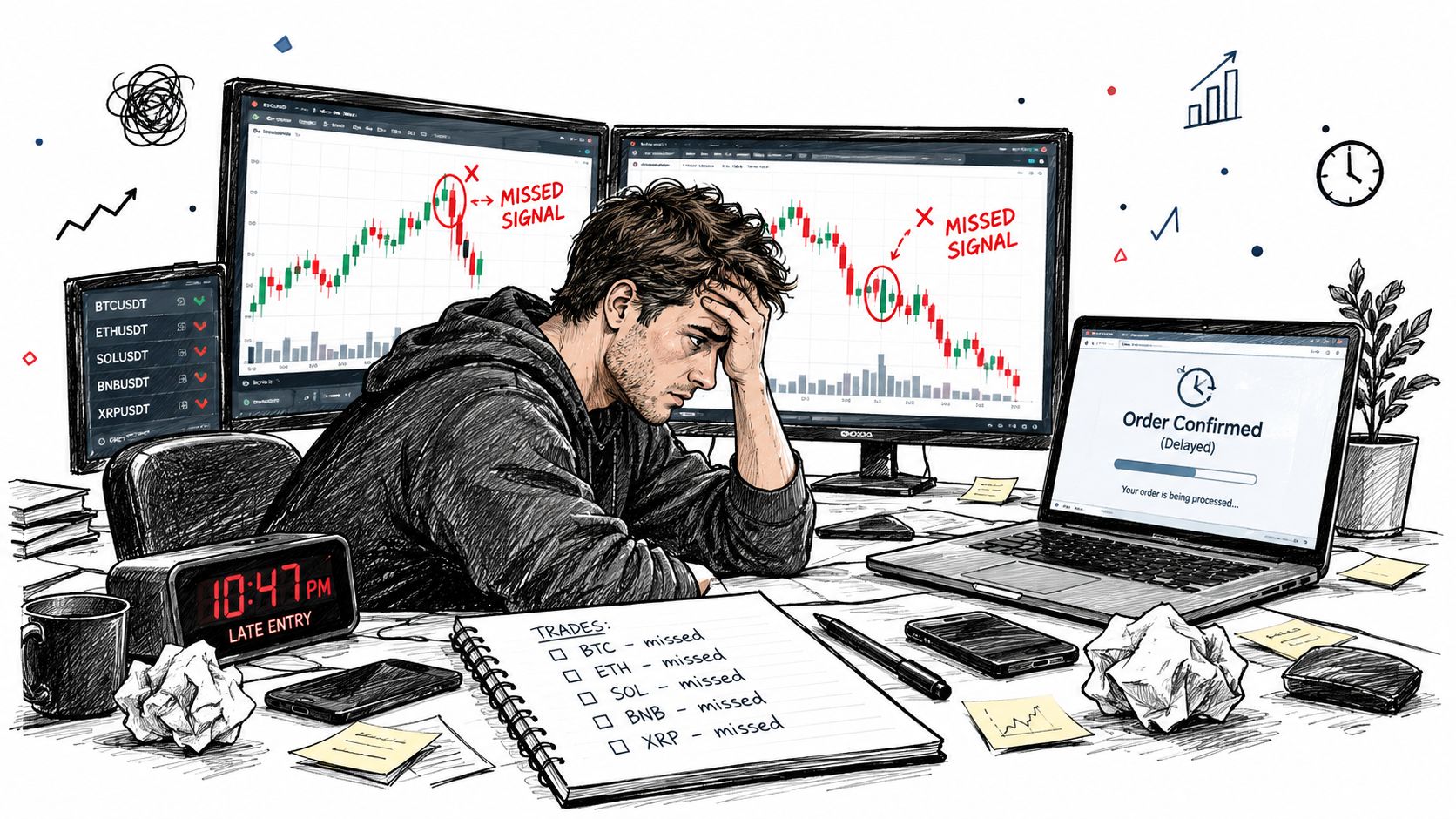
You may already know the frustration. A chart reaches your entry condition while you're away from the screen, or you see the alert but enter late because you were still checking the symbol, quantity, and order type. The strategy may have been correct, yet the manual handoff introduced hesitation, duplication, or an entirely different fill.
Algorithmic trading can reduce that repetitive friction, but it can't turn an untested idea into a reliable system. A careful beginner builds the logic, tests it with realistic assumptions, observes alerts without risking capital, and only then connects execution. The quiet danger usually sits between the signal and the broker, where missed alerts, duplicate events, stale orders, and weak monitoring can turn correct code into an incorrect trade.
## Table of Contents
- [Why Algorithmic Trading Exists for Retail Traders](#why-algorithmic-trading-exists-for-retail-traders)
- [Discretion versus a written system](#discretion-versus-a-written-system)
- [How Electronic Trading Evolved Into Beginner-Friendly Automation](#how-electronic-trading-evolved-into-beginner-friendly-automation)
- [Designing Your First Algorithmic Trading Strategy](#designing-your-first-algorithmic-trading-strategy)
- [Write the logic before writing the script](#write-the-logic-before-writing-the-script)
- [Backtesting Strategy Logic Before Real Market Exposure](#backtesting-strategy-logic-before-real-market-exposure)
- [Make the historical test harder to fool](#make-the-historical-test-harder-to-fool)
- [Execution Risks and Alert-to-Order Reliability](#execution-risks-and-alert-to-order-reliability)
- [Compare the handoff, not just the strategy](#compare-the-handoff-not-just-the-strategy)
- [Automating TradingView Alerts for Robinhood Executions](#automating-tradingview-alerts-for-robinhood-executions)
- [Use a test-first sequence](#use-a-test-first-sequence)
- [Why Most Beginner Algorithms Fail in Live Markets](#why-most-beginner-algorithms-fail-in-live-markets)
- [A Practical Learning Path and Recommended Tool Stack](#a-practical-learning-path-and-recommended-tool-stack)
## Why Algorithmic Trading Exists for Retail Traders
A discretionary trader might decide that a price breakout looks convincing, confirm the chart, choose a position size, and submit an order. Each decision can vary with stress, distraction, or the speed of the market. A systematic trader writes those decisions as rules, such as entering when defined conditions occur, exiting when invalidation appears, and calculating size from a predetermined limit.
**Algorithmic trading** doesn't predict the future by itself. It applies instructions consistently. A program can evaluate data, generate a signal, and send an order without waiting for a tired human to notice a chart. That consistency is useful when the strategy contains repetitive decisions that you can describe precisely.
### Discretion versus a written system
The difference isn't between “smart” and “simple” trading. It's between decisions that remain in your head and decisions that can be inspected, tested, and repeated.
- **Entry logic:** A discretionary trader interprets momentum. A systematic trader defines the exact condition that counts as momentum.
- **Exit logic:** A discretionary trader may hold through uncertainty. A systematic trader specifies when the trade is closed or rejected.
- **Position sizing:** A discretionary trader may adjust size emotionally. A systematic trader uses a declared sizing rule and maximum.
- **Supervision:** Automation still needs a human owner who can review failures and pause new activity.
Retail tools now make this workflow accessible outside institutional desks, but accessibility can create false confidence. Start with rules you can explain in plain language. If you can't identify the input, condition, action, and failure response, you aren't ready to automate the strategy.
## How Electronic Trading Evolved Into Beginner-Friendly Automation
Retail automation rests on infrastructure that developed long before consumer scripting platforms appeared. NASDAQ launched in **1971**, and the New York Stock Exchange introduced its Designated Order Turnaround system in **1976**, milestones that helped move markets from manual floor execution toward computerized routing ([history of trading algorithms and electronic execution](https://nurp.com/algorithmic-trading-blog/the-evolution-of-trading-algorithms-and-algorithmic-trading-software/)).
That history matters because a beginner's webhook or broker connection isn't operating in isolation. It depends on electronic market access, machine-readable prices, order-routing systems, and rules for acknowledging and filling orders. Those layers matured over decades before retail traders could use them through charting platforms and broker integrations.
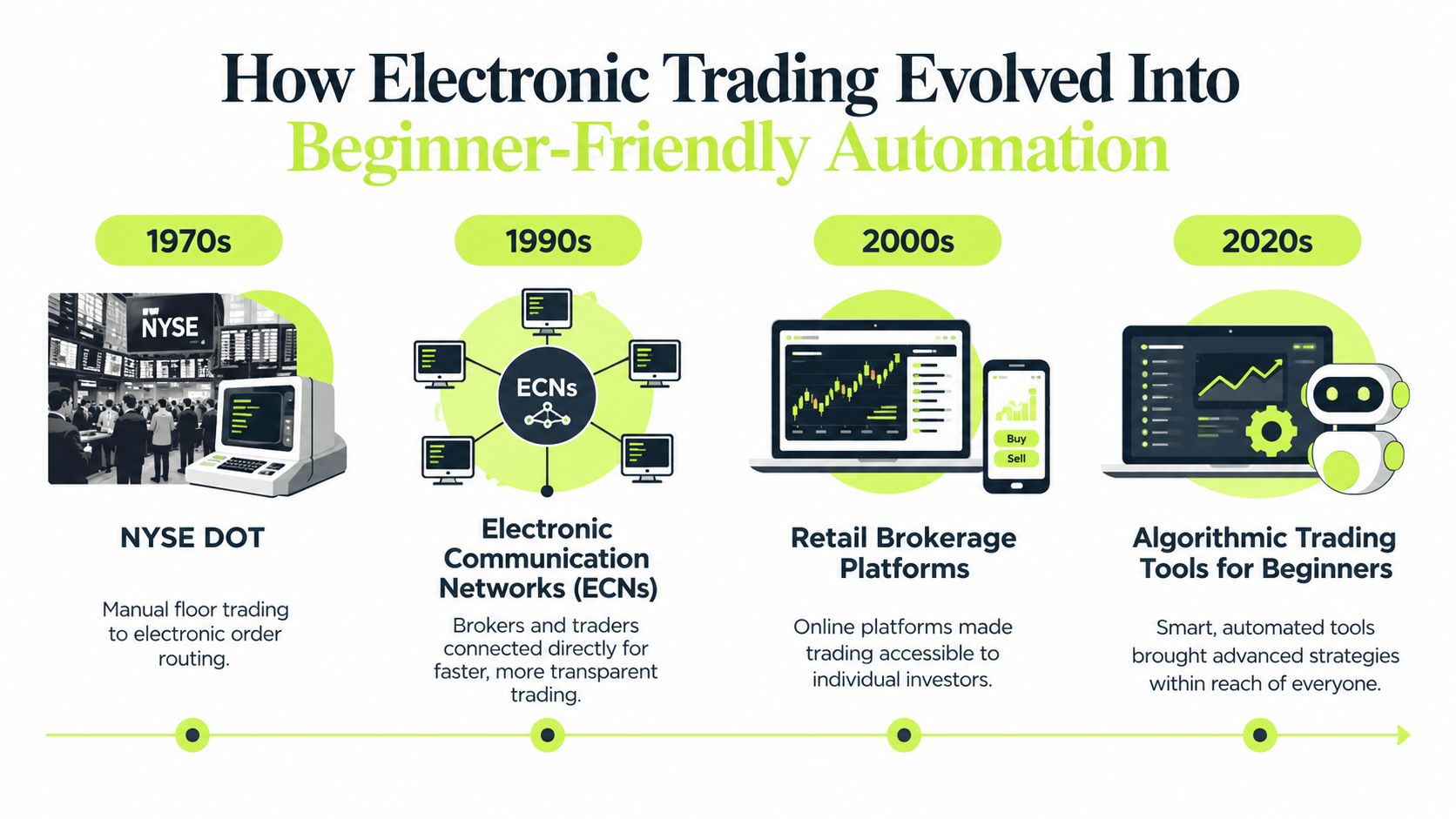
By **1998**, U.S. regulators had authorized electronic exchanges and alternative trading systems, supporting the wider adoption of computerized high-frequency trading. By **2009**, computers were executing upward of **60% of all U.S. trades**, according to the cited historical overview ([electronic trading history and automation milestones](https://nurp.com/algorithmic-trading-blog/the-evolution-of-trading-algorithms-and-algorithmic-trading-software/)).
The practical lesson for algorithmic trading for beginners is modest but important. You don't need to recreate an institutional trading floor to automate a rules-based process. You do need to respect the infrastructure beneath the interface, especially the difference between producing a signal and receiving a confirmed fill.
## Designing Your First Algorithmic Trading Strategy
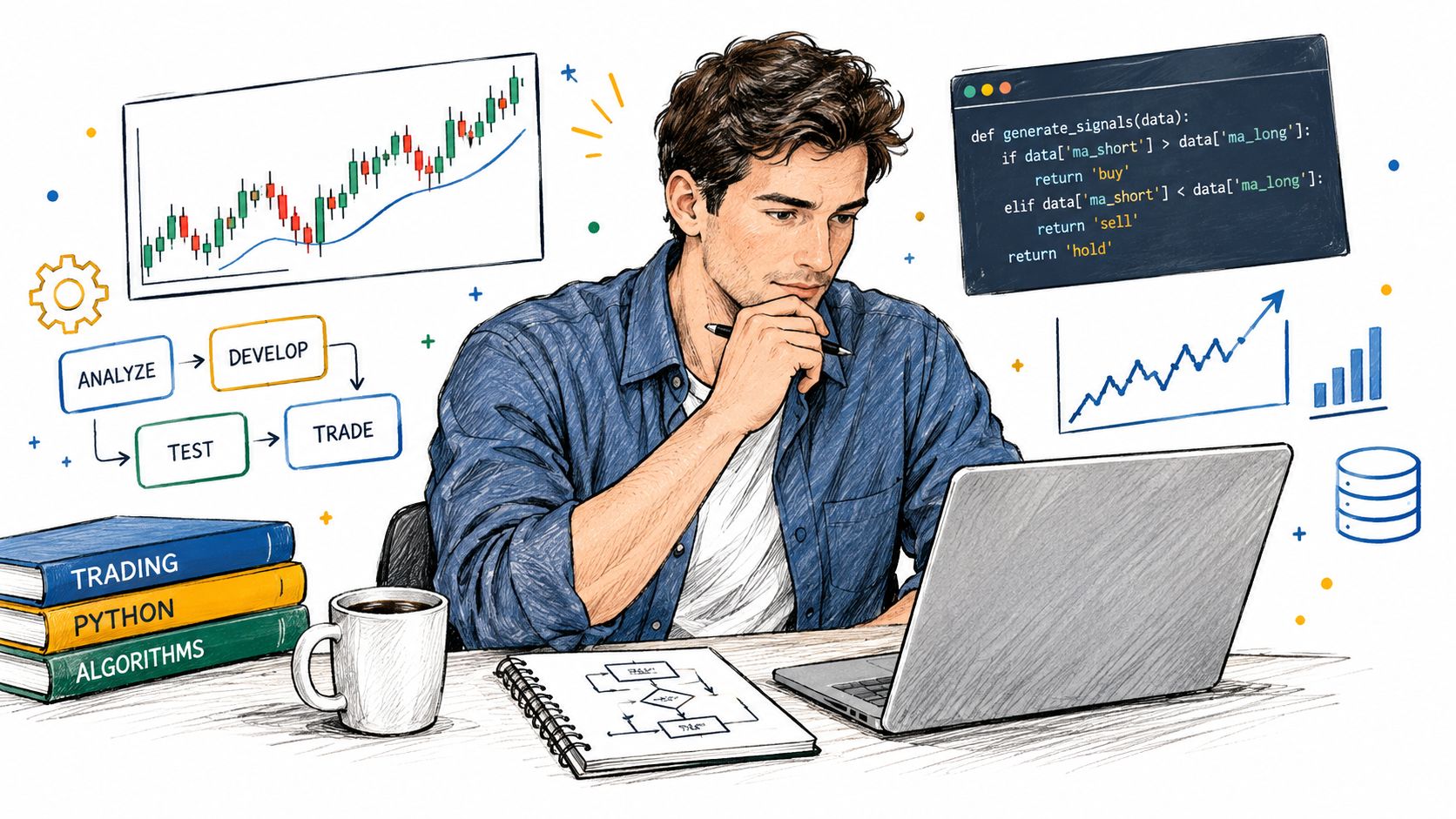
Start with a strategy that a computer can evaluate without interpretation. “Buy when the chart looks strong” is not a rule. “Enter when the selected moving-average condition is met at the close of a defined bar, then attach a stated exit and size limit” is testable.
### Write the logic before writing the script
Use a short specification with four parts:
1. **Market and timeframe:** State what you trade and the chart interval. Slower signals are generally easier to inspect than short-horizon signals that depend heavily on execution timing.
2. **Entry condition:** Define the data and exact event that creates a signal. Decide whether the condition is evaluated during a bar or only after it closes.
3. **Exit condition:** Include the invalidation rule, profit-taking rule, or time-based exit. An entry without an exit is an incomplete system.
4. **Position size and limits:** Declare how much the strategy may open, whether another entry is allowed while a position exists, and what happens after an error.
Pine Script on TradingView can express this logic in a strategy format, making the rules visible and testable. The [Pine Script automation documentation](https://docs.pineflows.com/pine-script-automation) can help you understand the routing considerations before you connect alerts to an execution workflow.
> **Practical rule:** If you can't describe what the system should do when an alert is repeated, delayed, rejected, or partially filled, the strategy specification isn't complete.
Don't judge the design by win rate alone. What matters is whether the expected result remains sensible after losing trades, costs, slippage, and the relationship between typical gains and losses. A strategy with frequent winning trades can still be fragile if occasional losses are much larger.
A short educational walkthrough can make the difference between an idea on a chart and a rule you can inspect.
Keep the first version deliberately small. Complexity makes it harder to know which rule created a result and harder to diagnose a failure after deployment.
## Backtesting Strategy Logic Before Real Market Exposure
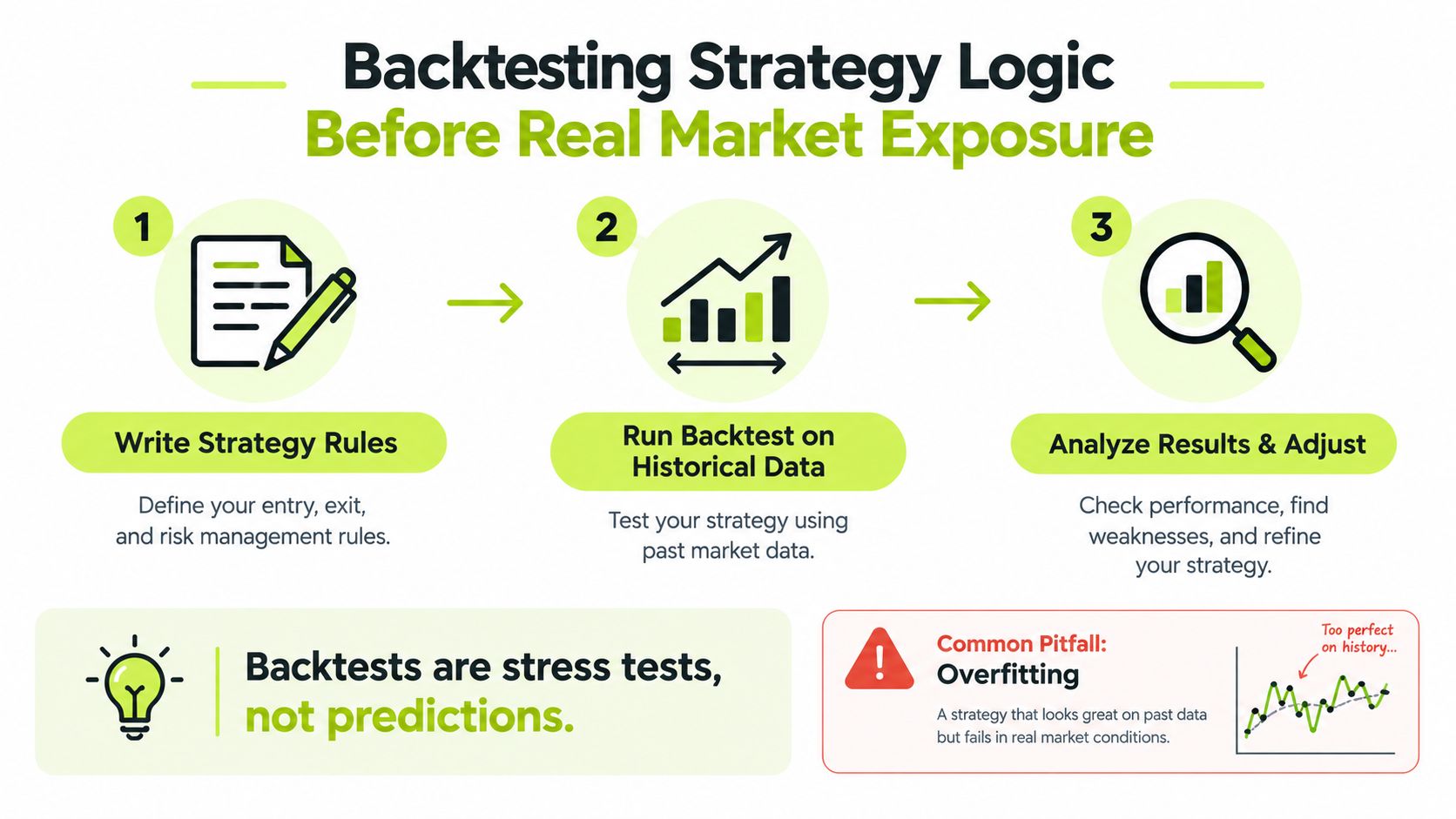
A backtest answers a narrow question: how would these rules have behaved on historical data under the assumptions you provide? It doesn't predict future performance. Its strongest use is exposing weaknesses in the strategy logic before you expose capital ([ACM review of algorithmic trading and backtesting limitations](https://cacm.acm.org/research/algorithmic-trading-review/)).
### Make the historical test harder to fool
A backtest can look attractive because it assumes ideal conditions. Add the frictions a live order encounters:
- **Commissions and fees:** Include the costs charged by the relevant account and market.
- **Slippage:** Model the difference between the signal price and the eventual fill.
- **Order behavior:** Decide how market, limit, stop, and partially filled orders should be represented.
- **Timing:** Prevent the strategy from using information that wasn't available when the decision occurred.
Overfitting creates another trap. If you keep changing parameters until one historical window looks excellent, you may have tuned the system to noise rather than a durable relationship. Look-ahead bias creates a similar illusion by allowing future information to influence a past decision.
Run the strategy across different market conditions instead of relying on one favorable period. Review trade-level behavior, drawdowns, losing streaks, skipped signals, and performance after costs. Gross returns are less useful than expectancy after realistic execution assumptions.
Live trading also introduces delay. One reference notes that a backtest may fill immediately while live brokerage execution can take about **half a second**, creating slippage influenced by volatility, latency, and strategy type ([QuantConnect live-trading reconciliation guidance](https://www.quantconnect.com/docs/v2/writing-algorithms/live-trading/reconciliation)). That delay matters most when the holding period is short and the expected edge is thin.
## Execution Risks and Alert-to-Order Reliability
The backtest may be correct, and the alert may still fail. Manual execution gives you a visible pause before submission, but that pause can cause late entries. Alert-based automation removes much of that delay, yet it introduces a different responsibility: proving that each signal was received, processed once, sent to the broker, and matched with the intended result.
Poorly calibrated alerting can produce so many notifications that people dismiss them. Weak supervision can then break the control loop, especially when a system runs unattended. Coverage of trade-surveillance challenges also points to fragmented monitoring and traceability problems, which means operational reliability deserves the same attention as signal logic (Nasdaq coverage of monitoring and alerting challenges).
### Compare the handoff, not just the strategy
| Workflow | Main advantage | Quiet failure |
|---|---|---|
| Manual order entry | You can inspect the signal and order before submission | Hesitation, missed entries, and inconsistent sizing |
| Alert-only workflow | You can observe live signal behavior without submitting orders | Alert overload or an unnoticed delivery failure |
| Automated execution | The system can submit deterministic orders | Duplicates, stale state, rejection, or an unconfirmed fill |
A reliable handoff needs more than a webhook endpoint. It should use a unique event ID, reject duplicate processing, record timestamps, retain the payload, and distinguish “order accepted” from “order filled.” It should also expose a pause control that blocks new entries when the system state is uncertain.
The [Robinhood connection documentation](https://docs.pineflows.com/connect-robinhood) illustrates the kind of integration detail beginners should inspect before enabling live orders. Treat every alert as an auditable event, not as a notification that you hope became a trade.
## Automating TradingView Alerts for Robinhood Executions
A TradingView-to-Robinhood workflow has several separate stages. TradingView evaluates the Pine Script strategy and emits an alert. A webhook receiver accepts the event, validates its contents, checks whether the event was already processed, and then decides whether it may submit an order. The broker returns an acknowledgement or rejection, while later status checks establish whether the order filled.
Use the [TradingView alert workflow documentation](https://docs.pineflows.com/tradingview-alert) to review the alert configuration and payload requirements before connecting a live account.
### Use a test-first sequence
Begin in test mode. The system should log incoming alerts without transmitting orders, allowing you to verify the symbol, direction, quantity, timestamps, and event identifier. Send repeated or delayed test events and confirm that the same event can't create multiple orders.
Then inspect the full audit trail:
- **Signal record:** What condition fired, and when?
- **Payload record:** What instrument, action, and size did the alert contain?
- **Delivery record:** Was the event received and processed?
- **Broker record:** Was an order accepted, rejected, or left pending?
- **Fill record:** What status and execution details came back?
Only after these checks should you consider enabling live submission. Keep an explicit pause control available. A useful pause should block new entries, cancel entry orders created by the automation, and preserve valid exits when they remain necessary for risk handling.
Never place broker credentials in chat or alert text. Use the broker's supported authentication flow, keep permissions limited where possible, and treat every connection as a production system that needs review.
## Why Most Beginner Algorithms Fail in Live Markets
A strong backtest doesn't guarantee a strong live workflow. Overfitting, look-ahead bias, execution costs, and market-regime changes can separate historical results from actual trading. The [Quantt beginner's guide to algorithmic trading](https://www.quantt.co.uk/resources/algorithmic-trading-beginners-guide) summarizes an industry estimate that **roughly 90% of retail algorithmic traders fail to outperform buy-and-hold in their first live year**.
That figure isn't a reason to abandon systematic trading. It is a reason to define success more carefully. A beginner who proves that alerts arrive correctly, duplicates are suppressed, fills are reconciled, and losses remain within a planned limit has built something more valuable than a visually impressive backtest.
> Automation doesn't remove uncertainty. It makes your response to uncertainty repeatable.
Skill development also takes time. The same industry guidance identifies **6 to 18 months** as a commonly needed period for learning programming, market microstructure, and risk management ([beginner learning timeline and live-trading risks](https://www.quantt.co.uk/resources/algorithmic-trading-beginners-guide)). Treat that as a planning consideration, not a promise or deadline.
Paper trading and alert-only operation provide safer intermediate stages. They let you discover wrong symbols, incorrect quantities, missing exits, stale credentials, and unexpected market conditions before those defects can affect real capital. A strategy should earn the right to advance through each stage.
## A Practical Learning Path and Recommended Tool Stack
Build the workflow in layers, and don't advance because the chart looks persuasive. Advance when the next layer has produced evidence that you understand its behavior.
1. **Write a plain-language specification.** State the market, timeframe, entry, exit, size, position limits, and failure response.
2. **Implement the smallest version.** Use TradingView and Pine Script so the conditions remain visible and easy to change.
3. **Backtest with costs and execution assumptions.** Review expectancy after commissions, slippage, and realistic fills across more than one market regime.
4. **Run alert-only.** Record every event, inspect payloads, and compare expected signals with received signals.
5. **Enable test mode for the broker path.** Verify acknowledgements, rejections, status changes, and fill details without transmitting live orders.
6. **Add supervision.** Configure notifications for failures, review logs, and keep a pause mechanism ready.
7. **Start with tightly controlled live exposure.** Change one variable at a time and continue reconciling every event.
The tool stack can stay simple: **TradingView and Pine Script** for strategy logic, a webhook workflow for delivery, a broker connection for order submission, and an audit log for traceability. Avoid adding services you can't monitor. Every extra adapter creates another place where an event can be transformed, delayed, duplicated, or lost.
Review the system after trades, not only after profitable periods. Ask whether the alert arrived, whether the right event ID was processed once, whether the broker acknowledged the intended order, and whether the fill matched the system's state. That discipline is the foundation of algorithmic trading for beginners.
---
Pineflows turns TradingView alerts from Pine Script strategies into executable Robinhood orders through a **test-first, auditable workflow** with event-ID deduplication, delivery receipts, fill checks, and pause controls. If you're ready to validate the alert-to-order handoff before risking capital, visit [Pineflows](https://pineflows.com) and review the guided setup.